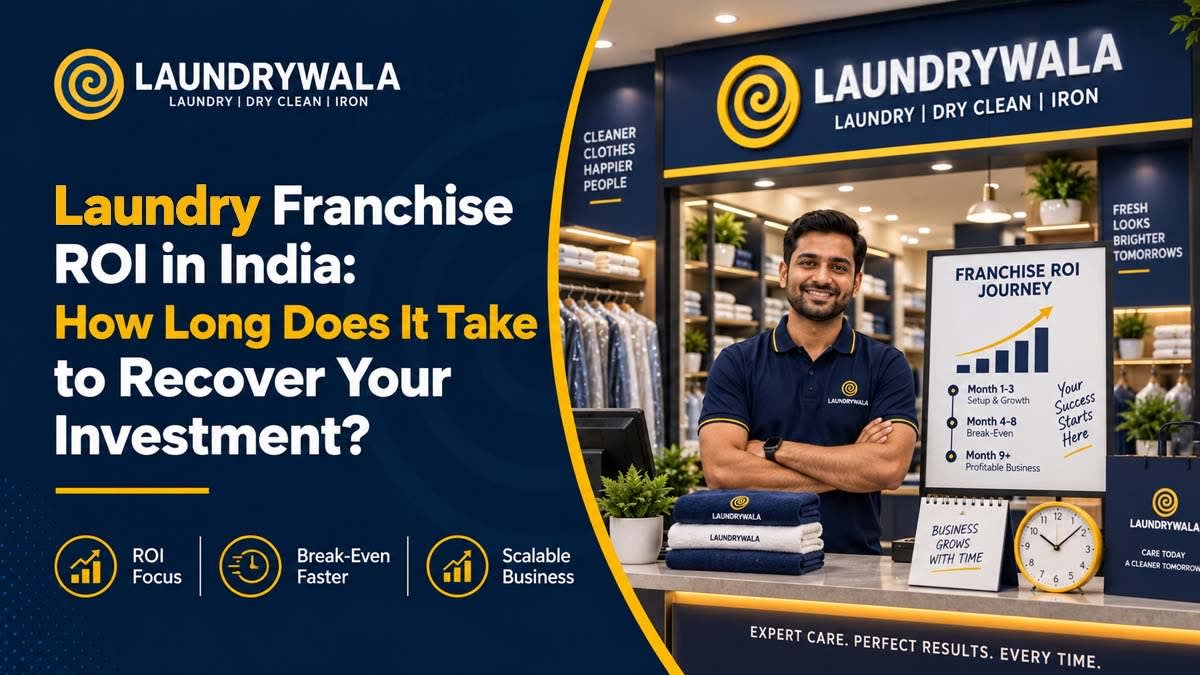
Laundry Franchise ROI in India: How Long Does It Take to Recover Your Investment?
Starting a laundry and dry-cleaning franchise is not only about asking how much the business can earn every month. A serious investor also needs to know:
How long will it take to recover the money I invest?
This is where laundry franchise ROI in India becomes important.
Two laundry stores may generate similar monthly sales but deliver completely different returns because one has lower rent, better customer retention, higher-value dry-cleaning orders or more efficient operating costs.
For anyone planning to invest ₹10 lakh, ₹15 lakh, ₹20 lakh or more, understanding ROI before signing a franchise agreement can prevent unrealistic expectations.
Laundrywala's current laundry franchise opportunity in India lists an indicative total investment of approximately ₹12–25 lakh, a space requirement of around 250–600 sq. ft., and an advertised ROI period of approximately 12–16 months.
These figures represent business potential and should not be treated as guaranteed returns. Actual investment recovery depends on your location, monthly sales, operating expenses and execution.
Quick Answer: What Is the ROI of a Laundry Franchise in India?
Laundry franchise ROI is the financial return generated from the money invested in setting up and operating the franchise.
A simple ROI formula is:
ROI (%) = Annual Net Profit ÷ Total Investment × 100
For example:
If your total investment is ₹15 lakh and your business generates ₹12 lakh annual net operating profit, then:
₹12 lakh ÷ ₹15 lakh × 100 = 80% annual ROI
However, entrepreneurs often use "ROI" when they actually mean investment recovery period or payback period.
The payback calculation is:
Investment Recovery Period = Total Investment ÷ Average Monthly Net Profit
If you invest ₹15 lakh and generate an average monthly profit of ₹1 lakh:
₹15 lakh ÷ ₹1 lakh = approximately 15 months
Understanding this difference is important when comparing franchise opportunities.
ROI vs Break-Even vs Payback Period: What Is the Difference?
These terms are often confused.
| Term | What It Means |
|---|---|
| Revenue | Total sales generated by the store |
| Operating Profit | Revenue remaining after operating expenses |
| Break-Even | Point where revenue covers ongoing operating costs |
| ROI | Return generated relative to the investment |
| Payback Period | Time required to recover the initial investment |
A store can reach monthly operating break-even without having recovered the original ₹15–20 lakh invested in machinery, interiors and setup.
For example, a store may start covering monthly rent, salaries and utilities in month six but still need another year to recover its initial investment.
That is why franchise buyers should always ask:
“When you say break-even, do you mean monthly operating break-even or complete investment recovery?”
How Much Investment Is Required for a Laundry Franchise?
The total investment depends on the franchise model.
Costs may include:
- Franchise or brand fee
- Commercial laundry machines
- Dry-cleaning equipment
- Store interiors
- Branding and signage
- Rent deposit
- Electrical work
- Plumbing
- Software and POS systems
- Packaging material
- Chemicals and detergents
- Initial marketing
- Staff recruitment
- Working capital
Laundrywala's current franchise page indicates a broad investment range of around ₹12–25 lakh, depending on store format and requirements.
For a detailed breakdown of these expenses, read our complete guide to laundry franchise cost in India.
Investors should never calculate ROI using only the franchise fee.
ROI should be calculated on the total amount actually invested in launching the business.
Laundry Franchise ROI Calculation with Examples
Here is a simple illustration of how monthly profit affects the investment recovery period:
| Total Investment | Average Monthly Net Profit | Approx. Recovery Period |
|---|---|---|
| ₹12 lakh | ₹1 lakh | 12 months |
| ₹15 lakh | ₹1.25 lakh | 12 months |
| ₹20 lakh | ₹1.5 lakh | 13.3 months |
| ₹25 lakh | ₹1.75 lakh | 14.3 months |
These calculations assume that the stated profit is generated consistently every month.
Real businesses rarely perform this evenly from day one.
During the first few months, an outlet may still be:
- Building local awareness
- Acquiring first-time customers
- Collecting Google reviews
- Optimising delivery routes
- Training staff
- Improving repeat orders
- Building apartment and corporate accounts
Therefore, actual investment recovery can be longer than a simple mathematical calculation suggests.
What Is a Realistic Laundry Franchise Payback Period?
There is no universal recovery period for every laundry business.
Laundrywala's main franchise page currently advertises an ROI period of around 12–16 months, while some of its broader business content discusses investment recovery ranges that can extend further depending on outlet conditions.
A sensible investor should therefore treat any advertised ROI timeline as a planning benchmark, not a promise.
Before investing, create three financial scenarios:
Conservative Scenario
Assume:
- Slower customer acquisition
- Lower average order value
- Higher marketing expense
- Moderate repeat business
This tells you whether the business remains financially manageable even if growth is slower than expected.
Expected Scenario
Use reasonable assumptions for:
- Order volume
- Average bill size
- Rent
- Salaries
- Utilities
- Marketing
- Delivery expenses
This should form the basis of your investment decision.
High-Performance Scenario
Calculate what may happen if:
- Repeat orders grow quickly
- Dry cleaning performs strongly
- Customer acquisition costs fall
- B2B accounts are acquired
Never make your investment decision using only the high-performance projection.
What Factors Affect Laundry Franchise ROI in India?
The laundry franchise ROI in India can change significantly based on the following factors.
1. Store Location
A laundry outlet needs access to customers who regularly pay for organised garment-care services.
Strong catchments may include:
- Apartment societies
- Gated communities
- Working professionals
- Nuclear families
- PG accommodation
- Hostels
- Hotels
- Corporate offices
- Premium residential areas
However, high footfall is not enough.
If rent is excessively high, strong sales may still produce weak profit.
The objective is not simply to find the busiest location.
It is to find the location with the best revenue-to-rent economics.
2. Monthly Order Volume
More orders generally help improve machinery utilisation and spread fixed costs across a larger revenue base.
Suppose two stores each spend ₹1.5 lakh per month on fixed and semi-fixed expenses.
Store A generates ₹2 lakh revenue.
Store B generates ₹4 lakh revenue.
Store B can potentially produce a significantly stronger margin because many fixed expenses do not double when sales double.
This is why increasing order volume is one of the strongest ways to improve ROI.
3. Repeat Customers
Laundry is naturally suited to repeat business.
Customers need:
- Washing
- Ironing
- Dry cleaning
- Office-wear care
- Bedding cleaning
- Shoe cleaning
again and again.
A loyal customer who places four orders per month is more financially valuable than four customers who order once and never return.
Repeat customers also help reduce the amount spent continuously acquiring new buyers.
4. Average Order Value
Order count alone does not determine profit.
Imagine:
Store A: 1,000 monthly orders × ₹250 average bill = ₹2.5 lakh revenue
Store B: 800 monthly orders × ₹500 average bill = ₹4 lakh revenue
Store B processes fewer orders but generates substantially higher sales.
Services such as:
- Dry cleaning
- Saree cleaning
- Lehenga cleaning
- Suit cleaning
- Blazer cleaning
- Shoe cleaning
- Carpet cleaning
- Curtain cleaning
- Blanket cleaning
can help increase average customer value.
Laundrywala's professional dry-cleaning services show how premium garment-care services complement regular laundry.
5. Profit Margin
Higher sales do not automatically create faster ROI.
Profit is what actually recovers your investment.
For example:
Store A
Monthly Revenue: ₹5 lakhMonthly Expenses: ₹4 lakhProfit: ₹1 lakh
Store B
Monthly Revenue: ₹4 lakhMonthly Expenses: ₹2.8 lakhProfit: ₹1.2 lakh
Despite generating less revenue, Store B produces more profit and may recover its investment faster.
Read our detailed guide on laundry franchise profit margin in India to understand how costs affect net profitability.
6. Rent
Rent can significantly affect the payback period.
A premium shop at ₹80,000 per month needs to generate enough additional business to justify the extra cost compared with a suitable location costing ₹35,000.
Over one year, the difference is:
₹45,000 × 12 = ₹5.4 lakh
That difference alone can materially change investment recovery.
Always evaluate rent as a percentage of expected revenue.
7. Staff Productivity
Hiring too many employees before the outlet reaches sufficient order volume increases monthly burn.
On the other hand, insufficient staffing can cause:
- Delays
- Poor ironing
- Incorrect tagging
- Customer complaints
- Rewashing
- Garment handling errors
The correct objective is productivity, not simply minimum staffing.
8. Pickup and Delivery Costs
Doorstep pickup can increase customer convenience and expand the outlet's effective service radius.
But every delivery has a cost.
Poor route planning can increase:
- Fuel expense
- Delivery salaries
- Vehicle maintenance
- Time per order
Efficient operators cluster pickups and deliveries geographically and monitor the economics of low-value orders.
How Much Monthly Profit Is Needed to Recover ₹15 Lakh?
Suppose the total investment is ₹15 lakh.
| Target Recovery Time | Required Average Monthly Profit |
|---|---|
| 12 months | ₹1.25 lakh |
| 15 months | ₹1 lakh |
| 18 months | Approx. ₹83,300 |
| 24 months | ₹62,500 |
This table demonstrates why monthly net profit matters more than headline revenue.
If you want to understand earning potential in greater detail, read our guide on laundry business profit in India.
Can a Laundry Franchise Recover ₹20 Lakh in 12 Months?
To recover ₹20 lakh in exactly 12 months purely through operating profit, the outlet would need to average approximately:
₹20,00,000 ÷ 12 = ₹1,66,667 net profit per month
That level may be achievable for a strong outlet, but investors should ask whether such profit is realistic for their specific location.
They should also account for the initial ramp-up period.
If the first three months produce lower profits, the following months need to generate substantially higher amounts to maintain a 12-month recovery target.
Tier 1 vs Tier 2 Cities: Which Can Deliver Better ROI?
A metro does not automatically offer better returns.
Metro and Tier 1 Markets
Delhi NCR, Mumbai, Bengaluru, Hyderabad and Pune can offer:
- Higher spending capacity
- Strong premium-service demand
- Large apartment clusters
- Higher dry-cleaning demand
But they may also involve:
- Higher rent
- Higher salaries
- More competition
- Higher advertising costs
Tier 2 and Growing Cities
Markets such as Lucknow, Jaipur, Indore, Nagpur and similar cities may offer:
- Lower rent
- Lower operating costs
- Growing organised laundry demand
- Lower branded competition in some areas
Even with lower total sales, a Tier 2 outlet can sometimes produce attractive ROI because operating expenses are lower.
Location economics matter more than city classification alone.
How Can You Improve Laundry Franchise ROI?
A franchise owner can improve returns by focusing on a few high-impact areas:
- Choose a dense residential catchment.
- Keep rent proportional to expected revenue.
- Build repeat customers rather than relying only on discounts.
- Increase dry-cleaning and premium-service orders.
- Improve average order value.
- Optimise delivery routes.
- Reduce rewash and garment-handling errors.
- Track machine capacity utilisation.
- Build strong Google reviews.
- Develop local apartment, hotel, PG or corporate relationships where viable.
A detailed financial plan should be created before opening. Our laundry business plan in India explains how investment, operating expenses and expected sales should be planned together.
Compliance Costs Should Also Be Included in ROI
Your ROI calculation should not ignore statutory and business-compliance expenses.
The Government of India's official Udyam Registration Portal provides MSME registration information and confirms that Udyam registration itself is free and paperless.
Entrepreneurs can also use the Government of India's Startup India Knowledge Bank for guidance on company registration, legal considerations and business planning.
For GST-related registration and compliance, businesses should refer to the official GST Portal and take professional tax advice based on their specific turnover and business structure.
Include all applicable accounting, statutory and tax-related expenses when projecting actual returns.
Why Consider a Laundrywala Franchise?
Laundrywala offers a structured franchise model for entrepreneurs looking to enter professional laundry and dry cleaning.
Its current main franchise page lists:
| Franchise Factor | Current Published Information |
|---|---|
| Total Investment | ₹12–25 lakh |
| Area Required | 250–600 sq. ft. |
| Advertised ROI Period | 12–16 months |
| Advertised Profit Potential | ₹1.5–3 lakh |
| Location Preference | Strong/premium catchments |
Actual results depend on the city, store format, location quality, customer acquisition, service mix and operating costs.
For this reason, investors should not rely on a national average alone.
A better approach is to request a location-specific financial assessment based on:
- Your city
- Proposed locality
- Rent
- Store size
- Nearby residential density
- Competition
- Expected service mix
If you are evaluating the opportunity, explore the Laundrywala franchise model or submit your details through the Laundrywala franchise enquiry page.