Laundry Business Profit in India 2026
How much profit does a laundry business actually generate in India, and is the number realistic for someone starting out in 2026? These are the two questions most investment guides answer poorly, either inflating the figures to attract franchise buyers or keeping them vague enough to avoid accountability. This article gives you the real numbers, drawn from how organised laundry franchise outlets actually operate across Indian cities, and explains exactly what drives profit up or down depending on location, format, and operational discipline.
laundry business in India can generate monthly profits of Rs 20,000 to Rs 1.75 lakh depending on outlet size, city tier, and service mix. Profit margins in organised laundry franchises typically range from 20 to 35 percent. Most franchise outlets reach break-even within 12 to 18 months on an initial investment of Rs 12 lakh to Rs 18 lakh.
Why the Laundry Sector in India Is Attracting Serious Investment in 2026
India's laundry market is not a niche opportunity. It is one of the largest and fastest-growing consumer service sectors in the country, and the organised segment within it is still early enough for a first-mover advantage to matter at the city level. Understanding the market size and growth trajectory is the first thing any investor should verify before evaluating individual business models.
Market Size and Annual Growth Rate
India's laundry and dry cleaning industry is valued at over Rs 30,000 crore and is growing at 8 to 10 percent annually. That growth is structural, not cyclical. It is being driven by three converging forces: urbanisation pulling more dual-income households into cities where time is scarce, hygiene awareness that accelerated sharply after 2020 and has not reversed, and a generational shift among younger urban consumers who expect app-based service and guaranteed quality rather than the informal dhobi arrangement their parents used.
The unorganised sector still dominates by volume, but it is losing customers in urban areas at a measurable rate. The gap between what a local dhobi can offer and what a professional laundry outlet delivers in terms of quality, consistency, turnaround time, and order tracking is now large enough that urban customers notice it and act on it.
Why Organised Laundry Chains Are Outgrowing the Market Average
Within the overall 8 to 10 percent sector growth, organised laundry chains are growing considerably faster. The reason is straightforward: they have solved the problems that kept urban customers away from professional laundry services in the past. Real-time order tracking, guaranteed 48 to 72 hour regular delivery, express options within 24 hours, and free home pickup on orders above Rs 349 have removed the friction that made organising laundry inconvenient. Once a customer uses a professional service and receives a garment back in better condition than they expected, retention is high.
For an investor, this means entering the organised segment means capturing customers who are actively leaving the unorganised segment, not competing within a fixed market.
How Laundry Business Profit Actually Works: Revenue, Margins, and What Drives Both
Profit in a laundry franchise is not a single number. It is the result of four variables: revenue per order, number of orders per week, service mix (which services dominate your revenue), and cost structure. Investors who evaluate a laundry business by looking only at headline revenue figures without understanding these variables make poor location and format decisions.
Monthly Revenue Ranges by Outlet Scale
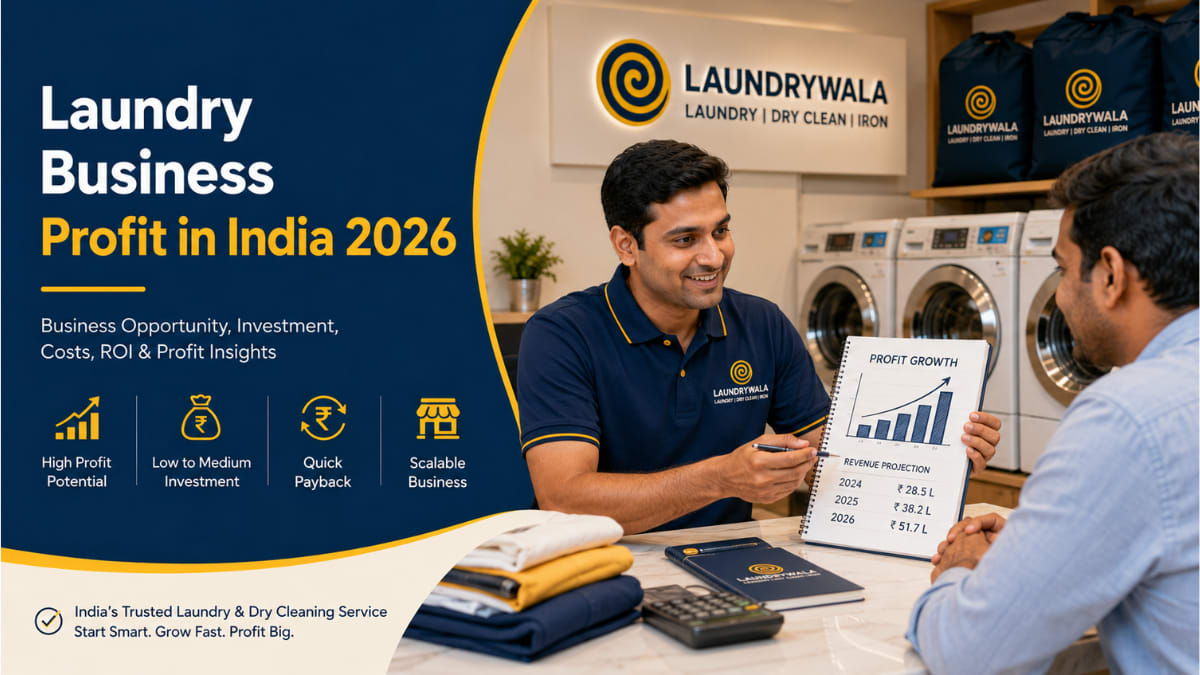
The table below shows realistic monthly revenue and profit ranges based on outlet scale and order volume. These figures reflect how most organised laundry franchise outlets perform once past the initial ramp-up period of three to six months.
| Outlet Scale | Weekly Orders | Monthly Revenue | Profit Margin | Monthly Profit |
|---|---|---|---|---|
| Small (walk-in only) | 40 to 60 | Rs 60,000 to Rs 1 lakh | 20 to 25% | Rs 12,000 to Rs 25,000 |
| Medium (walk-in + pickup/delivery) | 80 to 120 | Rs 1.2 lakh to Rs 2.5 lakh | 25 to 30% | Rs 30,000 to Rs 75,000 |
| Large (high-footfall + delivery radius) | 150 to 250 | Rs 3 lakh to Rs 5 lakh | 30 to 35% | Rs 90,000 to Rs 1.75 lakh |
These ranges are realistic. A medium-scale outlet in a well-chosen urban location, operating with reasonable efficiency and a good service mix, will land between Rs 30,000 and Rs 75,000 in monthly net profit after the ramp-up period. That figure grows as the customer base builds, because laundry is a repeat-use service with high retention among satisfied customers.
Which Services Contribute Most to Profit
Not all laundry services are equally profitable, and your service mix matters more than raw order volume in determining your margin.
Dry cleaning for premium and designer garments is the highest-ticket service in most urban outlets. A single saree or bandhgala suit processed for dry cleaning generates significantly more revenue per transaction than a standard wash-and-fold order. Customers who bring in Sabyasachi sarees, formal suits, lehengas, or couture pieces are also the most loyal customers in the book, because they have expensive garments they cannot risk with a local service. Once they trust your outlet, they return consistently.
Shoe and bag cleaning is a high-margin specialty service with low material input cost. Deep cleaning a pair of white sneakers or restoring a leather handbag takes time and skill, but the chemical and equipment cost per job is relatively low. Customers pay a significant premium for this service and there is very little price sensitivity among the urban professional segment.
Carpet, sofa, and upholstery cleaning generates large per-job revenue. These are lower-frequency orders but high in value. A single sofa cleaning job or full-home carpet clean can equal a week's worth of standard laundry orders in revenue.
Wash and fold and wash and iron are volume drivers. They bring in the repeat weekly customers who form your base revenue, but their margins are thinner. The best franchise operations use volume laundry as the floor and premium services as the multiplier.
The Cost Structure Franchise Investors Rarely Analyse Carefully
Profit margin depends on controlling four main cost categories: detergents and consumables, electricity and water, staff wages, and rent. In most tier-2 city outlets, staff wages and rent together account for 45 to 55 percent of total costs. Detergents and consumables in an eco-friendly operation add another 10 to 15 percent. What franchise investors often underestimate is electricity cost, particularly for outlets running commercial dryers at high volumes.
A franchise partner who does not track order-level profitability by service type in the first six months will almost certainly have a distorted view of which services are actually earning them money. Franchise systems that provide CRM and operational tracking tools significantly reduce this risk by making service-level data visible in real time.
What a Laundry Franchise Investment Looks Like in 2026
Before calculating profit, you need a clear picture of what you are investing. Laundry franchise investment in India ranges widely depending on the brand, format, and support structure, and the difference between formats is not just scale, it is operational complexity and the speed at which you can reach meaningful profitability.
Investment Components and What Each Covers
A typical organised laundry franchise investment in the Rs 12 lakh to Rs 18 lakh range covers the following components:
Franchise fee covers the licence to operate under the brand, use of the operating system, and access to training and support. This is a one-time payment and should never be confused with ongoing royalty, which in some franchise models is charged monthly regardless of performance.
Store setup and fit-out includes signage, counter installation, shelving, workflow design, and all branding materials. An outlet that looks professional and consistent with the brand standard converts more walk-in customers and commands higher order values.
Machinery and equipment includes commercial washing machines, dryers, steam press systems, and any specialty equipment for shoe cleaning or dry cleaning chemical treatment. The quality and capacity of equipment directly determines the volume and quality of work your outlet can handle.
Initial supplies covers detergents, consumables, packaging materials, and cleaning chemicals for the first operating period.
Training and launch support covers both pre-opening staff training and on-site assistance during the first weeks of operation, which has a measurable impact on early customer retention.
Break-Even Timeline and ROI Calculation
At a Rs 15 lakh investment and Rs 50,000 monthly net profit, break-even occurs at 30 months on net profit alone. This is why the royalty model matters enormously. A franchise that charges 8 to 12 percent royalty from month one on gross revenue will extend your break-even timeline by 12 months or more compared with one that waits until you have recovered your initial investment before charging royalty.
Based on how Laundrywala franchise outlets operate across their 30-plus city network, the break-even for most partners falls between 12 and 18 months, supported by the brand's 0 percent royalty model until the franchise partner has recovered their initial investment. For investors evaluating multiple franchise options, this is one of the most financially significant structural differences to compare.
How Location and City Tier Affect Laundry Business Profit
Location is the single biggest external variable in laundry franchise profitability. Two outlets running the same brand and the same service menu, in two different locations, can produce dramatically different results within the same city.
Metro Cities vs Tier-2 Cities: Profit Comparison
| City Type | Typical Monthly Revenue | Rent (Approx.) | Net Profit Range | Competition Level |
|---|---|---|---|---|
| Metro (Mumbai, Delhi, Bengaluru) | Rs 2.5 lakh to Rs 5 lakh | Rs 40,000 to Rs 80,000 | Rs 50,000 to Rs 1.5 lakh | High |
| Tier-1 (Pune, Hyderabad, Ahmedabad) | Rs 1.5 lakh to Rs 3.5 lakh | Rs 20,000 to Rs 45,000 | Rs 40,000 to Rs 1.1 lakh | Moderate |
| Tier-2 (Jaipur, Indore, Lucknow) | Rs 1 lakh to Rs 2.5 lakh | Rs 10,000 to Rs 25,000 | Rs 30,000 to Rs 85,000 | Low to Moderate |
Tier-2 cities present a compelling case for new investors. Rent is significantly lower, competition from organised laundry chains is limited, and the urban professional population in cities like Indore, Jaipur, Nashik, and Coimbatore has grown rapidly over the past five years. An investor who enters a tier-2 market before it becomes saturated has a meaningful first-mover advantage.
What Makes a Location High-Value for a Laundry Outlet
Footfall quality matters more than footfall volume. A location near a residential apartment cluster, a co-working hub, a university campus, or a corporate office park generates consistent, repeat customers. A location in a general market with high foot traffic but no residential density nearby generates lower repeat usage.
Delivery radius is equally important in 2026. An outlet with a strong pickup and delivery operation is not bounded by walk-in distance. The effective catchment area of an outlet with a well-run delivery operation can cover a 3 to 5 kilometre radius, which in a dense urban area means thousands of potential households.
Evaluating Laundrywala as a Laundry Franchise Investment
For investors who have decided that the laundry sector meets their criteria and are now evaluating specific brands, Laundrywala is among the most operationally transparent options available in the Indian market. Operating across 30-plus cities with 72-plus outlets and a customer base of nearly 4 lakh, the brand has the scale to provide genuine operational data to prospective partners rather than projections built on optimistic assumptions.
The franchise investment range of Rs 12 lakh to Rs 18 lakh is mid-tier for an organised retail service franchise in India, and it includes the full package: store setup, equipment, training, initial supplies, and marketing support including local Meta Ads, Google Ads, and local SEO for each franchise location. The 0 percent royalty until initial investment recovery is a meaningful financial advantage, particularly in the first year when revenue is still building.
The technology layer is worth examining specifically. Laundrywala's AI-based order management system and mobile app give franchise partners real-time operational visibility, which is rare at this investment level. The same app that customers use for scheduling pickups and tracking orders feeds into the franchise partner's CRM, making it possible to monitor performance, identify high-value customers, and manage operations without a separate technology stack. You can explore the full franchise and service offering at Website
Common Mistakes That Reduce Laundry Franchise Profit
Understanding profit potential is only half the picture. What franchise evaluation guides consistently underestimate is the impact of operational errors on margins, particularly in the first year. Most laundry franchise failures in India are not caused by weak market demand. They are caused by avoidable operational and financial management mistakes.
Underpricing Services to Win Customers Early
New franchise owners in competitive urban markets sometimes price below recommended rates in the first months to build volume quickly. This creates a customer base that is price-sensitive from the start, is resistant to price normalisation later, and skews the service mix toward low-margin volume work. In practice, most Laundrywala franchise outlets that maintain standard pricing from day one find that customers who convert early on standard pricing have higher average order values and lower churn than those acquired through discounting.
Ignoring the Delivery Radius as a Revenue Driver
Outlets that operate primarily as walk-in services and treat pickup and delivery as secondary are leaving significant revenue on the table. Free home pickup on orders above Rs 349 is a customer acquisition tool. An investor who does not actively promote this offering through the app, through local marketing, and through residential outreach is operating at reduced capacity. Delivery orders, once established as a habit, have very high retention because the customer associates the service with convenience rather than proximity.
Not Tracking Service-Level Profitability
Running a laundry franchise without tracking which services are generating the most margin is equivalent to running a restaurant without knowing which dishes are profitable. A franchise partner who handles 100 orders per week but does not know that 60 percent of their margin comes from dry cleaning and shoe care will not prioritise those services in their marketing or staffing decisions. The CRM system matters precisely because it makes this data visible without requiring manual tracking.
Three Numbers That Determine Whether a Laundry Franchise Will Work in Your Location
Before signing any franchise agreement, every investor should be able to answer three specific questions about their proposed location: how many households within a 3-kilometre radius have the income profile to use a professional laundry service regularly, what is the monthly rent as a percentage of projected monthly revenue at 60 percent capacity, and what is the estimated time to reach 80 orders per week based on the population density and competition in that specific area.
If your monthly rent at full occupancy of your proposed space exceeds 15 percent of projected monthly revenue at 60 percent capacity, the unit economics are structurally difficult regardless of how well you operate. If there are fewer than 5,000 households with relevant income profiles within your delivery radius, the customer pool is too small to sustain growth through referrals alone. And if you cannot reach 80 orders per week within six months in your location, you are in the wrong location.
A dedicated franchise advisor who can run these numbers against real local data before you commit is worth more than any financial projection provided by the franchisor. Laundrywala provides this support through dedicated franchise advisors for location planning, which reduces the risk of a location decision made on optimism rather than evidence.
To begin your franchise inquiry or explore outlet locations near you, contact Laundrywala at Toll-Free 1800-889-3225 or Franchise Support at +91 8650865586, or visit Website to submit a franchise inquiry and receive a detailed investment breakdown for your target city.
FAQs on Entrepreneurship & Business
Insights and strategies for modern entrepreneurs looking to grow in the professional laundry industry.