
Laundry Franchise Cost in India: Complete Investment Guide
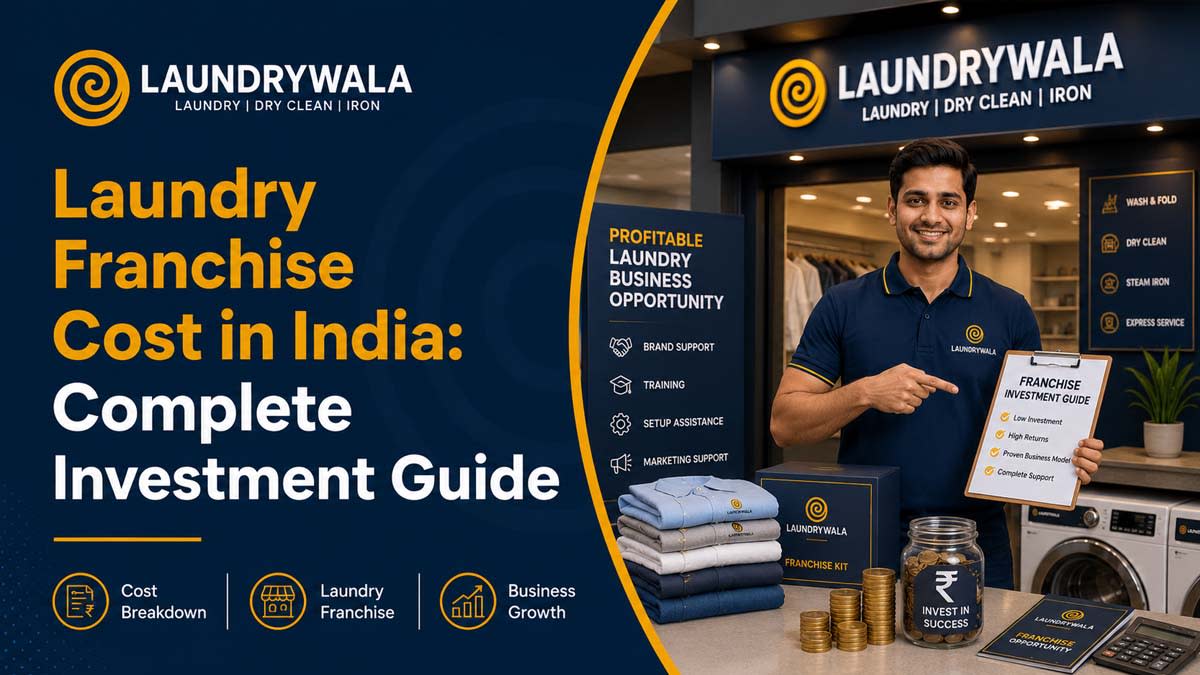
How much does a laundry franchise cost in India in 2026? Laundrywala currently offers three published franchise models, starting at ₹13.49 lakh for Alpha Basic, ₹15.99 lakh for Classic and ₹20.99 lakh for Combo Premium. These are package prices; the total funds required to open and operate an outlet may be higher.
A prospective investor must consider the franchise package, rental security deposit, additional site preparation, launch expenses and operating cash reserve. Some costs may already be included in a commercial proposal, so adding every possible expense without checking the quotation can result in an inflated budget.
The goal of investment planning is simple: determine how much capital must be arranged, what that capital covers and how much cash should remain available after opening.
This guide explains the laundry franchise cost in India, compares the available Laundrywala formats and provides a structured approach to calculating total project funding.
Laundry Franchise Cost in India: 2026 Price Comparison
The investment required for a professional laundry business varies with processing capacity, equipment, premises and service model.
Laundrywala's published franchise formats provide the following starting point.
| Franchise model | Published package price | Store size | Staff |
|---|---|---|---|
| Alpha Basic | ₹13.49 lakh | 200–250 sq. ft. | 2–3 |
| Classic | ₹15.99 lakh | 250–300 sq. ft. | 2–3 |
| Combo Premium | ₹20.99 lakh | 300–350 sq. ft. | 3–4 |
The compact Alpha Basic format may suit a smaller neighbourhood operation. Classic offers a different equipment configuration, while Combo Premium is designed for greater processing needs, including selected retail and commercial requirements.
The published prices should not be interpreted as confirmed all-inclusive project quotations.
For equipment details, package specifications and franchise enquiries, review the official Laundrywala franchise investment plans.
Investment Alert: Before paying a booking amount, obtain a current written quotation specifying taxes, machinery, installation, transport, store interiors, brand fees and any recurring charges.
What Is Included in the Total Cost of a Laundry Franchise?
A franchise-package price and a total business-startup budget serve different purposes.
The package refers to the commercial offering defined by the franchisor. The total project budget measures all funds needed to bring the proposed business into operation and support it through its early months.
An investor should separate costs into three categories.
1. Franchise Package
This is the quoted amount for the selected model.
It may cover machinery, branding, initial setup or other agreed services, depending on the contract. The exact inclusions must be obtained in writing.
2. Additional Startup Expenses
These are genuine expenses beyond the package quotation.
They may involve lease deposits, additional plumbing, electrical upgrades, property modifications, licenses or opening campaigns.
Do not add an expense twice if it is already included in the package.
3. Working Capital and Contingency
Working capital supports regular expenses while customers and repeat business develop.
A contingency reserve provides flexibility when actual cash requirements differ from the initial forecast.
Investment Cost Categories
| Cost category | Usually one-time or recurring? | What to verify |
|---|---|---|
| Franchise package | Initial | Itemized inclusions |
| Rental deposit | Initial funding; potentially refundable | Lease terms |
| Electrical or plumbing modifications | Usually initial | Scope and site estimate |
| Additional interior work | Usually initial | Work excluded from package |
| Initial stock | Initial and replenished | Included quantities |
| Opening campaign | Initial marketing | Budget and responsibilities |
| Employee salaries | Recurring | Staffing requirements |
| Utilities | Recurring | Expected use and tariffs |
| Equipment servicing | Recurring or periodic | Warranty and service terms |
| Cash contingency | Reserve | Reasonable risk allowance |
This classification makes the budget easier to audit and reduces confusion between setup expenses and monthly operating costs.
How to Calculate Total Laundry Franchise Investment
The complete funding requirement can be estimated using a straightforward formula.
Total Funding = Franchise Package + Unincluded Startup Costs + Rental Deposit + Working Capital + Contingency
A refundable rental deposit is included because cash must be arranged at the beginning, but it should not automatically be recorded as a non-refundable business expense.
Sample Laundry Franchise Budget
Consider an investor selecting the Classic franchise package.
| Budget item | Illustrative amount |
|---|---|
| Classic franchise package | ₹15,99,000 |
| Rental security deposit | ₹1,20,000 |
| Additional site modifications | ₹80,000 |
| Launch marketing not included in package | ₹30,000 |
| Working capital reserve | ₹4,50,000 |
| Additional contingency | ₹50,000 |
| Total funding required | ₹23,29,000 |
This is a budgeting example, not an official Laundrywala quote.
It assumes the additional items are not covered by the package. The working capital reserve represents three months of estimated cash expenses of ₹1.5 lakh per month.
The investor should replace every assumption with actual commercial and property information.
Budgeting Tip: A franchise costing ₹15.99 lakh at the package level may require additional cash to open and operate. Do not commit all available capital to initial setup expenses.
Franchise Fee vs Equipment Cost: Avoid Double Counting
One of the most common budgeting mistakes is adding a franchise fee and full machinery cost to the published package price without checking what the package already includes.
Suppose a franchise quotation provides a combined amount covering equipment, brand rights and setup services.
In that situation, the investor should not automatically treat each component as an additional cost.
Instead, request a written itemized quotation.
What the Commercial Proposal Should Clarify
- Is the franchise fee included in the package?
- Which washers, dryers and ironing equipment are supplied?
- Is machine transport included?
- Who pays for installation and commissioning?
- Which interior and branding works are included?
- Is initial software access included?
- Are taxes included or additional?
- Are ongoing royalties, technology or marketing charges applicable?
- What training and post-launch support are specified?
An itemized proposal makes it possible to compare franchises on their actual deliverables rather than headline prices.
A franchise offering a lower initial price may still require substantial spending on equipment or infrastructure.
Conversely, a higher initial package could include more components.
The correct comparison is like-for-like total investment, not the lowest advertised joining fee.
Property Costs: Rent, Deposit and Shop Readiness
Property selection affects both startup funding and monthly business expenses.
A shop with affordable rent may require expensive plumbing, electrical upgrades or other modifications.
A more expensive property may already provide suitable infrastructure.
Neither option should be evaluated using monthly rent alone.
Property Cost Comparison
| Factor | Property A | Property B |
|---|---|---|
| Monthly rent | ₹25,000 | ₹40,000 |
| Security deposit | ₹75,000 | ₹1,20,000 |
| Additional site preparation | ₹1,50,000 | ₹40,000 |
| Initial deposit + site preparation | ₹2,25,000 | ₹1,60,000 |
| Annual base rent | ₹3,00,000 | ₹4,80,000 |
These are hypothetical figures, not verified commercial rents.
Property B has a lower initial deposit-plus-preparation requirement but higher annual rent. Property A has lower ongoing occupancy costs but requires more initial modifications.
An investor should evaluate both initial funding and future cash flow.
Pre-Lease Technical Checks
Before signing a binding lease, confirm usable area, sanctioned electrical load, water supply, drainage, ventilation, machine access and permission for commercial processing.
The published Laundrywala formats recommend different store sizes. A technically unsuitable premises should not be selected only because the rent appears attractive.
The laundry franchise shop-size and infrastructure guide explains these considerations in more detail.
Pre-Lease Warning: Verify electrical capacity and drainage feasibility before paying a non-refundable deposit. Correcting major infrastructure problems after possession can materially increase startup expenses.
How Much Working Capital Does a Laundry Franchise Need?
Working capital is the cash available to support operations while the outlet establishes customer demand.
Even if the store is fully equipped, it still has to pay rent, employee salaries, utilities, consumables, maintenance, transport and marketing expenses.
Many businesses experience a gradual customer-acquisition period rather than immediate stable revenue.
Working capital helps the franchisee manage these fluctuations.
Working Capital Planning Table
| Monthly cash expenses | 2-month reserve | 3-month reserve | 6-month reserve |
|---|---|---|---|
| ₹1,00,000 | ₹2,00,000 | ₹3,00,000 | ₹6,00,000 |
| ₹1,50,000 | ₹3,00,000 | ₹4,50,000 | ₹9,00,000 |
| ₹2,00,000 | ₹4,00,000 | ₹6,00,000 | ₹12,00,000 |
| ₹2,50,000 | ₹5,00,000 | ₹7,50,000 | ₹15,00,000 |
These are simple reserve calculations. They are not fixed requirements published by Laundrywala.
The appropriate reserve depends on expenses, credit terms, expected early revenue, the risk of startup losses and available financing.
Working Capital Is Not the Same as Profit
A store may generate revenue from the first month but still need cash for inventory replenishment, wages or upcoming bills.
If customers pay immediately while most expenses are paid later, cash timing may be manageable.
However, commercial contracts involving delayed payment can create additional working-capital needs.
The investor should prepare a monthly cash-flow forecast rather than relying only on an annual profit estimate.
Cash-Flow Tip: Plan the reserve around potential cash shortfalls, not merely an assumption that several months of gross expenses must remain unused.
Example: Monthly Operating Budget
Investors should calculate expected recurring expenses separately from startup costs.
Below is a sample budget for a hypothetical laundry outlet.
| Monthly expense | Illustrative amount |
|---|---|
| Rent | ₹35,000 |
| Employee salaries | ₹65,000 |
| Electricity and water | ₹25,000 |
| Cleaning products | ₹30,000 |
| Packaging | ₹10,000 |
| Delivery and collection | ₹20,000 |
| Local marketing | ₹15,000 |
| Maintenance and other expenses | ₹15,000 |
| Total monthly operating expenses | ₹2,15,000 |
This budget is an example only. It does not establish the actual cost of operating a Laundrywala store.
Some outlets may also incur franchise-specific charges, taxes, insurance, additional repairs or financing costs.
The operator should update the financial model when actual quotations and operating data become available.
For a detailed explanation of how expenses influence earnings, see the laundry franchise profit margin guide.
Launch Marketing: What Should Be Included in the Budget?
Customers need to know when a new laundry outlet becomes available in their locality.
Marketing may involve Google Business Profile, local search advertising, apartment-society outreach, introductory offers and referral activities.
However, a large launch budget is not necessarily effective.
The campaign should target people within a practical service area and provide a clear reason to book.
Launch Marketing Budget Checklist
| Activity | Budget consideration |
|---|---|
| Signage and outdoor visibility | Confirm package inclusion |
| Google Business Profile | Profile setup and maintenance |
| Search advertising | Keywords and target geography |
| Social media campaigns | Audience and creative production |
| Flyers and society promotions | Printing and distribution |
| Introductory offers | Discount cost and contribution |
| Referral promotions | Incentive expense |
| Customer communication | Software or messaging costs |
Business owners can refer to Google's official local ranking guidance for information on relevance, distance and prominence in local search results.
The actual marketing budget should reflect local competition and expected customer acquisition costs.
A campaign generating many enquiries may still be inefficient if few people become paying repeat customers.
How City and Location Affect Laundry Franchise Costs
The same franchise package can result in different total funding requirements across India.
Commercial rents, property deposits, wages and utility modifications vary by location.
A metropolitan property may have higher occupancy expenses, while a smaller city's commercial space may be more affordable.
However, customer spending, local competition and demand for professional garment care also vary.
Metro vs Tier 2 Market Considerations
| Factor | Metropolitan locality | Tier 2 or emerging locality |
|---|---|---|
| Commercial property | May be expensive | May cost less |
| Security deposit | Market-dependent | Market-dependent |
| Employee expenses | Can be higher | May be lower |
| Customer demand | Depends on catchment | Depends on catchment |
| Paid advertising | Often competitive | Competition varies |
| Delivery distances | Traffic-sensitive | Geography-sensitive |
Investors should select a locality using actual property estimates and expected customer demand.
A low-rent shop with insufficient orders can be a poor investment.
Likewise, a high-rent outlet cannot depend on location prestige alone to justify its costs.
The correct goal is a property where realistic customer revenue supports sustainable operations.
Laundry Franchise vs Independent Laundry Business: Cost Differences
Some entrepreneurs compare a franchise with starting an independent laundry business.
An independent setup may avoid a franchise joining fee, but the owner has to arrange systems, equipment, marketing and operating processes.
A franchise may provide a recognized brand and agreed support, but it introduces contractual obligations and may include recurring fees.
| Cost or responsibility | Franchise model | Independent business |
|---|---|---|
| Brand development | Established branding | Self-developed |
| Franchise joining fee | May apply | Not applicable |
| Equipment selection | Approved configuration | Owner decides |
| Staff training | Agreement-dependent | Self-arranged |
| Technology | May be included or licensed | Purchased or developed |
| Marketing | Potential brand guidance | Owner-managed |
| Operating standards | Franchise requirements | Owner-defined |
| Ongoing contractual fees | May apply | No franchise royalty |
Neither structure guarantees profitability.
Investors should compare the complete cost of establishing, managing and operating the proposed business.
A cheaper startup may involve greater work building systems, while a franchise may offer support that reduces some implementation challenges.
Does a Higher Franchise Investment Mean Better ROI?
Not necessarily.
A larger processing facility may support more orders, but additional capacity has financial value only when sufficient demand exists.
ROI compares returns with the investment committed.
It should not be confused with monthly sales or operating profit margin.
Simple Investment Recovery Example
Assume two business proposals have different total funding requirements.
| Metric | Proposal A | Proposal B |
|---|---|---|
| Total invested capital | ₹18,00,000 | ₹24,00,000 |
| Monthly cash available for recovery | ₹60,000 | ₹80,000 |
| Simplified payback | 30 months | 30 months |
Both examples produce the same simplified payback despite different investment amounts.
Actual recovery may take longer because of startup losses, taxes, reinvestment or inconsistent monthly cash flows.
Investors wanting to examine this financial measure further can use the laundry franchise ROI and investment-recovery guide.
ROI Caution: Never calculate investment recovery from total revenue. Use cash genuinely available for capital recovery after relevant obligations.
A Practical Seven-Step Investment Evaluation
Before committing funds, the investor should follow a structured sequence.
Step 1: Obtain the Current Franchise Proposal
Request the package price and a detailed description of equipment, branding, software, training and service support.
Step 2: Identify Excluded Startup Costs
Obtain separate estimates for deposits, electrical work, plumbing, property modifications and any other excluded items.
Step 3: Verify the Property
Confirm that the outlet can accommodate the selected equipment and operating model.
Technical site approval should precede significant financial commitments.
Step 4: Build a Working Capital Forecast
Estimate monthly cash expenses, early-stage customer revenue and potential temporary cash shortages.
Step 5: Calculate Total Funding
Add the published package price and genuine additional funding requirements without duplicating included expenses.
Step 6: Test Financial Scenarios
Prepare conservative, expected and higher-demand projections with corresponding costs.
Determine whether the business remains manageable if sales develop more slowly than anticipated.
Step 7: Review the Agreement
Read the conditions covering ongoing fees, operating responsibilities, territorial rights, renewal, support and exit.
Investors should assess the financial model and contractual obligations together.
Common Budgeting Mistakes to Avoid
The most common investment mistake is confusing the franchise-package price with the full amount needed to operate the business.
Another is assuming that equipment, interiors, transport and taxes must all be added separately when some may already be included.
Property selection can also increase costs if the shop lacks adequate electrical capacity, water or drainage.
Investors may underestimate working capital and allocate nearly all available funds to the initial setup.
Others rely on promotional returns without examining the financial assumptions.
How to Reduce These Risks
Require an itemized quotation, verify the premises, maintain a cash reserve and review all recurring expenses before signing.
A realistic budget should reflect the proposed locality rather than using generic national averages.
Investor Reminder: An attractive franchise price is only useful when the complete business plan is financially manageable.
Business Registration and Compliance Expenses
The legal and administrative costs of opening a laundry business depend on the location, legal structure and services performed.
Eligible entrepreneurs can review the Government of India's official Udyam Registration Portal for free MSME registration.
The Ministry of Micro, Small and Medium Enterprises provides official guidance about MSME-related programmes.
For relevant taxes, businesses can refer to the official Goods and Services Tax portal.
Where applicable, property use, electrical installation, fire safety and environmental requirements must also be checked with the relevant authorities.
Such costs should be included in the budget when they apply to the proposed operation.
FAQs – India's Best Laundry Franchise Chain
Straight answers for entrepreneurs evaluating Laundrywala as a profitable laundry business and low investment franchise in India.
Still have questions?
Can't find what you're looking for? Our fabric care specialists and franchise advisors are here to help.