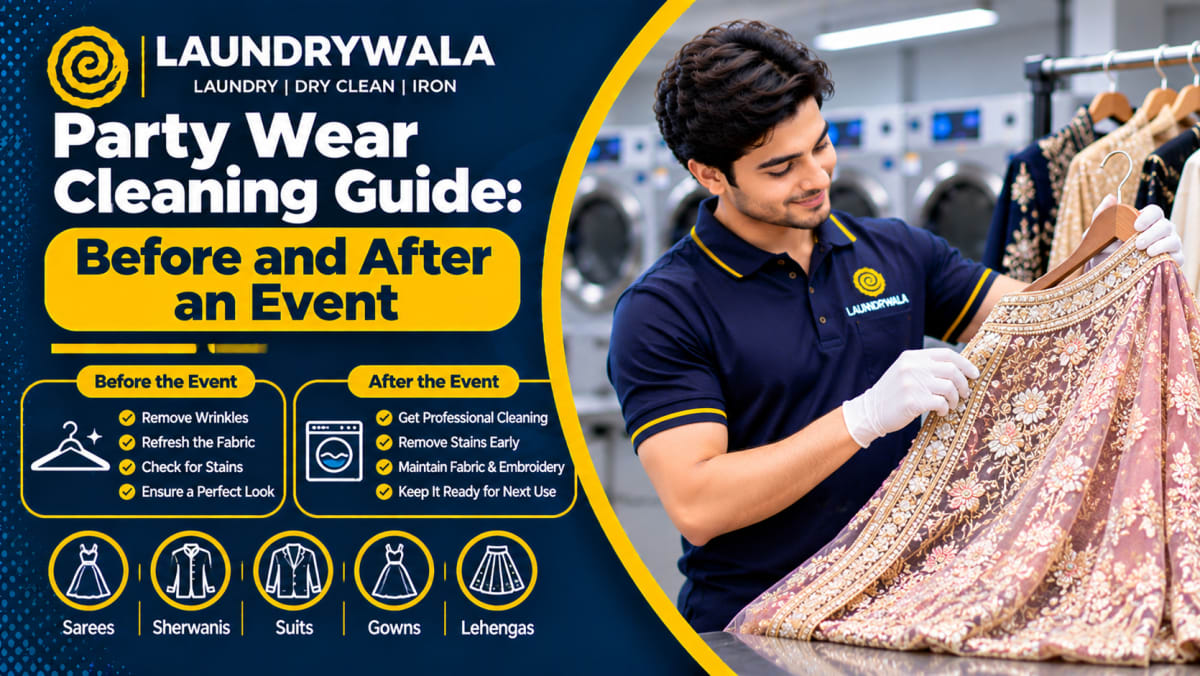

Resham embroidery adds a rich, elegant finish to suits, kurtas, Anarkalis, gowns, dupattas and other occasion-wear garments. The smooth and glossy threads create floral, geometric and traditional patterns that can make even a simple outfit look luxurious.
However, resham embroidery can be sensitive to water, detergent, friction, stain removers, heat and incorrect ironing. The embroidery thread, base fabric, lining and decorative elements may all react differently during cleaning.
A professional Resham embroidery suit dry cleaning service begins by inspecting the complete outfit. The cleaner should identify the base fabric, embroidery thread, colours, stains, lining, embellishments and care instructions before recommending a suitable process.
Quick answer: Do not automatically machine-wash a resham-embroidered suit. Read its care label and inspect the embroidery for loose threads, colour transfer and existing damage. Silk, georgette, velvet, organza, lined and heavily embroidered suits generally require professional assessment. Avoid bleach, hard brushing, aggressive rubbing and direct ironing over the embroidery.
What Is Resham Embroidery?
“Resham” is commonly used to describe smooth, lustrous embroidery thread. Depending on the garment, this thread may be made from natural silk, artificial silk, rayon, viscose, polyester or a blended material.
Therefore, a garment described as having resham work does not automatically contain pure silk thread. Two visually similar suits may use entirely different embroidery fibres.
Resham embroidery may be created by hand or machine and can include:
- Floral patterns
- Leaves and vines
- Paisley motifs
- Geometric designs
- Borders and neck panels
- Sleeve embroidery
- Buti work
- Satin stitches
- Chain stitches
- Aari-style patterns
- Raised threadwork
- Multicoloured designs
The Government of India’s official hand-embroidery craft information identifies cotton, silk, velvet and georgette as common base fabrics and notes that embroidery can use cotton, silk, zari and wool threads along with sequins, beads and mirrors.
Because the thread and base fabric may differ, the complete garment must be considered before cleaning.
Why Does Resham Embroidery Need Special Care?
Resham thread creates a smooth decorative surface, but its sheen and appearance can be affected by friction, moisture, chemicals and heat.
Incorrect cleaning may cause:
- Embroidery colour bleeding
- Fading or dullness
- Loose or broken threads
- Snagged stitches
- Shrinkage of the base fabric
- Puckering around embroidered sections
- Lining distortion
- Water rings
- Flattened raised embroidery
- Shine marks from direct ironing
- Sequins or beads becoming loose
- Metallic details becoming dull
- Uneven drying
- Transfer of dark thread colour onto light fabric
A suit may also contain several materials within one outfit. For example, a georgette kurta may have rayon embroidery, a polyester lining, metal hooks, sequins and a contrasting chiffon dupatta.
Even if the primary fabric is washable, the embroidery, lining or decorations may not tolerate the same process.
Can Resham Embroidery Suits Be Dry Cleaned?
Many resham-embroidered suits can be professionally dry cleaned, particularly when their care labels recommend it. However, dry cleaning should not be considered automatically suitable for every embroidered garment.
The process depends on:
- Base fabric
- Embroidery-thread material
- Thread colour
- Care-label instructions
- Lining and interfacing
- Stain type
- Decorative elements
- Existing damage
- Previous cleaning attempts
- Colourfastness
Professional dry cleaning may be appropriate when:
- The care label recommends dry cleaning
- The garment is made from silk, velvet or organza
- The suit contains heavy threadwork
- The embroidery uses several strong colours
- Sequins, beads, pearls or stones are present
- The outfit has a structured lining
- The base fabric may shrink in water
- Oil, makeup or difficult stains are present
- The outfit is designer-made or expensive
- The fabric or embroidery fibre is unknown
If the care label says “Do Not Dry Clean,” the instruction should not be ignored. A professional cleaner may recommend wet cleaning, careful washing, surface cleaning or another compatible process.
Laundrywala’s guide explaining which clothes should be professionally dry cleaned provides additional guidance for embroidered, structured and delicate garments.
Always Check the Care Label First
The garment-care label should be checked before washing, dry cleaning, drying, steaming or ironing a resham-embroidered suit.
The label may contain instructions such as:
- Hand wash
- Gentle machine wash
- Wash separately
- Do not bleach
- Dry flat
- Dry in shade
- Do not tumble dry
- Iron at low temperature
- Iron on reverse
- Do not iron decoration
- Professional dry clean
- Mild professional process
- Do not dry clean
- No steam
The GINETEX care-labelling guidance explains that care symbols apply to the garment’s colour, finish, accessories and decorative applications—not only its primary fibre.
The FTC’s garment-care rule also explains that care instructions may include specific warnings when washing, drying, ironing, bleaching, solvents or steam could damage a garment.
For help understanding common washing and professional-cleaning symbols, read Laundrywala’s guide on how to understand fabric-care labels.
If the care label is missing, request a professional inspection instead of guessing the cleaning method.
Cleaning Resham Embroidery on Different Fabrics
The correct method depends on both the embroidery and the fabric supporting it.
| Base fabric | Main cleaning risks | Recommended approach |
|---|---|---|
| Cotton | Shrinkage, thread bleeding and puckering | Follow the label; gentle washing may be possible |
| Silk | Water marks, colour changes and loss of lustre | Professional assessment is generally safer |
| Georgette | Snagging, stretching and shape loss | Avoid scrubbing, twisting and heavy agitation |
| Chiffon | Tearing, distortion and pulled threads | Use minimal friction and careful support |
| Organza | Creasing, snagging and heat damage | Use controlled cleaning and finishing |
| Rayon or viscose | Weakness when wet, shrinkage and dye movement | Avoid uncontrolled soaking and wringing |
| Velvet | Flattened pile and pressure marks | Avoid hard pressing and direct ironing |
| Linen | Shrinkage, deep creases and embroidery stress | Follow label-approved cleaning and finishing |
| Polyester blend | Heat damage and embroidery distortion | Use controlled temperature and mechanical action |
| Net | Snagging and stretching | Protect embroidery from jewellery and rough surfaces |
| Brocade | Metallic-thread and weave damage | Request professional inspection |
| Wool blend | Felting, shrinkage and shape changes | Follow the care label and avoid ordinary washing |
When a suit combines several materials, the most delicate component should guide the treatment.
Can a Resham-Embroidered Suit Be Washed at Home?
Some simple cotton or polyester suits with stable embroidery may be washable when the care label permits it.
Before washing at home:
- Inspect the embroidered areas for loose threads.
- Check whether the embroidery colour transfers.
- Read the complete care instructions.
- Turn the garment inside out.
- Separate it from rough or heavily soiled clothes.
- Use a suitable mild detergent.
- Select the temperature recommended on the label.
- Avoid soaking the garment unnecessarily.
- Do not scrub the embroidery.
- Avoid twisting or hard wringing.
- Dry the outfit according to the label.
- Check it before ironing.
Hand washing is not automatically safe. Rubbing, prolonged soaking and wringing can still distort embroidery or weaken the base fabric.
Machine washing should only be considered when the manufacturer explicitly permits it. A delicate cycle does not make every embroidered suit washable.
Which Resham Suits Should Not Be Washed at Home?
Professional assessment is a safer choice when the outfit contains:
- Natural silk
- Velvet
- Fine organza
- Delicate chiffon
- Rayon with unstable dye
- Heavy resham embroidery
- Several contrasting thread colours
- Zari or metallic work
- Sequins or beads
- Pearls or stones
- Mirror work
- Adhesive-backed decoration
- Structured lining
- Padding or boning
- Fragile net
- Loose or damaged embroidery
- Old or weakened fabric
Laundrywala’s guide on professional care for delicate clothes explains why fabric assessment, controlled cleaning, suitable drying and careful finishing are helpful for sensitive outfits.
For premium or designer garments, review the precautions in How to Clean Expensive Designer Clothes Safely.
How Can You Test Whether Resham Colour May Bleed?
Colourfastness should ideally be assessed by a professional, particularly when the garment is valuable.
Warning signs include:
- Strong red, maroon, navy, black or green thread on light fabric
- Colour transferring to tissue or cloth
- Fading around previously wet areas
- A coloured ring around an old stain
- Thread colour visible on the lining
- Dye transfer from the dupatta
- Previous bleeding during washing
Do not perform aggressive testing on a visible embroidered section. Testing itself can create a pale patch, water ring or loose thread.
Even when one hidden area appears stable, other thread colours or decorative components may respond differently.
If colour bleeding has already occurred, avoid drying or ironing the affected area before assessment. Laundrywala’s guide on removing colour bleeding from clothes explains why heat can make transferred dye more difficult to treat.
How Should Stains on Resham Embroidery Be Handled?
Stains may settle on the base fabric, embroidery thread or both. Rubbing the affected area can spread the stain and disturb the stitches.
Food and Oil Stains
Ghee, cooking oil, butter and gravy can penetrate through the embroidery into the underlying fabric.
Remove solid food carefully using a clean spoon. Blot excess oil with a white absorbent cloth without rubbing. Do not add hot water or apply dishwashing liquid.
Tea and Coffee
Blot liquid immediately without spreading it. Milk, sugar or cream can turn a simple beverage spill into a combination stain.
Do not iron or blow-dry the area.
Makeup and Lipstick
Foundation, lipstick and concealer may contain pigment, wax and oil.
Avoid sanitiser, alcohol, hairspray, acetone and nail-polish remover. These products may remove embroidery colour or damage the garment’s finish.
Laundrywala’s guide on removing makeup stains from clothes safely provides additional fabric-specific precautions.
Perspiration and Deodorant
Perspiration can collect around the neckline, underarms, upper back and sleeves. It may not be immediately visible but can gradually cause stiffness, odour or discolouration.
Point out these areas when handing over the suit.
Ink Stains
Do not rub ink or apply sanitiser. Protect the stained section from touching another part of the garment and arrange professional inspection promptly.
Mud
Avoid rubbing wet mud across the embroidery. Loose dry material may be carefully lifted, but hard brushing can pull threadwork and damage the base fabric.
Stain-Removal Methods to Avoid
Do not experiment with strong household products on resham embroidery.
Avoid:
- Chlorine bleach
- Undiluted vinegar
- Lemon juice
- Baking-soda paste
- Toothpaste
- Dishwashing liquid
- Hand sanitiser
- Acetone
- Nail-polish remover
- Hairspray
- Hard toothbrushes
- Metal scrapers
- Boiling water
- Direct dryer heat
- Aggressive rubbing
These methods may reduce one stain while creating colour loss, a water ring, weakened fabric or damaged threadwork.
The final stain-removal result depends on the stain, fabric, thread, age and previous treatment. Laundrywala’s guide on whether dry cleaning removes stains explains why complete removal cannot be guaranteed in every case.
Professional Resham Embroidery Suit Cleaning Process
The exact process depends on the garment. A responsible cleaner should not place every embroidered suit through the same standard cycle.
1. Garment Registration
Every piece in the outfit is counted and tagged, including:
- Kurta or kameez
- Trousers or salwar
- Dupatta
- Inner layer
- Jacket
- Belt
- Detachable tassels
- Decorative accessories
Matching pieces should be submitted together when practical.
2. Care-Label Review
The cleaner checks the manufacturer’s instructions relating to washing, solvents, moisture, drying, steam and ironing.
3. Fabric Identification
The cleaner identifies the outer fabric and lining. Similar-looking materials may react differently to water, solvent and heat.
4. Embroidery Assessment
The threadwork is checked for:
- Loose ends
- Broken stitches
- Pulled threads
- Existing fading
- Colour transfer
- Surface abrasion
- Missing decorative elements
- Previous repairs
5. Embellishment Inspection
Sequins, beads, stones, mirrors, zari and glued components require separate assessment.
6. Colourfastness Assessment
Where appropriate, a hidden section may be tested to identify obvious colour movement or surface changes.
7. Stain Identification
The cleaner reviews the stain’s source, location, age and any products previously applied.
8. Process Selection
Depending on the label and garment condition, the cleaner may recommend:
- Professional dry cleaning
- Mild dry-cleaning process
- Professional wet cleaning
- Gentle laundering
- Localised stain treatment
- Surface cleaning
- Specialist hand treatment
9. Controlled Cleaning
Mechanical action, moisture, cleaning time and temperature may need to be limited to protect the embroidery and fabric.
10. Drying and Finishing
The suit should be fully dried and finished using a method compatible with its most sensitive material.
11. Final Quality Inspection
Before packaging, the garment is checked for:
- Remaining stains
- Odour
- Colour changes
- Embroidery condition
- Shape
- Lining
- Closures
- Moisture
- Finishing
- Matching pieces
Laundrywala’s professional dry-cleaning service provides inspection-based care for eligible delicate, embroidered and premium garments.
Resham Embroidery With Zari, Sequins or Beads
Resham thread is often combined with other decorations. These components can increase cleaning risk.
Zari and Metallic Thread
Metallic work may become dull, tarnished or distorted. Perfume, moisture, strong chemicals and direct heat should be avoided.
Sequins
Sequins may lose colour, bend, crack or detach. Plastic sequins can also be affected by excessive heat.
Beads and Stones
Beads may crack under pressure, while stones may be attached using thread, metal settings or adhesive. A solvent-safe fabric does not guarantee that the adhesive is also safe.
Mirror Work
Mirrors can crack, become loose or snag the surrounding fabric. Read Laundrywala’s detailed guide on dry cleaning mirror-work clothes safely when an outfit combines resham thread with reflective decoration.
Pearls
Decorative pearls may have delicate coatings that respond poorly to chemicals, rubbing or high heat.
Heavily embellished suits should be inspected piece by piece before cleaning.
Can Resham Embroidery Be Steam Ironed?
Steam ironing may be suitable when the care label permits it, but direct heat and heavy pressure can flatten or distort embroidery.
Possible risks include:
- Loss of thread lustre
- Flattened raised work
- Impressions on the reverse side
- Colour transfer
- Water marks
- Melted synthetic thread
- Loosened adhesive
- Tarnished zari
- Damaged sequins
Safer precautions may include:
- Checking the ironing symbol
- Turning the garment inside out
- Using a clean pressing cloth
- Selecting the correct temperature
- Supporting raised embroidery
- Avoiding direct pressure on decorations
- Testing a hidden area first
Pure silk also requires careful heat control. The Silk Mark Organisation of India’s silk-care guidance recommends low-to-medium heat, reverse-side ironing and avoiding direct water spraying that may create water spots.
If the fabric or embroidery thread is unknown, use professional finishing instead of household ironing.
How Should a Resham Suit Be Prepared for Pickup?
Before sending the suit for professional cleaning:
- Empty all pockets.
- Count every piece.
- Photograph the complete outfit.
- Photograph loose or damaged embroidery.
- Point out every known stain.
- Explain what caused the stain.
- Mention any home treatment already attempted.
- Share the care label.
- Remove detachable jewellery where appropriate.
- Keep detached beads or stones in a labelled pouch.
- Avoid ironing stained areas.
- Share the date if the outfit is needed for an event.
Laundrywala’s festive-wear dry-cleaning guide provides additional advice for preparing embroidered suits, sarees and gowns for professional cleaning.
How Often Should a Resham-Embroidered Suit Be Cleaned?
There is no fixed schedule suitable for every resham suit.
Cleaning frequency depends on:
- Duration of wear
- Perspiration
- Visible stains
- Fabric type
- Odour
- Weather and humidity
- Skin contact
- Embellishments
- Storage period
- Care instructions
A briefly worn outfit may only need temporary airing if it remains completely clean and dry. However, a suit exposed to perspiration, food, makeup, perfume or rain should be assessed before storage.
Repeated unnecessary cleaning may stress delicate embroidery, but storing a stained garment can also cause long-term damage.
How Should Resham Embroidery Suits Be Stored?
Clean and completely dry the suit before long-term storage.
Follow these precautions:
- Use a breathable cotton or muslin cover.
- Avoid sealed plastic for long-term storage.
- Store the outfit away from direct sunlight.
- Keep it away from damp walls.
- Use acid-free tissue between embroidered sections.
- Avoid sharp folds across heavy embroidery.
- Do not place heavy garments over delicate threadwork.
- Wrap metallic accessories separately.
- Remove safety pins.
- Avoid spraying perfume inside the cover.
- Refold the garment periodically.
- Check for moisture, insects and loose threads.
A lightweight suit may be stored on a broad padded hanger when its construction permits it. Heavy suits may be safer when stored flat to prevent shoulder stretching.
For more detailed storage precautions, read Laundrywala’s guide on storing clothes without smell or moisture damage.
When Should You Choose Professional Cleaning?
Professional cleaning is worth considering when:
- The label recommends dry cleaning
- The suit contains natural silk
- The base fabric is velvet, organza or fine georgette
- The embroidery is heavy or multicoloured
- Zari, beads, sequins or stones are present
- The garment has a structured lining
- Oil, makeup or ink stains are present
- Colour transfers from the thread
- Home treatment has created a visible patch
- The fabric cannot be identified
- The outfit is expensive or sentimental
- The embroidery is loose or damaged
A professional may decline or modify the treatment when the fabric is extremely weak, the colour is unstable or the embellishments are already severely damaged.
Why Choose Laundrywala for Resham Embroidery Suit Care?
Laundrywala provides professional laundry, dry cleaning and ironing services with doorstep pickup and delivery across serviceable locations.
A resham-embroidered suit can be inspected for:
- Base fabric
- Embroidery fibre
- Care instructions
- Colourfastness
- Stains
- Lining
- Zari
- Beads and sequins
- Existing damage
- Suitable cleaning process
- Finishing requirements
The treatment should be selected according to the individual garment rather than the general name “resham embroidery.”
Use the Laundrywala store locator to find the nearest outlet and confirm service availability.
To request an inspection or schedule pickup, contact Laundrywala or call 1800 889 3225.
FAQs about best Dry Cleaning Tips
Get answers about premium dry cleaning processes, delicate garment handling, and how we care for your fabrics.
Still have questions?
Can't find what you're looking for? Our fabric care specialists and franchise advisors are here to help.