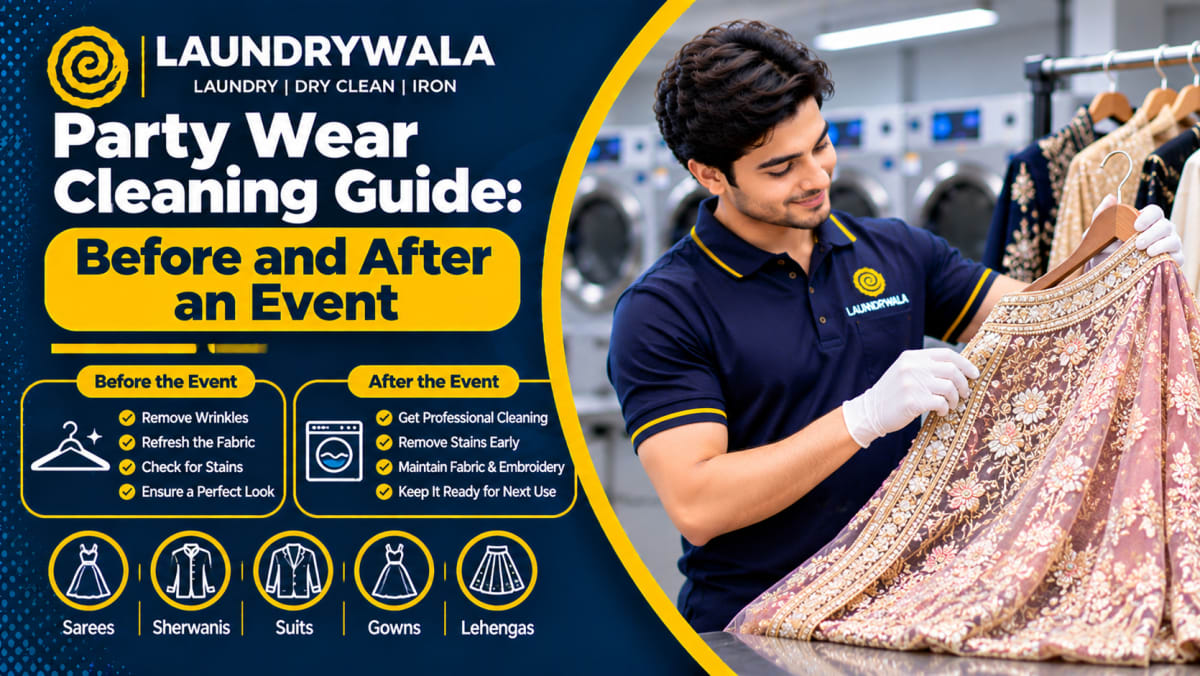
Party-wear clothes often combine delicate fabrics, decorative details and structured construction. A single outfit may include silk, satin, velvet, net, lace, sequins, embroidery, beads, metallic threads, padding and a separate lining. These materials cannot always be washed, dried or ironed like everyday clothes.
Following the right party wear cleaning guide can help protect an outfit before an event, manage accidental stains during the celebration and prevent odour, discolouration or permanent marks after the event.
Quick answer: Check the garment’s care label, inspect the outfit several days before the event and arrange cleaning or finishing early. During the event, blot spills without rubbing or applying random chemicals. After wearing the outfit, inspect the neckline, underarms, cuffs and hem before deciding whether it needs airing, spot treatment, laundry or professional dry cleaning.
Why Does Party Wear Need Special Care?
Party wear is usually selected for its appearance, drape and decorative finish rather than frequent washability. It may contain several materials that react differently to moisture, detergent, solvent, heat and mechanical movement.
Common party-wear garments include:
- Cocktail and evening dresses
- Sarees and designer blouses
- Gowns and layered dresses
- Anarkalis and embellished suits
- Sherwanis and bandhgalas
- Blazers and formal suits
- Velvet dresses and jackets
- Sequinned tops and skirts
- Embroidered kurtas
- Lace dresses
- Organza, chiffon and georgette outfits
- Designer jumpsuits
- Children’s party dresses
Incorrect treatment may cause:
- Colour bleeding or fading
- Shrinkage or distortion
- Loss of garment structure
- Water rings on silk or satin
- Flattened velvet pile
- Loose sequins, beads or stones
- Damaged embroidery or zari
- Snagging of net, lace or organza
- Lining shrinkage
- Permanent stain setting
- Shine marks from direct ironing
- Stretching at the shoulders
Laundrywala’s guide on cleaning expensive designer clothes safely explains why fibre, construction and embellishments should be assessed before treating a premium outfit.
What Should You Do Before Wearing Party Clothes?
Party-wear preparation should begin several days before an event. Taking the outfit out of storage at the last moment leaves little time to handle odour, creases, stains, missing buttons or loose decorations.
1. Remove the Outfit From Storage Early
Take the complete outfit out at least a few days before the event. Remove the dress, matching bottom, blouse, jacket, dupatta, belt and detachable accessories.
Do not assume that an outfit is ready simply because it was cleaned before storage. Long-term storage may leave fold lines, a stale smell, dust or yellowing around previously unnoticed stains.
Check whether every matching piece is available and still fits correctly.
2. Read the Garment-Care Label
The care label should be checked before washing, steaming, ironing or sending the outfit for dry cleaning.
It may include instructions such as:
- Dry clean only
- Professional dry clean
- Professional wet clean
- Hand wash
- Do not wash
- Do not bleach
- Do not tumble dry
- Iron at low temperature
- Do not iron
- Do not steam
The GINETEX care-labelling guidance explains that care symbols indicate the maximum permitted treatment while considering the garment’s colouring, finishing, accessories and decorative applications.
The FTC’s garment-care guidance also explains that an instruction such as “Dry Clean Only” should be supported by evidence that washing may harm the garment.
If the label is missing or unreadable, do not guess. A professional cleaner should inspect the fabric, lining, colour and decorations before recommending a process.
3. Inspect the Entire Outfit in Good Light
Place the garment on a clean surface or padded hanger and inspect:
- Neckline and collar
- Underarm areas
- Sleeve cuffs
- Waistband
- Front of the garment
- Hem and train
- Inner lining
- Zips, hooks and buttons
- Pleats and folds
- Embroidery and zari
- Beads, sequins and stones
- Previously repaired sections
- Areas touching the skin
Look for yellow marks, makeup, perfume rings, food stains, loose threads, pulled fabric or missing decorations.
Photograph any existing damage before giving the garment to a cleaner. This creates a useful condition record and helps ensure that weak sections receive extra attention.
4. Arrange Cleaning Before the Event
If the outfit has stains, odour or visible soil, arrange cleaning early enough to allow inspection, treatment, finishing and collection.
Do not depend on last-minute aggressive spot cleaning. Strong rubbing or unsuitable chemicals may create permanent fading, water rings or fabric damage.
Laundrywala’s professional dry-cleaning service provides inspection-based care for eligible delicate, formal and premium garments. Service availability and turnaround time should be confirmed with the nearest outlet.
5. Check the Outfit After Cleaning
When receiving a cleaned garment, inspect it before the event.
Confirm that:
- Every matching piece has been returned
- The visible stains have been treated
- The garment smells fresh
- Pleats and structure look correct
- Buttons, hooks and zips work properly
- Embroidery and decorative parts are secure
- No new crease or shine mark is visible
- The garment has been packaged correctly
Stain removal cannot always be guaranteed. Results depend on the stain, fabric, colour, age and previous treatments. Laundrywala’s guide on whether dry cleaning removes stains explains these limitations in detail.
How Should Party Wear Be Ironed or Steamed?
Party wear should not automatically be pressed using the highest iron temperature.
Direct heat may:
- Melt synthetic net or sequins
- Flatten velvet pile
- Damage metallic prints
- Create shine on dark fabric
- Distort embroidery
- Weaken adhesive-backed stones
- Leave water marks on silk
- Flatten pleats or textured details
Check the care label before applying heat. Use a clean pressing cloth when suitable and keep the iron away from beads, stones, sequins, prints and zari.
Steam can help relax some creases, but it is not safe for every fabric or decoration. Moisture may affect water-sensitive silk, adhesive, colour or metallic finishes.
If you are unsure about the correct temperature, use Laundrywala’s professional steam-ironing service rather than experimenting immediately before an event.
How Should You Transport Party Wear to an Event?
Transportation can undo careful cleaning and finishing if the outfit is tightly folded or crushed.
Use a clean, breathable garment cover for suits, gowns, jackets and structured dresses. Avoid placing heavy items on top of the garment.
For sarees, dupattas and unstructured outfits:
- Make as few folds as possible.
- Place clean tissue between heavily decorated sections.
- Keep jewellery away from delicate fabric.
- Wrap sharp hooks and decorative accessories separately.
- Do not place shoes directly against the outfit.
- Avoid carrying leaking cosmetics or perfume in the same bag.
- Unpack and hang or lay out the garment after reaching the venue.
Heavy gowns and beaded garments should not be left hanging from weak shoulder straps for long periods. Use internal support loops when provided by the manufacturer.
What Should You Do If a Stain Occurs During the Event?
The first response can influence whether a stain is removable. The aim during an event is to control the spill without spreading it or damaging the fabric.
General Emergency Stain Steps
- Remove any solid material gently with a clean spoon.
- Blot liquid using a clean, white absorbent cloth.
- Work from the outside of the stain towards the centre.
- Do not rub or scrub the fabric.
- Do not apply direct heat.
- Avoid bleach, sanitiser and nail-polish remover.
- Keep the affected area away from jewellery and other colours.
- Tell the cleaner what caused the stain.
The American Cleaning Institute’s stain-removal guide recommends treating stains promptly, following fabric-care instructions and avoiding dryer heat while a stain remains. Delicate party wear may still require professional treatment instead of home laundering.
Food and Oil Stains
Ghee, butter, gravy and fried food can penetrate silk, satin and blended fabrics.
Lift solid food carefully and blot excess oil using a clean, absorbent cloth. Do not add water or rub the mark. Avoid applying powder unless the garment manufacturer or a professional cleaner specifically recommends it.
Makeup and Lipstick
Foundation, concealer, lipstick and other cosmetics may contain oils, waxes and pigments.
Do not use sanitiser, alcohol or nail-polish remover. These products may remove the garment’s colour or surface finish along with the makeup.
Laundrywala’s guide to removing makeup stains from clothes provides additional precautions for different garments.
Tea, Coffee and Soft Drinks
Blot the liquid immediately without pressing it deeper into the fabric. Milk, sugar and artificial colour can make the stain more complicated.
Do not use hot water unless the garment’s care instructions and fabric type clearly permit it.
Ink Stains
Avoid rubbing an ink mark because this can increase the affected area. Do not apply alcohol, sanitiser or acetone to an expensive outfit without professional guidance.
Protect the stained area from touching another part of the garment and arrange inspection promptly.
Mud and Dust
Wet mud should not be aggressively scrubbed into the fabric. Allow a professional to assess it, especially when the affected garment is silk, organza, velvet or heavily embroidered.
Loose dry surface dust may be lifted carefully, but hard brushing can damage delicate fibres or decorative work.
Perspiration and Deodorant
Perspiration is not always immediately visible. It may remain around the neckline, underarms and back and gradually cause odour or discolouration.
Tell the cleaner about these areas even when no strong stain is visible. Repeatedly spraying perfume over perspiration does not clean the garment and may add an oily fragrance mark.
What Should You Do After the Event?
Do not return a worn outfit directly to the wardrobe.
1. Empty the Pockets
Remove tissues, receipts, makeup, pins, food wrappers and other items. Check hidden pockets in jackets, trousers, gowns and ethnic outfits.
2. Inspect the Outfit Again
Use good lighting to inspect:
- Neckline
- Underarms
- Front and back
- Sleeves and cuffs
- Waist area
- Hem and train
- Inner lining
- Dupatta or stole
- Matching trousers or skirt
Food and beverage stains may be transparent when fresh but darken during storage.
3. Allow Temporary Airing
If the garment is not wet or heavily stained, place it in a clean, shaded and ventilated area for a short period.
Do not leave a valuable outfit in strong sunlight. Sunlight can fade colour and affect delicate fibres and decorations. Airing may reduce surface moisture, but it does not replace cleaning when the outfit contains stains, perspiration or odour.
4. Do Not Store a Stained Outfit
Stains can oxidise, darken or attract insects during storage. Sugar, perspiration, body oils and food residue may not be immediately visible.
A garment that appears clean after an event may still contain residue around the neckline, lining and underarms. Arrange suitable cleaning before long-term storage.
5. Send Matching Pieces Together
When practical, send the full outfit together:
- Jacket and trousers
- Saree and blouse
- Kurta and matching bottom
- Dress and belt
- Gown and detachable components
- Sherwani and matching accessories
Cleaning only one part of a matching set may lead to differences in colour appearance, freshness or finishing.
Can Party Wear Be Washed at Home?
Some simple party clothes may be washable when the care label permits it. However, appearance alone cannot confirm whether a garment is safe to wash.
Home washing may be unsuitable when the outfit contains:
- Silk, velvet or wool
- Structured lining
- Boning or padding
- Heavy embroidery
- Mirror work
- Zari or metallic thread
- Sequins, beads or stones
- Lace, organza or delicate net
- Contrasting colours
- Adhesive-backed decoration
- Leather or suede panels
- Pleats requiring special finishing
Before home washing, confirm the permitted water temperature, cycle, detergent, drying method and ironing temperature.
Laundrywala’s guide on understanding fabric-care labels can help explain common washing, drying and ironing instructions.
For clothes with reflective decorative elements, read Can Mirror-Work Clothes Be Dry Cleaned Safely? before selecting a cleaning method.
Cleaning Different Party-Wear Fabrics
| Fabric or detail | Main concern | Safer approach |
|---|---|---|
| Silk | Water marks, colour bleeding and loss of texture | Follow the care label and seek professional assessment |
| Satin | Snagging, water rings and shine marks | Avoid rubbing and direct high heat |
| Velvet | Flattened pile and pressure marks | Use fabric-specific professional cleaning and finishing |
| Organza | Creasing, distortion and pulled threads | Minimise friction and avoid aggressive washing |
| Chiffon | Snagging and stretching | Handle gently and avoid heavy decoration pulling the fabric |
| Lace | Tearing, distortion and caught threads | Protect from jewellery and use low-friction handling |
| Net or tulle | Melting, snagging and shape loss | Avoid direct heat and machine agitation |
| Sequins and beads | Loosening, colour change or melting | Inspect attachment and avoid direct ironing |
| Zari and metallic thread | Tarnishing, dullness and heat damage | Keep away from moisture, perfume and high heat |
| Wool suits | Shrinkage and structural distortion | Use care-label-compatible professional cleaning |
| Mirror work | Cracking, detachment and abrasion | Protect decorations and request individual inspection |
| Embroidery | Colour bleeding and thread damage | Test colourfastness and minimise surface friction |
Party outfits combining several materials should be treated according to their most sensitive component.
What Does Professional Party-Wear Cleaning Involve?
The exact process depends on the garment, but professional care may include:
Garment Inspection
The cleaner examines the fabric, label, lining, colour, stitching and decorations. Existing wear, tears, missing stones and loose threads should be recorded.
Stain Identification
Different stains require different treatment. Food oil, tea, makeup, ink and perspiration do not respond to one universal chemical.
Colour and Decoration Assessment
Contrasting colours, embroidery, sequins, beads and metallic details may require testing or protection.
Controlled Cleaning
A suitable professional process is selected according to the label, material and garment condition. “Dry cleaning” should not be assumed to be suitable for every expensive outfit.
Finishing
Controlled steam or pressing may help restore drape, pleats and shape. The temperature and pressure should suit the most sensitive section.
Final Quality Check
The outfit should be checked for stain results, odour, colour, shape, finishing, closures and decorative details before packaging.
Complete restoration cannot be guaranteed when a stain is permanent or the garment already has weak fabric, colour loss or damaged decoration.
How Should Party Wear Be Stored After Cleaning?
Store the garment only when it is completely clean and dry.
The Canadian Conservation Institute’s textile-care guidance advises against ordinary dry-cleaner plastic bags for long-term textile storage because limited air circulation can encourage moisture buildup. It also recommends avoiding wire hangers and providing suitable support for garments.
Follow these storage practices:
- Use a breathable cotton or muslin garment cover.
- Avoid sealed plastic for long-term storage.
- Keep the garment away from direct sunlight.
- Store it in a dry and ventilated wardrobe.
- Use a broad, padded hanger for suitable dresses and jackets.
- Do not hang very heavy, fragile or heavily beaded garments.
- Store heavy embellished outfits flat when appropriate.
- Use acid-free tissue to support folds.
- Wrap jewellery, belts and metal accessories separately.
- Avoid spraying perfume inside the cover.
- Do not place heavy clothes over delicate lace or net.
- Inspect stored party wear periodically.
For additional storage precautions, read Laundrywala’s guide on storing clothes for a long time.
Does Party Wear Need Cleaning After Every Use?
Not every party outfit automatically needs full cleaning after one short use. The decision depends on:
- Duration of wear
- Weather and humidity
- Perspiration
- Food or drink exposure
- Visible stains
- Odour
- Fabric type
- Skin contact
- Future storage period
- Care-label instructions
An outfit worn briefly in a cool indoor environment may only need careful airing if it remains completely clean. However, visible stains, perspiration, makeup or long-term storage generally justify professional assessment.
Repeated unnecessary cleaning can also place stress on delicate fabrics and decorations. The goal is appropriate cleaning—not simply maximum cleaning frequency.
Why Choose Laundrywala for Party-Wear Cleaning?
Laundrywala provides professional laundry, dry cleaning and ironing services across serviceable locations.
Depending on the garment and outlet availability, party wear can be inspected for:
- Fabric and lining type
- Stain condition
- Colourfastness concerns
- Embroidery and decoration
- Suitable cleaning process
- Finishing requirements
- Existing damage
- Packaging and storage needs
Before booking, share clear photographs of the garment, care label, stains and decorative details. Mention any home remedies or cleaning products already applied.
Use the Laundrywala store locator to find the nearest outlet, or contact Laundrywala to ask about party-wear cleaning and pickup availability.
Laundrywala FAQs
Find answers to commonly asked questions about our services, processes, and how we deliver quality across India.
Still have questions?
Can't find what you're looking for? Our fabric care specialists and franchise advisors are here to help.