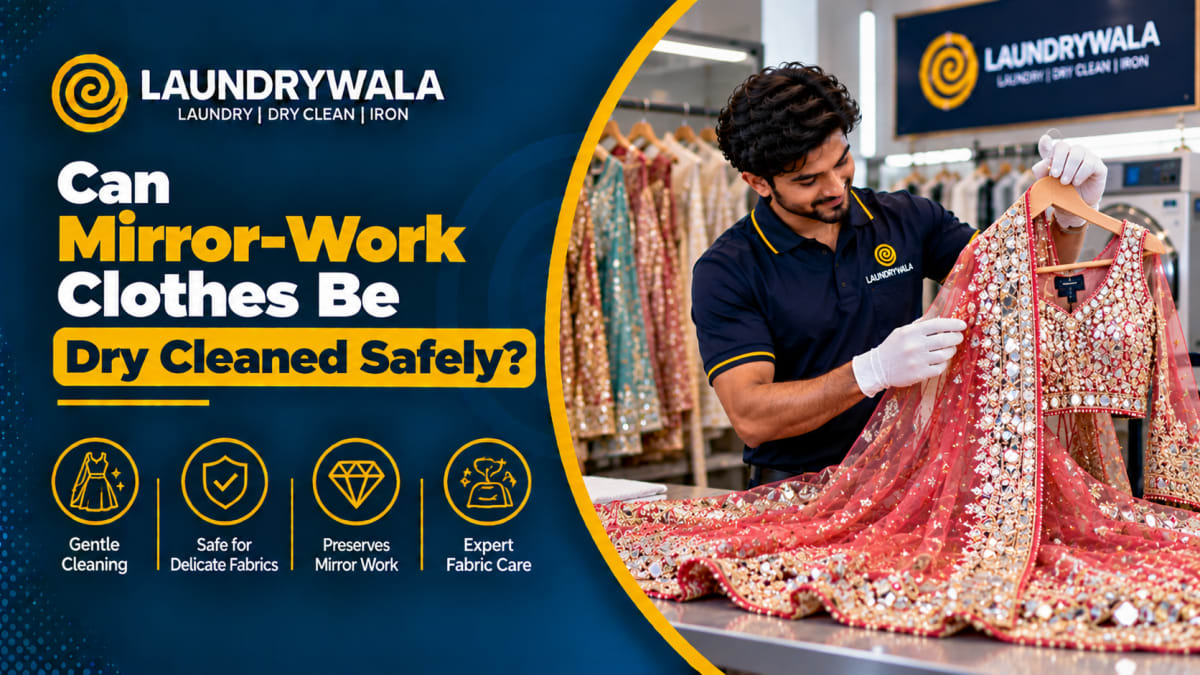
Mirror-work clothing is known for its eye-catching shine and intricate craftsmanship. Lehengas, sarees, blouses, kurtas, dupattas, jackets and festive dresses decorated with small mirrors can look spectacular, but they are also difficult to clean safely.
The main fabric may be silk, cotton, georgette, velvet or synthetic net, while the mirrors may be attached with embroidery thread, metal settings, adhesive or decorative frames. Each component can react differently to water, cleaning solvent, movement, heat and steam.
So, can clothes with mirror work be dry cleaned safely?
Quick answer: Many mirror-work clothes can be professionally dry cleaned, but only after the garment has been inspected. The cleaner must check the base fabric, dye stability, mirror condition, attachment method, embroidery, lining and care label. Garments with loose, cracked or glued mirrors may require a modified process, protective handling or an alternative cleaning method.
Dry cleaning should not be considered automatically safe for every mirror-work outfit. The correct process depends on how the garment was constructed and whether all its materials can tolerate professional cleaning.
What Is Mirror Work on Clothes?
Mirror work is a traditional decorative technique in which small reflective pieces are attached to fabric. It is also commonly known as shisha work.
Mirror embellishments may be found on:
- Lehengas
- Sarees
- Blouses
- Dupattas
- Kurtas and kurtis
- Anarkali suits
- Sharara and gharara sets
- Jackets and waistcoats
- Bridal garments
- Festive gowns
- Handbags and potlis
- Traditional regional outfits
- Cushion covers and decorative textiles
The reflective pieces may be made from glass, acrylic, plastic or another mirror-like material. They may be surrounded by embroidery, zari, beads, sequins or coloured thread.
Traditional mirror work is usually secured with hand embroidery. Modern fashion garments may use machine stitching, metal frames, adhesive or a combination of techniques.
This difference is important because stitched and glued mirrors do not always respond to cleaning in the same way.
Can Mirror-Work Clothes Be Dry Cleaned?
Yes, many mirror-work garments can be professionally dry cleaned when their condition and care instructions permit it.
However, the word “dry clean” on a care label does not mean the garment can be processed without inspection. A mirror-work outfit may contain several components:
- Outer fabric
- Lining
- Sewing thread
- Embroidery thread
- Mirrors
- Adhesive
- Beads or sequins
- Zari
- Hooks and zips
- Structured padding
The US Federal Trade Commission’s official garment-care labelling guidance explains that cleaning instructions should be suitable for the complete garment, not only its primary fabric.
If the silk or cotton base fabric can be dry cleaned but the mirror adhesive is solvent-sensitive, the normal process may still cause damage. Similarly, stable mirrors may remain attached while weak embroidery thread breaks during mechanical movement.
Professional assessment is therefore necessary before confirming whether dry cleaning is suitable.
What Are the Main Risks When Cleaning Mirror Work?
Mirror-work garments are more complicated than ordinary clothing because the decorative surface can be affected by handling, cleaning and finishing.
Mirrors Becoming Loose
Embroidery thread may weaken through wear, moisture, age or friction. Mechanical movement during cleaning can loosen mirrors that were already unstable.
Glass Mirrors Cracking
Thin glass pieces can crack when pressed against other decorations, exposed to impact or placed under excessive pressure.
Adhesive Failure
Some modern garments use glue to attach mirrors or decorative frames. Cleaning solvent, water or heat may soften or weaken the adhesive.
Fabric Snagging
A cracked mirror or exposed edge can catch the surrounding fabric, lining or another part of the outfit.
Thread Damage
Mirror work is often secured using decorative thread. Strong agitation, brushing or spot rubbing can break or pull the stitches.
Colour Bleeding
The garment may contain several contrasting colours. Dark embroidery thread, printed fabric or lining may release colour during an unsuitable process.
Tarnishing of Decorative Borders
Metallic thread, zari, metal frames and sequins may become dull or discoloured if treated with incompatible products.
Heat Damage
Acrylic mirrors, plastic decorations, glue and synthetic fabric may distort when exposed to excessive heat.
Pressure Marks
Direct pressing can flatten embroidery, crack mirrors or leave impressions on the reverse side of the fabric.
Laundrywala’s guide on cleaning expensive designer clothes safely explains why garments combining fabric, lining and embellishments must be treated as complete items.
Stitched Mirrors vs Glued Mirrors
The method used to attach the mirrors is one of the most important cleaning considerations.
| Attachment type | How it is identified | Main cleaning risks |
|---|---|---|
| Hand-stitched mirrors | Decorative thread surrounds and holds each mirror | Weak or broken thread, loose mirrors and snagging |
| Machine-stitched mirrors | Repeated uniform stitches secure the decoration | Stitch breakage and fabric stress |
| Metal-framed mirrors | Mirror sits inside a small metal setting | Tarnishing, sharp edges and frame detachment |
| Glued mirrors | Little or no securing thread is visible | Adhesive softening, discolouration and mirror loss |
| Mixed attachment | Mirrors use both thread and adhesive | Different parts may react differently |
| Acrylic mirror work | Reflective plastic pieces instead of glass | Scratching, clouding and heat distortion |
Stitched mirrors may tolerate controlled professional cleaning when the thread and base fabric are stable. Glued mirrors require greater caution because the adhesive may not be compatible with solvent, water or steam.
A cleaner should not pull a mirror to test it. The attachment should be examined visually and with minimal handling.
Always Check the Care Label First
The care label is the safest starting point when deciding how a mirror-work garment should be cleaned.
The label may include instructions such as:
- Dry clean only
- Professionally dry clean
- Mild process
- Short cycle
- Do not wash
- Do not bleach
- Do not tumble dry
- Cool iron
- Do not iron decoration
- No steam
- Specialist clean only
The ISO 3758 textile-care standard establishes a system of symbols covering washing, bleaching, drying, ironing and professional textile care.
GINETEX also explains through its official care-labelling guidance that symbols communicate the maximum permitted treatment and consider colouring, finishing, buttons, zips and decorative applications.
If the label is missing, faded or unclear, the garment should not automatically be placed into a standard cleaning cycle. Its fabric and embellishments should first be identified and tested where appropriate.
Laundrywala’s guide on understanding fabric-care labels provides a simpler explanation of common garment-care symbols.
Which Mirror-Work Garments Need Extra Care?
Every mirror-work outfit requires inspection, but some garments carry greater risk because of their fabric, weight or construction.
Mirror-Work Lehengas
A lehenga may combine silk, velvet, net, cancan, satin lining, embroidery, stones and several layers. The garment’s weight can place stress on mirror stitches and waist seams.
Sarees With Mirror Embroidery
Sarees require attention to the fabric, fall, border, pallu and blouse. Mirrors near fold lines may press against the fabric during storage.
Laundrywala’s detailed saree dry-cleaning service guide explains the precautions required for silk, zari, bridal and embellished sarees.
Mirror-Work Blouses
Blouses may contain padding, cups, hooks, lining and adhesive-based structure. Sweat and makeup commonly collect around the underarms, neckline and back.
Dupattas and Net Fabric
Lightweight net or organza can snag on a loose mirror edge. A heavy border may also distort the garment when it is wet or unsupported.
Velvet Mirror-Work Clothing
Velvet requires protection from pressure, crushing and surface marks. Direct pressing around mirrors may damage both the pile and embellishments.
Bridal and Designer Outfits
Bridal garments often combine mirror work with zari, stones, pearls, sequins and several fabrics. They should be assessed piece by piece rather than cleaned as one ordinary set.
What Should Be Checked Before Dry Cleaning?
A detailed pre-cleaning inspection can identify existing damage and help select an appropriate process.
The garment should be checked for:
- Fabric type and condition
- Care-label instructions
- Colourfastness
- Loose or missing mirrors
- Cracked glass pieces
- Exposed sharp edges
- Weak embroidery thread
- Glued decorations
- Tarnished metal frames
- Loose zari or sequins
- Open seams
- Damaged lining
- Previous repairs
- Existing stains
- Areas affected by home remedies
Clear photographs should be taken before cleaning, particularly when the garment is expensive, bridal or sentimental.
The Canadian Conservation Institute’s guidance on caring for textiles and costumes notes that threads holding beads and sequins can weaken through wear and ageing, increasing the risk of decorative elements becoming detached.
Although everyday mirror-work outfits are not museum objects, the same principle is relevant: decorations may appear secure even when their supporting threads have already weakened.
How Are Stains Treated on Mirror-Work Clothes?
Stain treatment is one of the most sensitive stages because rubbing the fabric may disturb mirrors or embroidery.
Common stains include:
- Makeup
- Foundation
- Lipstick
- Perfume
- Hair products
- Sweat
- Body oil
- Food
- Tea or coffee
- Cooking oil
- Mehendi
- Mud
- Storage marks
Before treating a stain, the cleaner should consider:
- What caused the stain
- How long it has been present
- Whether the fabric has been treated at home
- Whether the stain is near a mirror
- Whether embroidery colour may bleed
- Whether adhesive is present
- Whether the surrounding fabric can tolerate moisture
Stain treatment should be controlled and localised. Aggressive brushing, scraping or saturating the area may loosen mirrors or create a ring around the stain.
Complete removal cannot always be guaranteed. A permanent faint mark may be safer than repeated treatment that damages the fabric or decorative work.
What Happens During Professional Mirror-Work Garment Cleaning?
The exact method depends on the garment, but a professional process may include the following steps.
1. Garment Intake and Documentation
The garment is tagged and photographed. Existing stains, missing mirrors, loose stitches, tears and previous damage are recorded.
Matching pieces such as the blouse, lehenga, dupatta, belt or jacket should be submitted together. This helps the cleaner inspect the complete outfit and maintain a consistent finish.
2. Care-Label Review
The manufacturer’s washing, drying, ironing and professional-cleaning instructions are checked.
3. Fabric and Embellishment Inspection
The cleaner examines the main fabric, lining, embroidery, mirrors, frames, glue, fasteners and structured sections.
4. Colour and Component Testing
Where appropriate, hidden sections may be tested for colour movement and compatibility with the proposed treatment.
5. Loose-Mirror Protection
Loose decorations may need to be documented and protected. Repairs, when required, should be discussed separately before cleaning.
6. Stain Assessment
Stains are identified and treated using a method suitable for the surrounding fabric and decorative work.
7. Process Selection
Depending on the care label and construction, the garment may receive:
- Controlled professional dry cleaning
- A mild professional process
- Limited wet cleaning
- Surface cleaning
- Localised stain treatment
- Specialist hand treatment
Not every mirror-work garment should receive complete immersion or a standard dry-cleaning cycle.
8. Reduced Mechanical Action
A delicate garment may require limitations on cleaning time, movement, moisture, extraction and temperature.
9. Controlled Drying
The garment should be supported according to its weight and construction. Heavy mirror work can stretch lightweight fabric if the item is handled carelessly.
10. Careful Finishing
Steam and pressing should be controlled. Direct pressure over mirrors and embroidery must be avoided.
11. Final Quality Inspection
The garment is checked for stains, shape, finish, loose decorations and overall condition before packaging.
Laundrywala’s professional dry-cleaning service covers eligible sarees, lehengas, gowns, sherwanis and embellished occasion wear after garment inspection.
Can Mirror-Work Clothes Be Washed at Home?
Home washing may be possible only when the manufacturer clearly permits it and the garment is simple, stable and colourfast.
Do not assume that a cotton base makes the complete outfit washable. Mirrors, embroidery thread, lining and adhesive may still be sensitive.
Avoid machine washing when:
- The label says “Dry Clean Only”
- Mirrors are glued
- Glass pieces are loose or cracked
- The fabric is silk, velvet, organza or fine net
- The garment contains zari or metallic embroidery
- The outfit is heavily embellished
- Several colours are combined
- The lining is structured
- The garment is bridal, designer or expensive
- The material cannot be identified
A washing-machine drum can create friction and impact between mirrors. High-speed spinning may place additional stress on the fabric and stitches.
Do not soak a mirror-work garment for several hours. Prolonged moisture may encourage colour transfer, thread weakening and adhesive failure.
For garments combining several delicate materials, read Laundrywala’s guide explaining why professional care is better for delicate clothes.
Home Cleaning Methods to Avoid
Popular household remedies may turn a small stain into permanent damage.
Avoid using:
- Chlorine bleach
- Strong detergent
- Dishwashing liquid
- Sanitiser
- Acetone
- Nail-polish remover
- Hair spray
- Toothpaste
- Lemon juice
- Undiluted vinegar
- Hard toothbrushes
- Metal stain scrapers
- Direct hot water
Do not rub two decorated sections against each other. Mirrors may scratch, crack or catch the fabric.
Avoid twisting and wringing the outfit. Do not place a heavy lehenga on a narrow hanger while wet.
Do not glue a loose mirror immediately before sending the garment for cleaning. The adhesive may spread onto the fabric or react during treatment. Inform the cleaner and arrange a suitable repair.
Can Mirror-Work Clothes Be Steam Ironed?
Mirror-work garments can sometimes be professionally finished with controlled steam, but direct ironing over mirrors should be avoided.
Possible risks include:
- Cracked mirrors
- Melted acrylic pieces
- Weakened adhesive
- Flattened embroidery
- Tarnished metallic work
- Impressions on the reverse side
- Heat marks on synthetic fabric
- Velvet pile damage
The garment should be finished from a suitable side using controlled temperature, pressure and protective padding.
If the care label says “No Steam” or “Do Not Iron,” those instructions should be followed.
Never place a household iron directly over a mirror-work section, even through a thin cloth, unless the garment manufacturer has specifically confirmed that the method is safe.
How Should Mirror-Work Clothes Be Prepared for Pickup?
Before sending the garment for professional cleaning:
- Empty every pocket.
- Remove detachable belts or accessories.
- Photograph the complete outfit.
- Photograph loose or missing mirrors.
- Point out stains and their likely causes.
- Share the care label.
- Mention previous cleaning attempts.
- Keep matching pieces together.
- Do not fold mirrors tightly against each other.
- Avoid applying perfume or stain remover.
- Do not iron the stained area.
- Place detached mirrors in a labelled pouch.
Tell the cleaner if the outfit is bridal, designer, vintage, rented or intended for an upcoming event.
Laundrywala’s festive-wear dry-cleaning guide also recommends sending valuable outfits several days before they are needed, allowing enough time for inspection, cleaning, drying and finishing.
How Should Mirror-Work Clothes Be Stored After Cleaning?
Cleaning alone cannot protect the garment if it is stored incorrectly.
Wait until the outfit is completely dry before placing it inside a wardrobe.
Use Breathable Packaging
Do not leave valuable mirror-work garments inside ordinary sealed dry-cleaning plastic for several months. Use a clean, breathable garment cover or suitable archival storage material.
Prevent Mirrors From Rubbing
Place soft, acid-free tissue or clean white cotton material between decorated sections. This prevents mirrors from scratching each other or snagging the fabric.
Support Heavy Garments
Heavy lehengas, gowns and sarees may be better stored flat when hanging could stretch the shoulders or waistband.
Use Padded Hangers
If the garment is suitable for hanging, use a broad padded hanger. Avoid wire hangers.
Avoid Sharp Folds
Do not create tight folds directly across mirrors. Pad unavoidable folds and change their position periodically.
Keep the Storage Area Dry
Store the garment away from damp walls, direct sunlight and excessive heat. Inspect it regularly for odour, moisture, loose decorations and insect activity.
The Smithsonian Institution’s antique textile storage guidance recommends clean, cool, dry and dark storage with protection from crushing and sharp folds. These preventive principles are also useful for valuable mirror-work clothing.
When Might a Cleaner Decline the Garment?
A responsible professional may decline or postpone cleaning when:
- Several mirrors are already detached
- Glass pieces are cracked or sharp
- The fabric is tearing
- Adhesive is sticky or deteriorated
- Dye transfers during testing
- Embroidery thread is severely weakened
- The garment contains unidentified materials
- Previous home treatment caused damage
- The risk is greater than the expected cleaning benefit
- The item requires repair or conservation first
Declining treatment is sometimes the safest decision. Cleaning should not be attempted simply because the garment is expensive or urgently required.
Historically important, extremely fragile or irreplaceable mirror-work textiles may need a textile conservator rather than an ordinary garment-cleaning service.
The Canadian Conservation Institute’s guidance on caring for glass-bead decorations stresses careful examination of decorative pieces, supporting material and weak threads before cleaning. Similar caution is valuable when assessing fragile glass mirror work.
Why Choose Laundrywala for Mirror-Work Garment Care?
Laundrywala provides professional dry-cleaning and garment-care services for eligible silk sarees, lehengas, gowns, sherwanis, designer wear and embellished clothing.
Before treatment, mirror-work garments can be inspected for:
- Fabric type
- Care instructions
- Dye stability
- Mirror attachment
- Loose embroidery
- Stains
- Lining
- Existing damage
- Heat-sensitive decoration
- Finishing requirements
The final process depends on the individual garment. No cleaning method should be selected solely because the outfit is labelled expensive or designer.
Laundrywala also offers doorstep pickup and delivery in serviceable locations. Customers should share clear photographs and garment details before booking when the outfit is heavily embellished or valuable.
Use the Laundrywala store locator to find a nearby outlet and confirm whether mirror-work garment cleaning is available.
To request an inspection, contact Laundrywala or call the toll-free number 1800 889 3225.
FAQs about best Dry Cleaning Tips
Get answers about premium dry cleaning processes, delicate garment handling, and how we care for your fabrics.
Still have questions?
Can't find what you're looking for? Our fabric care specialists and franchise advisors are here to help.