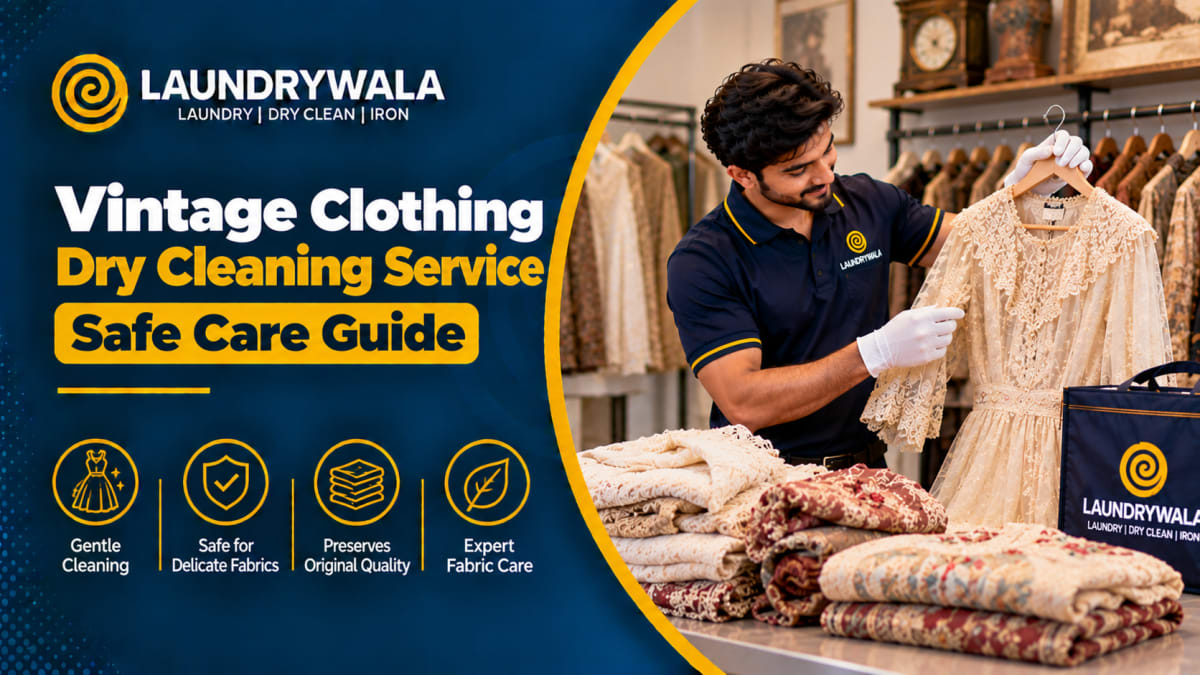
Vintage clothing carries more than fabric and stitching. An old silk saree may preserve family memories, a classic wool coat may represent a particular era, and an embroidered dress may contain materials and craftsmanship that are difficult to replace.
Age, however, changes how garments respond to cleaning. Fibres may weaken, dyes can become unstable, seams may loosen and decorative components may deteriorate even when the clothing still looks wearable. This is why a vintage clothing dry cleaning service should begin with careful inspection rather than automatically placing every old garment through a standard cleaning cycle.
Quick answer: Some vintage garments can be professionally dry cleaned, but dry cleaning is not automatically safe for every old item. The cleaner must assess the fabric, dye, seams, lining, buttons, embroidery, previous repairs and overall condition before selecting a process. Extremely fragile, historically important or museum-quality garments may require a qualified textile conservator instead of a regular commercial cleaning service.
This guide explains how vintage garment cleaning works, which risks should be checked and how old and delicate clothing can be prepared, cleaned and stored more safely.
What Is Considered Vintage Clothing?
The term “vintage clothing” is commonly used for garments associated with an earlier fashion period. However, age alone does not determine how an item should be cleaned.
A 30-year-old polyester dress stored carefully may remain stronger than a 10-year-old silk outfit exposed to moisture, sunlight or aggressive cleaning. The garment’s material, manufacturing method, previous use and storage history may matter more than its exact age.
Vintage clothing can include:
- Silk sarees and dupattas
- Wool coats and jackets
- Old suits and blazers
- Lace dresses
- Embroidered gowns
- Beaded evening wear
- Handwoven garments
- Velvet jackets and dresses
- Leather and suede clothing
- Military or ceremonial uniforms
- Traditional regional outfits
- Heirloom wedding garments
- Old theatre or dance costumes
- Garments purchased from vintage or thrift stores
Not every second-hand garment is vintage, and not every vintage garment is historically valuable. Laundrywala’s guide to professional cleaning for thrifted clothes explains the general cleaning considerations for pre-owned clothing. Vintage care requires an additional focus on ageing fibres, old construction and preservation risk.
Why Does Vintage Clothing Need Special Cleaning?
Modern garments are generally designed with current cleaning processes and care standards in mind. Vintage clothes may contain ageing materials that behave unpredictably when exposed to water, solvent, heat, moisture, pressure or mechanical movement.
The Metropolitan Museum of Art’s guidance on the care and handling of costumes explains that garments are often composite objects. The exterior fabric, lining, sewing thread, fasteners and decorations may all be made from different materials with different ageing properties.
A single vintage dress may contain:
- Silk or rayon outer fabric
- Cotton sewing thread
- Metal hooks
- Glass beads
- Plastic sequins
- An acetate lining
- Old elastic
- Adhesive-backed decorations
- Leather or fur trim
The outer fabric may appear stable while the lining or stitching has become extremely weak. Cleaning based only on the visible surface can therefore cause damage.
Common age-related problems include:
- Brittle or powdering fibres
- Weak seams
- Small holes
- Shattered silk
- Yellowed lining
- Tarnished metal
- Deteriorated elastic
- Cracked prints
- Loose beads or sequins
- Old adhesive becoming sticky
- Colour transfer
- Permanent fold lines
- Mould-like marks
- Insect damage
- Previous repairs using incompatible thread
A professional assessment helps identify these risks before cleaning begins.
Can All Vintage Clothes Be Dry Cleaned?
No. Dry cleaning can be suitable for certain old garments, but it should not be treated as a universal solution.
The Canadian Conservation Institute’s basic care guidance for textiles explains that commercial dry cleaning may be considered only for physically strong historic textiles and should involve customised treatment, testing and careful control.
Dry cleaning may be considered when:
- The garment is physically stable
- The care instructions permit professional dry cleaning
- The fabric is suitable for the chosen solvent
- The dye passes colourfastness testing
- The lining and thread remain secure
- Decorations can tolerate the process
- The garment has oil-based soil or stains
- The cleaner can reduce mechanical action and heat
- Existing damage has been documented
Dry cleaning may be unsuitable when:
- Silk is splitting or shattering
- The garment tears with light handling
- Dye transfers onto a dry cloth
- Beads or sequins are already falling off
- Plastic decorations have become sticky or brittle
- The lining is severely weakened
- Adhesive-backed details are lifting
- Painted areas are cracked
- Leather or fur trim requires separate treatment
- The material cannot be identified
- The garment is historically important or irreplaceable
In some cases, limited surface cleaning or conservation treatment may be safer than complete cleaning. The objective should be to protect the garment—not to make it look completely new at any cost.
Start With a Complete Condition Assessment
A reliable vintage clothing dry cleaning service should inspect the garment before providing a final cleaning recommendation.
The inspection should cover the complete item, including areas that are not easily visible.
Fabric and Fibre
The cleaner should identify the main fabric wherever possible. Silk, wool, cotton, linen, rayon, acetate, nylon and polyester respond differently to solvent, water, heat and movement.
Older labels may use outdated fibre names, while handmade garments may have no composition label at all.
Seams and Stitching
Shoulder seams, underarms, waistlines, cuffs and closures receive significant stress during wear. Old thread can weaken faster than the surrounding fabric.
Even a gentle cleaning cycle may open a seam that was already deteriorating.
Lining and Interlining
Vintage coats, dresses and suits often contain linings, padding and internal structure. The outer fabric may remain strong while an acetate or silk lining has become brittle.
Buttons, Zips and Fasteners
Old metal zips can corrode, while early plastic buttons may react badly to solvent or heat. Fabric-covered buttons may bleed, shrink or lose their shape.
Decorative Work
Beads, sequins, pearls, metallic thread, zari, embroidery, lace and glued stones require separate assessment. Some old sequins were made from materials that can soften or dissolve during cleaning.
Existing Damage
Holes, fading, abrasions, old stains, previous repairs and missing decorations should be photographed before processing. This creates a clear record of the garment’s condition.
Laundrywala’s guide on professional care for delicate clothing provides additional information about how fabric, construction and decoration influence process selection.
What if the Care Label Is Missing or Unreadable?
Many vintage garments do not have readable care labels. The original label may have been removed, faded or written under older care standards.
When a label is available, it should still be checked carefully. The US Federal Trade Commission’s garment-care labelling guidance explains that care instructions should account for the complete garment, including components that may be damaged by cleaning.
Laundrywala’s guide on understanding fabric-care labels can help customers recognise common washing, drying, ironing and professional-cleaning instructions.
Professional-care symbols may specify:
- Whether dry cleaning is permitted
- Which solvent category may be used
- Whether a mild process is required
- Whether professional wet cleaning is permitted
- Whether professional cleaning is prohibited
- Whether special limitations apply
GINETEX’s official textile-care symbol guide explains that letters and bars inside or below the professional-cleaning symbol provide instructions for professional cleaners.
When the label is missing, the cleaner may need to rely on fibre identification, construction assessment and tests performed in hidden areas. If the material cannot be identified confidently, cleaning may need to be declined or referred to a specialist.
How Are Different Vintage Fabrics Evaluated?
There is no single cleaning method for every vintage material.
| Vintage material | Main concerns | Possible professional approach |
|---|---|---|
| Silk | Weak fibres, water marks, colour loss and splitting | Detailed inspection and controlled specialist treatment |
| Wool | Felting, shrinkage, moth damage and distortion | Mild process with limited moisture, heat and movement |
| Cotton | Weak fold lines, fading and old stains | Cleaning only after strength and colour testing |
| Linen | Creasing, abrasion and weakened folds | Supported handling and controlled cleaning |
| Rayon or viscose | Weakness when wet, shrinkage and distortion | Professional assessment before water-based treatment |
| Acetate | Solvent sensitivity, heat damage and weak lining | Careful material identification and process selection |
| Velvet | Crushed pile, pressure marks and water spotting | Low-pressure specialist cleaning and finishing |
| Lace | Broken threads, snagging and loss of shape | Supported handling with minimal movement |
| Beaded garments | Weak thread and decoration loss | Individual inspection and possible protective netting |
| Leather or suede | Drying, cracking, colour change and texture damage | Specialist leather or suede cleaning |
| Fur-trimmed garments | Dryness, shedding and incompatible materials | Separate specialist assessment |
| Metallic or zari work | Tarnishing, thread breakage and colour change | Limited treatment after testing |
This table offers general guidance only. Two garments made from similar-looking fabric may still require different processes because their dyes, finishes, linings and condition are different.
How Are Old Stains Treated?
Vintage stains are often difficult to identify. They may have oxidised, changed colour or become chemically bonded with the fabric over many years.
Possible stains include:
- Perspiration
- Body oil
- Perfume
- Makeup
- Food and drink
- Ink
- Rust
- Storage dust
- Tobacco residue
- Water marks
- Mould-related discolouration
- Old cleaning products
Aggressive stain removal can create a lighter patch, weaken fibres or spread colour. Complete stain removal should never be promised before examination.
A responsible cleaner may:
- Record the stain’s location and appearance.
- Ask what is known about the garment’s history.
- Test the fabric and dye in a concealed area.
- Select the mildest suitable treatment.
- Work gradually rather than oversaturating the area.
- Stop when further treatment could damage the garment.
- Explain when a permanent shadow is likely to remain.
Avoid applying bleach, sanitiser, acetone, vinegar, baking soda, hair spray or ordinary stain remover to vintage garments. A home remedy may alter an old dye or finish permanently.
Old stains can sometimes be part of the garment’s history. For a collectible or historically significant piece, preservation may be more important than complete cosmetic improvement.
What Happens During Professional Vintage Garment Cleaning?
The exact process depends on the garment, but a careful service may include the following stages.
1. Customer Consultation
The customer shares the garment’s age, known fabric, previous cleaning history, stains, repairs and sentimental or financial importance.
2. Documentation
The garment is photographed, tagged and checked for missing buttons, open seams, holes, fading and loose decorations.
3. Material Assessment
The cleaner examines the outer fabric, lining, stitching, trims, fasteners and decorative components.
4. Colour and Compatibility Testing
Small concealed sections may be tested for colour transfer, solvent sensitivity and moisture reaction.
5. Risk Discussion
The customer should be informed about existing damage, stains that may remain and areas that could deteriorate during treatment.
6. Process Selection
Depending on the assessment, the cleaner may recommend controlled dry cleaning, professional wet cleaning, limited surface care, specialised leather treatment or referral to a conservator.
7. Reduced Mechanical Action
Where appropriate, cleaning time, movement, temperature, moisture and extraction may be adjusted to reduce stress.
8. Controlled Drying and Reshaping
The garment may require supported drying, reshaping or low-temperature finishing rather than an ordinary high-heat process.
9. Final Inspection
The cleaner checks the garment for remaining stains, loose threads, shape, finish and decoration security before packaging.
Laundrywala’s professional dry-cleaning service handles delicate and premium garments after inspection. Acceptance and the recommended process depend on the item’s construction and physical condition.
Can Vintage Clothes Be Washed at Home?
Some stable, colourfast vintage cotton or synthetic garments may be washable, but home washing should not be assumed to be safe.
Do not machine-wash an old garment simply because it has no dry-cleaning label. Ageing thread, weak elastic, hidden interfacing and unstable dye may react badly to water and agitation.
Avoid home washing when:
- The material is unknown
- The garment is made from silk, wool or rayon
- The item is structured or lined
- Colours transfer when lightly tested
- Lace, beads or sequins are present
- The garment has painted or printed details
- Seams appear weak
- The fabric feels brittle
- Old stains require treatment
- Leather, suede or fur is attached
- The item has high financial or sentimental value
Do not soak a vintage garment for several hours. Prolonged water exposure can increase dye bleeding, fibre swelling and distortion.
If the item is important, arrange professional assessment before washing it. Laundrywala’s article on cleaning expensive designer clothes safely covers similar precautions for garments containing multiple materials and delicate construction.
What About Musty Smells, Mould and Insects?
A musty smell may indicate poor storage, retained moisture or previous mould activity. Fragrance spray does not remove the underlying problem.
Keep a suspicious garment separate from the rest of the wardrobe. Inspect it in good light for:
- White, grey, green or black spots
- Powdery deposits
- Damp patches
- Fabric discolouration
- Small holes
- Insect cases or webbing
- Larvae or shed skins
- Weak or powdering fibres
Do not shake a visibly mould-affected garment inside the home. Avoid brushing it near other clothing because particles may spread.
Moth or beetle activity also requires isolation. Washing or dry cleaning the garment without inspecting the wardrobe may allow the problem to return.
The US National Park Service lists dedicated guidance on mould, museum textile cleaning and storage in its Textile Conserve O Grams.
Serious mould contamination, active insect infestation or extensive fibre damage may require a conservator or another qualified specialist. A normal dry cleaner may not be equipped to decontaminate a historically valuable textile safely.
When Should You Contact a Textile Conservator?
Professional dry cleaners care for wearable garments, while textile conservators focus on stabilising and preserving historically important or extremely fragile objects.
Choose a textile conservator when:
- The garment has historical or museum value
- The item is extremely rare
- Fabric is splitting or turning to powder
- Weighted silk appears to be shattering
- Decorations are actively falling off
- The garment contains unusual early plastics
- The material cannot be safely identified
- Mould or insect damage is extensive
- Previous restoration has altered the garment
- The clothing will be displayed or archived
- Cleaning could reduce the garment’s authenticity or value
The Smithsonian Museum Conservation Institute recommends treating antique textiles as fragile and consulting a professional conservator instead of attempting improvised treatment. Its antique textile handling guidance also stresses careful planning and minimal handling.
A trustworthy cleaning service should be willing to decline treatment when the risks exceed its capabilities.
How Should You Prepare Vintage Clothes for Pickup?
Prepare the garment carefully before handing it over.
- Do not apply stain remover or perfume.
- Do not iron the garment.
- Do not cut loose threads.
- Do not attempt to glue detached decorations.
- Photograph the front, back and damaged areas.
- Note loose buttons, beads and seams.
- Share the garment’s estimated age.
- Mention previous cleaning or repair attempts.
- Provide the care label or original instructions.
- Keep detachable accessories in a separate labelled pouch.
- Do not fold fragile beaded garments tightly.
- Use a breathable cover for short transportation.
- Tell the cleaner if the garment is valuable or irreplaceable.
Ask the cleaner to confirm:
- Whether the item can be accepted
- Which cleaning method is proposed
- What risks have been identified
- Whether stain removal is possible
- Whether repairs are required before cleaning
- How the item will be finished and packaged
- Whether any result can be guaranteed
- What the estimated turnaround time and price will be
Laundrywala’s complete garment and fabric-care services can be reviewed before requesting an assessment.
How Should Vintage Clothing Be Stored After Cleaning?
Correct storage is as important as cleaning.
The Smithsonian Institution’s antique textile storage guidance recommends keeping old textiles in a clean, cool, dry and dark area with minimal temperature and humidity fluctuation.
Before storage, ensure the garment is completely dry and free from active insects.
Store Fragile Garments Flat
Heavy, beaded, bias-cut or structurally weak garments may stretch when hung. Store them flat in an archival-quality box when possible.
Use Padded Hangers Carefully
A physically strong jacket, coat or dress may be placed on a wide padded hanger. Do not use thin wire hangers.
Support Folds
If folding is necessary, place acid-free tissue or clean, prewashed white cotton material inside folds. Avoid tight creases because old fibres may split along the fold line.
Avoid Ordinary Plastic Covers
Sealed plastic can trap moisture. Use a breathable cotton garment bag or another storage material suitable for textiles.
Protect From Light and Heat
Sunlight and strong indoor light can cause fading and fibre deterioration. Keep vintage garments away from windows, heaters and damp walls.
Avoid Direct Contact With Wood and Ordinary Cardboard
Unsealed wood, newspaper and acidic cardboard may transfer harmful compounds or colour to textiles.
Inspect Regularly
Check stored garments periodically for odour, dampness, new stains, loose decorations and insect activity. Refold flat-stored garments differently so the same fibres are not placed under continuous stress.
Why Choose Laundrywala for Vintage Garment Assessment?
Laundrywala provides professional cleaning services for everyday, delicate, designer and selected vintage garments in serviceable locations.
Before treatment, the team can inspect the garment’s fabric, label, stains, lining, seams and decoration. Depending on its condition, the item may be considered for controlled dry cleaning or another suitable professional process.
Customers should understand that age-related deterioration cannot be reversed through cleaning. Existing fading, fibre weakness, permanent stains, missing decoration and previous damage may remain visible.
For the safest assessment, provide:
- Clear photographs
- Garment age and history
- Fabric information
- Care-label images
- Details of stains and odours
- Information about previous cleaning
- Photographs of loose or damaged areas
- Your city and PIN code
Use the Laundrywala store locator to find a nearby outlet and confirm whether vintage garment assessment is available.
For booking assistance, contact Laundrywala or call the toll-free number 1800 889 3225.
FAQs about best Dry Cleaning Tips
Get answers about premium dry cleaning processes, delicate garment handling, and how we care for your fabrics.
Still have questions?
Can't find what you're looking for? Our fabric care specialists and franchise advisors are here to help.