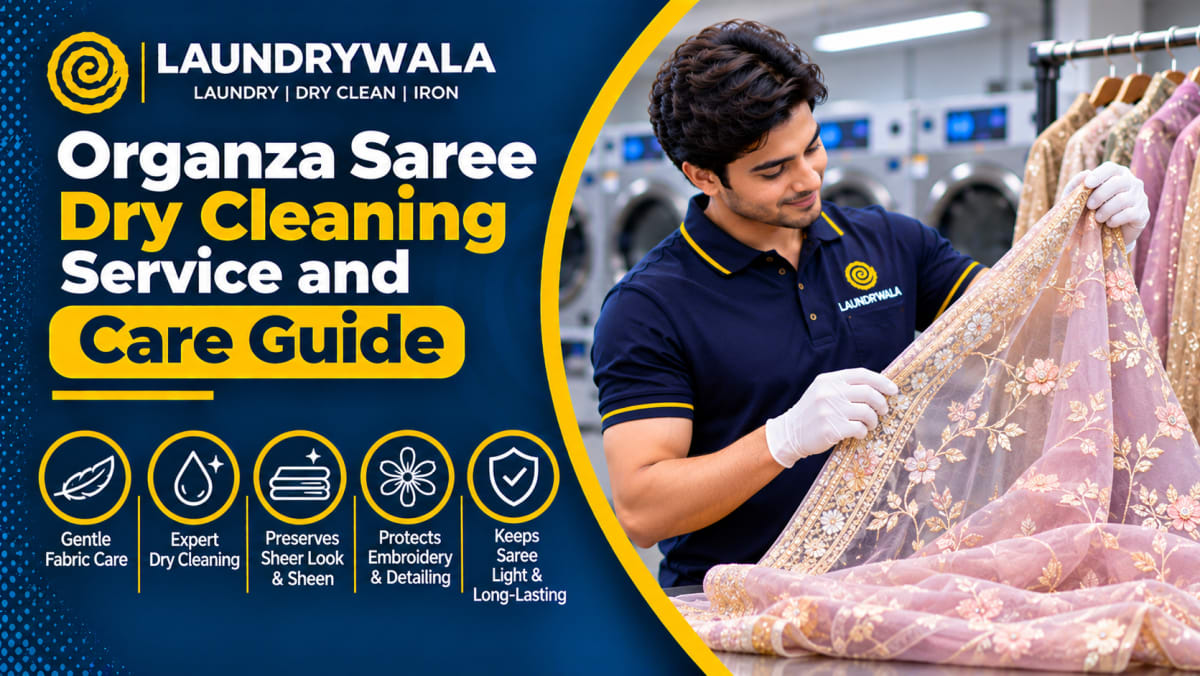
Organza sarees are known for their light transparency, crisp structure and elegant appearance. They are frequently decorated with zari borders, embroidery, sequins, beads, prints, applique work or hand-painted details. These features make an organza saree beautiful, but they also make cleaning more complicated than ordinary garment washing.
Water, detergent, friction and heat can affect the fabric’s stiffness, transparency, colour and surface. Embroidery may shrink differently from the base material, zari may discolour and glued decorations may loosen.
A professional organza saree dry cleaning service should inspect the complete saree before selecting a cleaning process. The cleaner must consider the base fibre, colour, embroidery, borders, stains, lining and existing damage rather than treating every organza saree in the same way.
Quick answer: Check the saree’s care label and identify whether the organza is made from silk, polyester, nylon or a blended fibre. Avoid soaking, machine washing, scrubbing and applying household stain removers. Sarees made from silk organza or containing zari, embroidery, beads, sequins or delicate borders should be professionally assessed before cleaning.
What Is Organza Fabric?
Organza is a thin, lightweight and sheer woven fabric with a crisp texture. Its characteristic structure comes from fine, tightly twisted yarns woven into a plain weave.
Traditional organza was generally made from silk. Modern organza may also be manufactured using:
- Polyester
- Nylon
- Rayon blends
- Silk-synthetic blends
- Other manufactured fibres
The fibre content matters because silk organza and synthetic organza do not respond identically to water, detergent, solvents, heat or ironing.
Silk Organza
Silk organza has a luxurious appearance and naturally crisp structure. It can be sensitive to:
- Water marks
- Colour bleeding
- Excess heat
- Strong chemicals
- Hard rubbing
- Prolonged sunlight
- Improper storage
- Moisture
- Heavy pressure on folds
The Silk Mark Organisation of India’s silk-care guidance recommends careful handling, shade drying, low-to-medium ironing temperatures and avoiding direct water spray while ironing silk.
Polyester Organza
Polyester organza may be more resistant to some types of handling, but it can still be damaged by high heat, hard brushing and unsuitable stain removers.
Synthetic fibres may melt, shine or develop permanent creases when exposed to excessive ironing temperatures.
Embroidered Organza
An embroidered organza saree combines at least two different components: the sheer base fabric and the decorative threadwork.
The embroidery may use:
- Silk thread
- Cotton thread
- Metallic thread
- Zari
- Resham
- Beads
- Sequins
- Pearls
- Mirror work
- Stones
- Glued decorations
Each component may react differently during cleaning.
Why Do Organza Sarees Need Special Cleaning?
Organza is lightweight but not necessarily easy to clean. Its crisp texture, transparency and decorative work require controlled handling.
Incorrect cleaning can cause:
- Loss of crispness
- Fabric distortion
- Water rings
- Colour bleeding
- Permanent wrinkles
- Uneven texture
- Torn yarns
- Pulled threads
- Snagging
- Zari discolouration
- Loose beads or sequins
- Adhesive failure
- Shrinkage
- Stiff detergent residue
- Shiny iron marks
- Flattened embroidery
An ordinary washing-machine cycle creates movement, pressure and friction. These forces can damage the delicate weave or pull decorative threads.
A saree may also contain a different fabric in its border or pallu. Even when the main body is synthetic organza, the border may contain silk, velvet, metallic zari or glued embellishments that require another treatment.
Is Dry Cleaning Safe for Every Organza Saree?
Dry cleaning can be appropriate for many organza sarees, but it should not be selected automatically.
A professional cleaner should first inspect:
- Fibre content
- Care label
- Fabric strength
- Dye stability
- Zari condition
- Embroidery
- Beads and sequins
- Glued decorations
- Prints
- Painted details
- Existing tears
- Previous cleaning damage
- Type and age of stains
The FTC’s garment-care labelling guidance notes that the entire garment and all its components must be considered when determining an appropriate cleaning method.
Some decorations may not tolerate standard dry-cleaning solvents. Other sarees may contain colour that releases during water-based treatment.
Professional cleaning does not always mean that every organza saree receives the same solvent or process. The cleaner may recommend controlled dry cleaning, specialist wet cleaning, surface treatment or another material-appropriate method.
Laundrywala’s guide to understanding garment-care labels can help you identify washing, drying, ironing and dry-cleaning symbols.
When Should an Organza Saree Be Professionally Cleaned?
Professional cleaning should be considered when:
- The care label says “Dry Clean Only.”
- The saree is made from silk organza.
- Zari work is present.
- The saree has embroidery or beads.
- Oil or makeup has stained the fabric.
- Food or drink was spilled.
- The saree has water marks.
- Colour transfers during testing.
- The fabric feels weak or brittle.
- The saree is valuable or sentimental.
- It is a wedding or festive saree.
- The saree has not been cleaned for a long time.
- Home treatment has already created a mark.
- The fibre cannot be identified confidently.
- The pallu or border uses another delicate material.
Laundrywala’s professional dry-cleaning service can inspect the fabric, decorations and stains before recommending a suitable process.
What Should You Check Before Giving the Saree for Cleaning?
A careful pre-cleaning inspection protects both the customer and the cleaner.
Read the Care Label
Check whether the manufacturer has provided instructions for washing, dry cleaning, ironing or bleaching.
India’s BIS textile-care labelling standard describes symbols used to communicate suitable textile-care processes.
Identify Existing Damage
Look for:
- Small tears
- Open seams
- Pulled threads
- Loose embroidery
- Missing stones
- Cracked beads
- Weak zari
- Colour loss
- Previous water rings
- Permanent creases
- Iron shine
- Adhesive marks
Photograph the saree before submitting it for cleaning.
Explain the Stain
Tell the cleaner:
- What caused the stain
- When it occurred
- Where it is located
- Whether it was exposed to heat
- Which home products were applied
- Whether the saree was previously cleaned
- Whether colour has transferred before
Stain information helps the cleaning team select a safer treatment.
Provide the Blouse and Petticoat Separately
Do not assume that a blouse and petticoat can be cleaned through the same process as the saree.
A blouse may contain:
- Padding
- Hooks
- Cups
- Lining
- Heavy embroidery
- Sweat stains
- Deodorant residue
- Different fabric
Each item should be inspected and tagged separately.
How Does Professional Organza Saree Dry Cleaning Work?
The exact process depends on the saree, but a professional workflow may include the following stages.
1. Garment Inspection
The cleaner examines the base fabric, border, pallu, embroidery, stitching and stains.
The saree may be held against light to identify:
- Thin areas
- Tears
- Weak yarns
- Water marks
- Colour differences
- Hidden stains
- Damaged decorations
Organza is transparent, so even small marks may remain visible from both sides.
2. Care-Label and Fibre Assessment
The team checks whether the saree is silk organza, synthetic organza or a blend.
When no label is available, the cleaner may rely on professional assessment and customer information. A fibre should not be guessed solely from appearance.
3. Colourfastness Testing
A hidden area may be tested to determine whether colour transfers or changes during the proposed treatment.
Testing is particularly important for:
- Dark colours
- Contrasting borders
- Hand-painted sarees
- Multicoloured prints
- Red and maroon dyes
- Black organza
- Silk zari sarees
- Vintage garments
A successful test reduces risk but cannot guarantee that every part of a complex saree will respond identically.
4. Decoration Protection
Loose beads, sequins, stones, mirrors and embroidery are documented.
Depending on their construction, decorations may require:
- Protective covering
- Reduced agitation
- Shorter processing
- Individual spot treatment
- Hand finishing
- Avoidance of specific solvents
- Separate customer approval
Laundrywala’s guide on whether mirror-work clothes can be dry cleaned explains why the attachment method and base fabric must be evaluated together.
5. Stain Treatment
Stains are treated according to their type, age and location.
The cleaner should avoid excessive rubbing because organza threads can snag or separate.
Not every stain can be completely removed. Permanent dye changes, heat-set marks, old oxidation and previous chemical damage may remain visible.
6. Selected Cleaning Process
The cleaning method is chosen after testing and inspection.
The saree should not automatically be processed with heavy everyday garments. Controlled handling can reduce:
- Friction
- Snagging
- Decoration loss
- Dye transfer
- Creasing
- Fabric distortion
7. Controlled Drying
Organza should be dried in a way that protects its structure and avoids unnecessary pressure.
Silk-care recommendations from Karnataka Silk Industries Corporation emphasise shade drying and protecting silk from excessive moisture, insects, dust and light.
8. Finishing and Ironing
Organza requires careful finishing because excessive heat may flatten its texture, create shine or damage synthetic fibres.
The finishing team should consider:
- Fibre content
- Embroidery
- Zari
- Seams
- Existing creases
- Heat sensitivity
9. Final Inspection
The saree is checked for:
- Remaining stains
- Colour changes
- New snags
- Loose embroidery
- Broken decorations
- Pressing marks
- Odour
- Uneven finishing
- Packaging quality
10. Protective Packaging
After cleaning and finishing, the saree should be packed only when completely dry and cool.
Customers should remove temporary plastic packaging before long-term storage and transfer the saree into suitable breathable protection.
How Are Common Organza Saree Stains Treated?
Oil and Grease
Food oil, hair oil and body lotion can create translucent marks that become especially visible on sheer fabric.
Blot fresh oil gently with a clean absorbent cloth. Do not rub or add water blindly.
Professional treatment is generally safer for oil stains on silk organza.
Makeup
Foundation, lipstick, kajal and concealer may contain oils, waxes and pigments.
Avoid makeup remover, micellar water, sanitiser and alcohol. Products designed for skin may damage the saree’s colour or leave water rings.
Laundrywala’s guide on removing makeup stains from clothes explains why stain treatment should match the fabric and cosmetic type.
Food and Drink
Remove solid food carefully with a blunt spoon. Blot liquids without spreading them.
Milk, tea, coffee, juice and sugary drinks may leave both colour and residue. Tell the cleaner exactly what was spilled.
Sweat
Sweat may affect blouse underarms, saree borders and sections touching the neck or waist.
Do not store a worn organza saree without cleaning. Invisible sweat and body oil can become more noticeable over time.
Perfume
Perfume can create marks on sheer silk, particularly when sprayed directly.
Apply fragrance to the body and allow it to dry before wearing the saree. Avoid spraying perfume onto organza or zari.
Water Marks
Water itself may leave rings on certain silk or finished fabrics.
Do not wet the entire saree in an attempt to blend a single water ring. Seek professional assessment.
Ink
Avoid acetone, sanitiser and nail-polish remover. These solvents may spread the ink or remove the saree’s dye and finish.
Can an Organza Saree Be Washed at Home?
Home washing should only be considered when the manufacturer’s care label explicitly permits it.
Do not assume that synthetic organza is automatically machine washable. The border, embroidery, zari, print, lining and decorative attachments may still require specialised cleaning.
If hand washing is permitted:
- Use the recommended water temperature.
- Use an approved gentle detergent.
- Test the colour first.
- Avoid soaking for longer than instructed.
- Do not scrub.
- Do not twist or wring.
- Support the entire saree when lifting it.
- Rinse gently.
- Dry according to the label.
- Keep it away from harsh sunlight.
- Do not apply excessive heat.
Machine washing may create permanent creases, snags and decoration damage. It should only be used when the complete saree—not merely the base fabric—is labelled machine washable.
For expensive sarees, follow Laundrywala’s guide on washing and storing expensive sarees safely.
Organza Saree Cleaning Mistakes to Avoid
Avoid these common mistakes:
- Machine washing without checking the label
- Soaking the saree overnight
- Scrubbing stains with a toothbrush
- Applying detergent directly to silk
- Using bleach
- Using sanitiser on ink
- Applying lemon juice
- Rubbing with baking soda
- Using hot water
- Twisting or wringing
- Drying in harsh sunlight
- Hanging a very wet saree from one point
- Ironing at high temperature
- Spraying water during ironing
- Ironing directly over zari
- Storing the saree while damp
- Keeping it in ordinary plastic for months
- Folding heavy embellishments under pressure
- Applying perfume directly to the fabric
A home remedy may remove one mark but create a larger water ring, colour change or damaged surface.
How Should an Organza Saree Be Ironed?
Ironing must be selected according to the fibre and decoration.
Before ironing:
- Check the care label.
- Identify whether the organza is silk or synthetic.
- Turn the saree to the reverse side when appropriate.
- Use a clean pressing cloth.
- Select a low, label-approved temperature.
- Test a hidden section.
- Avoid pressing directly over zari, stones and embroidery.
- Keep the iron moving.
- Avoid heavy pressure.
- Allow the saree to cool before folding.
Do not spray water directly onto silk organza. Water droplets may create visible spots.
Steam may not be suitable for every silk, print, metallic thread or glued decoration. Professional finishing is safer when the saree is valuable or complex.
How to Store an Organza Saree After Dry Cleaning
Correct storage is necessary to protect the saree after cleaning.
Remove Temporary Plastic Packaging
Plastic packaging may be useful during transportation but may not be suitable for long-term storage.
Once the saree reaches home, make sure it is completely dry and cool before transferring it to a breathable cover.
Use a Cotton or Muslin Cover
A clean cotton or muslin cover can protect the saree from dust while allowing better airflow than ordinary sealed plastic.
Make sure the cover is clean, dry and colourfast.
Fold Carefully
Avoid sharp, heavily compressed folds.
Use suitable acid-free tissue or clean, colourless material to support delicate folds when necessary. Do not use newspaper because the ink may transfer.
Protect Zari
Keep metallic zari away from moisture, perfume and unsuitable storage materials.
Silk-care guidance recommends wrapping zari sarees carefully and protecting them from excessive moisture and light.
Avoid Heavy Pressure
Do not place blankets, heavy jackets or other bulky garments on top of the saree.
Pressure may flatten embroidery, create hard folds or damage beads.
Change the Folds Periodically
For long-term storage, refold the saree periodically so pressure does not remain on the same lines.
Choose the Right Environment
Store the saree in a clean, dry and dark area away from:
- Direct sunlight
- Damp walls
- Bathroom moisture
- Water leakage
- Excess heat
- Dust
- Insects
- Strong perfume
- Open pest-control chemicals
The Canadian Conservation Institute’s textile-care guidance explains that light, moisture, unsuitable storage materials and poor handling can cause irreversible textile damage.
How Often Should an Organza Saree Be Dry Cleaned?
An organza saree does not need dry cleaning after every brief wear when it remains completely clean.
Cleaning frequency depends on:
- Duration of wear
- Sweat
- Weather
- Food and drink exposure
- Makeup
- Visible stains
- Odour
- Storage duration
- Fabric type
- Embroidery
- Care-label instructions
Arrange professional cleaning when the saree has visible stains, sweat, food residue or odour, or before storing it for an extended period.
Do not repeatedly dry clean a delicate saree without need. Professional inspection can determine whether full cleaning, spot treatment, airing or careful finishing is more appropriate.
Laundrywala’s guide on how often clothes should be dry cleaned explains why cleaning frequency should depend on use, fabric and garment condition.
What Determines the Cost of Organza Saree Dry Cleaning?
Pricing can vary according to:
- Silk or synthetic organza
- Saree size
- Embroidery level
- Zari work
- Beads and sequins
- Stone or mirror work
- Type of stains
- Age of stains
- Fabric condition
- Colourfastness risk
- Previous home treatment
- Required finishing
- Pickup and delivery location
A plain synthetic-organza saree may require less specialised handling than a silk-organza wedding saree with heavy embroidery.
Request an inspection and current price quotation rather than assuming that every organza saree has one fixed cleaning charge.
When Can Complete Restoration Not Be Guaranteed?
Professional cleaning can improve many stains and odours, but it cannot reverse every form of damage.
Complete restoration may not be possible when:
- Dye has permanently faded.
- Bleach has removed colour.
- Heat has melted synthetic organza.
- The fabric is torn.
- Zari has corroded.
- Glue has yellowed.
- Stones have already detached.
- Silk has weakened with age.
- An old stain has oxidised.
- Hard ironing has created shine.
- The fabric has permanent water rings.
- Home chemicals have changed the surface.
A responsible cleaner should explain visible risks before processing the saree.
Why Choose Laundrywala for Organza Saree Care?
Laundrywala provides professional garment-care and dry-cleaning services across serviceable locations.
Depending on the saree, the process may include:
- Care-label assessment
- Fabric inspection
- Colourfastness testing
- Stain identification
- Decoration documentation
- Material-appropriate cleaning
- Controlled drying
- Careful finishing
- Quality checking
- Protective packaging
- Doorstep pickup and delivery
Laundrywala also provides specialist care for festive sarees, gowns and suits and explains the additional considerations involved in cleaning expensive designer clothes.
Use the Laundrywala store locator to confirm organza saree cleaning availability near you.
To request an inspection, contact Laundrywala and share photographs of the full saree, care label, embroidery and stains.
FAQs about best Dry Cleaning Tips
Get answers about premium dry cleaning processes, delicate garment handling, and how we care for your fabrics.
Still have questions?
Can't find what you're looking for? Our fabric care specialists and franchise advisors are here to help.