
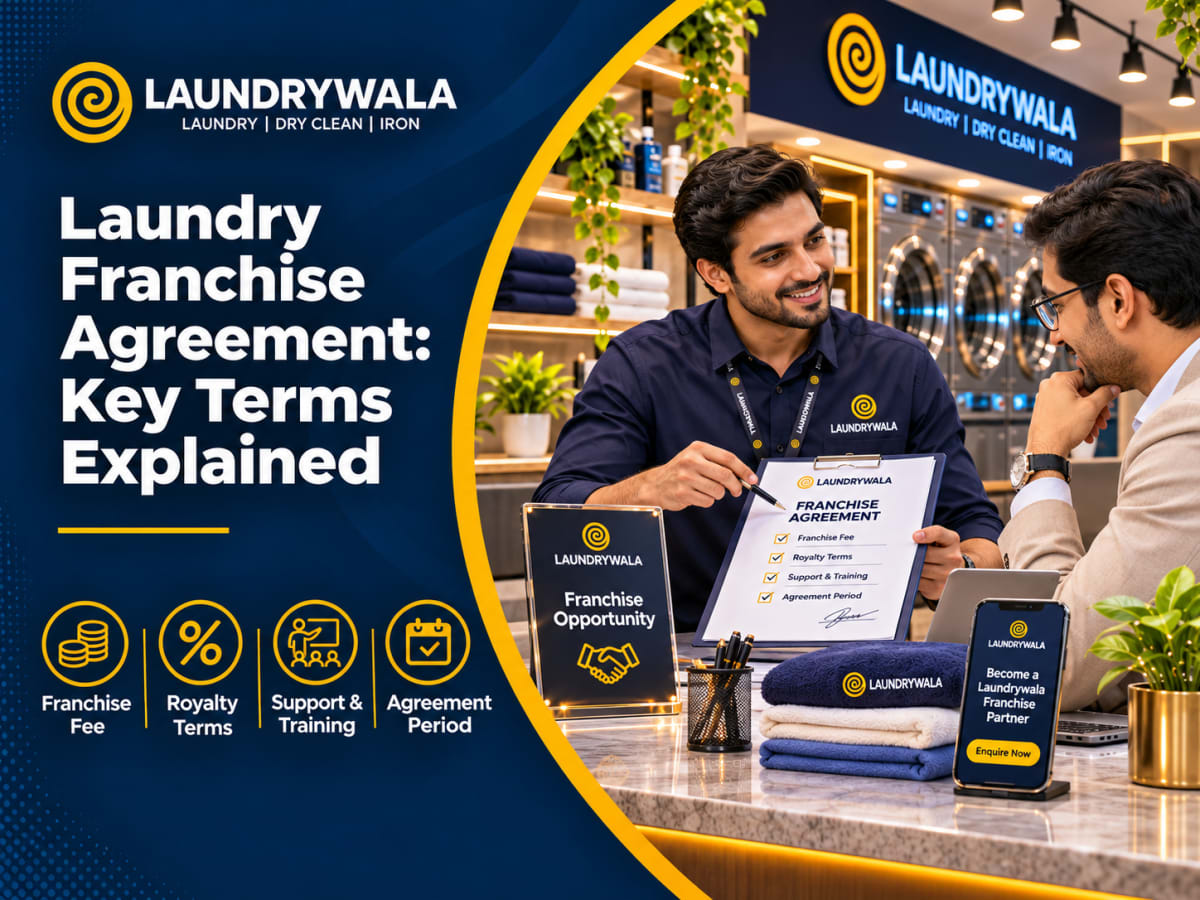
Starting a laundry franchise can be an attractive opportunity for entrepreneurs interested in India's organised garment-care industry. An established brand may provide store setup guidance, machinery recommendations, training, technology and operating procedures. However, before investing in equipment or opening a commercial outlet, entrepreneurs must understand one of the most important documents involved in the business: the franchise agreement.
A Laundry Franchise Agreement is a legally binding contract that defines the commercial relationship between the franchise brand and the franchise owner. It explains how the business may operate, which services the franchisor provides, what the investor must pay and how both parties should fulfil their responsibilities.
Many first-time entrepreneurs focus primarily on investment, monthly revenue and return on investment. While these financial considerations are important, the contractual conditions can influence the business for years after opening.
For example, an agreement may define whether a franchise owner receives an exclusive territory, how royalties are calculated, who owns the machinery and what happens if the outlet stops operating. It may also explain employee training, software access, brand usage, customer complaints and contract termination.
Misunderstanding these conditions can lead to unexpected expenses, operational disagreements and financial difficulties.
This is why reading the complete agreement before signing is essential.
In this guide, Laundrywala explains common laundry franchise agreement terms in India, including franchise fees, royalty charges, territory rights, agreement duration, renewal conditions, operational support, machinery ownership and dispute resolution.
The objective is to help prospective investors understand what these terms generally mean and which questions they should ask before making a financial commitment.
What Is a Laundry Franchise Agreement?
A laundry franchise agreement is a written contract between a franchisor and a franchisee.
The franchisor is the business that owns or controls the brand and grants permission to operate under its approved business system.
The franchisee is the entrepreneur or business entity that obtains those rights and operates the outlet according to the agreed conditions.
A franchise agreement generally explains the scope of brand usage, commercial payments, operating standards, training arrangements and responsibilities of both parties.
It may also contain provisions relating to confidentiality, intellectual property, customer information, renewal and termination.
Why Is a Written Agreement Important?
A written agreement provides a reference point when questions or disagreements arise.
For example, if a franchisee expects marketing assistance but the agreement only promises initial branding support, the two parties may have different expectations.
Similarly, an investor might assume that machinery ownership transfers automatically after making an initial payment, even though the actual supply arrangement says otherwise.
Clearly documented conditions reduce such misunderstandings.
Is a Franchise Agreement Legally Binding in India?
A properly formed franchise agreement can be legally enforceable under applicable Indian law.
India does not have one comprehensive national statute regulating every aspect of franchising. General contract principles and other applicable laws govern different elements of the relationship.
The Indian Contract Act, 1872 provides the foundational legal framework for contractual obligations.
However, the enforceability of a specific clause depends on its wording, circumstances and relevant law.
Investors should obtain independent legal advice before signing.
Why You Must Understand Laundry Franchise Agreement Terms Before Investing
The franchise agreement can affect daily operations, financial commitments and long-term business ownership.
It should therefore be evaluated with the same care as the investment proposal.
Financial Planning
The agreement may define initial fees, royalties, software charges, marketing contributions and other payments.
Understanding these obligations helps investors develop a realistic financial plan.
Operational Responsibilities
Franchise owners may be responsible for employees, rent, electricity, garment handling, customer service and local marketing.
The agreement should identify responsibilities clearly.
Brand Protection
Franchisees normally receive defined rights to use the franchisor's brand rather than ownership of the brand itself.
The agreement may specify how logos, signage, advertisements and uniforms must be used.
Long-Term Business Security
Contract duration, renewal and termination conditions determine the circumstances under which the franchise relationship continues or ends.
A business with substantial equipment investment should carefully examine these provisions.
1. Franchise Fee: What Does It Mean?
The franchise fee is generally an upfront payment made by the franchisee to obtain specified rights and initial services.
It may cover permission to use the brand, access to an approved business model and certain setup or training arrangements.
However, the exact inclusions vary between franchise agreements.
Is the Franchise Fee the Total Investment?
Not necessarily.
The total project investment may include machinery, interiors, store deposits, electrical modifications, equipment installation and working capital.
A franchise fee should not automatically be treated as the complete cost of opening a store.
Is the Franchise Fee Refundable?
Refundability depends on the written agreement and applicable law.
Some agreements contain refund restrictions, while others specify circumstances under which certain payments may be returned.
Investors should clarify the refund terms before transferring money.
What Should Investors Check?
Ask whether the franchise fee is separate from the machinery package, which services it covers and whether any additional charges apply.
Also confirm the payment schedule and the conditions attached to each payment.
For a broader understanding of initial funding, read Laundrywala's laundry franchise investment guide.
2. Royalty Charges in a Laundry Franchise Agreement
Royalty is a payment that a franchisee may be required to make to the franchisor during the operating relationship.
Royalties can be calculated in different ways.
Some franchises charge a percentage of revenue, while others may apply a fixed periodic amount or another agreed calculation.
Gross Revenue vs Net Profit
This distinction is extremely important.
A royalty based on gross revenue may remain payable even when the franchise owner has not earned a net profit.
A royalty based on net profit operates differently and requires a precise definition of allowable expenses.
Never assume that a percentage quoted in a proposal refers to profit.
Understanding a Royalty Calculation
Consider a hypothetical agreement that charges a 5% royalty on defined monthly gross revenue.
If eligible monthly revenue is ₹3,00,000, the royalty would be ₹15,000.
This example is only for explaining the calculation. It is not a statement of Laundrywala's current royalty rate.
The agreement should clearly define the revenue base, applicable taxes, discounts, refunds and payment dates.
What Does No Royalty Until ROI Mean?
Some franchise promotions refer to a royalty-free period until investment recovery.
Investors must understand how ROI or investment recovery is defined.
Questions include whether the calculation uses cash flow, accounting profit or another measure; which investment expenses qualify; and who verifies when the threshold has been reached.
Laundrywala has publicly promoted royalty-related benefits linked to ROI. However, the applicable rate, calculation, eligibility and duration must be confirmed against the current signed agreement.
3. Territory Rights and Area Exclusivity
Territory rights determine where a franchisee is authorised to operate.
These clauses can be particularly important for laundry businesses that serve customers through doorstep pickup and delivery.
What Is an Exclusive Territory?
An exclusive territory generally means that the franchisor agrees not to grant specified competing franchise rights within a defined area, subject to the agreement's exact conditions.
The territory might be defined by municipal boundaries, postal codes, mapped locations or other geographical descriptions.
What Is a Non-Exclusive Territory?
Under a non-exclusive arrangement, the franchisor may retain the right to appoint additional outlets or conduct certain business activities within the same geographical market.
The exact rights must be specified.
Why Territory Matters in Laundry Businesses
Laundry stores often collect orders from several nearby neighbourhoods.
Two outlets serving overlapping areas may create confusion regarding customer ownership, advertising and delivery responsibilities.
Investors should examine whether the agreement addresses website enquiries, app bookings, institutional customers and overlapping delivery zones.
Questions to Ask
Does the franchise receive territorial exclusivity? Can another outlet open nearby? Who receives online leads originating inside the territory? Can the franchisee serve customers outside its approved area?
These answers should be documented rather than assumed.
4. Franchise Agreement Duration and Validity
Agreement duration refers to the period for which the contractual relationship is intended to remain in force.
Some agreements specify a fixed number of years, while others use different continuing or renewal arrangements.
Why Duration Matters
A laundry business may require substantial investment in machinery, interiors and property improvements.
The investor should understand how long the contractual brand-use rights continue and what conditions apply during that period.
Fixed-Term Agreements
A fixed-term franchise contract has a defined commencement date and expiry date.
Continuation after expiry may depend on renewal conditions.
Long-Term or Lifetime Arrangements
Promotional descriptions such as "lifetime validity" require careful interpretation.
The written agreement should specify whether the right continues indefinitely, remains subject to compliance, or can end upon certain contractual events.
A lifetime description does not necessarily mean the agreement can never be terminated.
When Does the Agreement Begin?
The commencement date may differ from the store-opening date.
Some agreements begin upon signing, while others define separate dates for setup and commercial operations.
This distinction can affect the timing of fees, milestones and contractual obligations.
5. Renewal Terms and Additional Fees
Renewal determines whether the franchise relationship can continue after a specified term.
Not every franchise agreement provides automatic renewal.
Some require notice, updated documentation or satisfaction of operational conditions.
What Does a Renewal Clause Usually Cover?
A renewal clause may specify when the franchisee must request an extension, whether a renewal fee applies and which performance requirements must be satisfied.
It may also determine whether the renewed relationship follows the original terms or a revised agreement.
Why Renewal Costs Matter
A franchise owner might plan to operate the business for many years.
Unexpected renewal expenses can affect long-term financial planning.
Ask whether the agreement provides a renewal right, whether any additional fees apply and whether renewal can be refused under specified circumstances.
If the brand advertises no renewal fee, verify that the written contract reflects the same arrangement.
6. Machinery Ownership and Equipment Responsibilities
Commercial laundry businesses depend on washers, dryers, boilers, ironing equipment and other machinery.
Equipment ownership should therefore be clearly documented.
Who Owns the Machinery?
The answer depends on how equipment is purchased, leased or supplied.
A franchisee may own machines purchased under the agreement, but ownership should not be inferred solely from the payment amount.
Review invoices, ownership provisions and any finance or lease arrangements.
Who Pays for Repairs?
Machinery requires maintenance and may experience breakdowns.
The agreement should distinguish between manufacturer warranty, ordinary wear, misuse, repairs and replacement.
Can Equipment Be Replaced?
Some franchise systems require the use of approved machinery.
Before replacing equipment, the franchisee may need to obtain permission or meet technical specifications.
What Happens to Machinery After Termination?
An agreement may contain conditions governing the continued use, return, transfer or purchase of certain equipment.
Investors should understand whether they can retain and independently operate equipment after the franchise relationship ends.
7. Training and Operational Support Clauses
Training is often presented as an important advantage of franchising.
However, a promise of support becomes meaningful only when its scope is defined.
Initial Staff Training
A laundry franchise may require training in fabric identification, stain treatment, washing, finishing, quality control and customer handling.
The agreement should clarify the training programme, responsibilities and associated costs.
Pre-Launch Assistance
Pre-launch support may include location evaluation, store layout, machinery planning, branding and installation coordination.
Investors should understand which services are provided directly and which involve third-party vendors.
Ongoing Operational Support
Some franchise arrangements include periodic operational reviews, staff assistance or technical guidance after opening.
The agreement should clarify the nature, availability and limitations of this support.
Additional Training Costs
New employee training or refresher programmes may have separate conditions.
Ask whether continuing training is included or subject to additional fees.
Laundrywala describes store setup, staff training, technology and operational assistance in its official laundry franchise programme.
The current agreement should specify the actual support package applicable to each franchise partner.
8. Branding and Trademark Usage Rights
A franchise owner normally operates using the franchisor's brand under a licence.
This is different from owning the trademark.
What Is a Trademark Licence?
A trademark licence permits another party to use protected branding under defined conditions.
This may include business names, logos, signs and marketing materials.
The official IP India trademark guidance explains the importance of trademarks as business assets that may be licensed or assigned.
Can Franchisees Change the Brand Design?
Franchise agreements may require approved signage, colours, uniforms and advertising materials.
A franchisee should not assume that it can modify brand elements independently.
Can the Brand Be Used Online?
The agreement may regulate website domains, local social media accounts, advertising creatives and business listings.
These rights should be clarified before creating independent digital assets using the franchise brand.
What Happens After Termination?
Brand-use rights commonly end when the agreement is validly terminated or expires.
The franchisee may be required to remove signage, stop using protected marks and comply with agreed transition procedures.
9. Software, Billing Systems and Customer Data
Modern laundry businesses often use digital software for billing, garment identification, customer management and delivery tracking.
A franchise agreement should define technology access and related responsibilities.
Software Licensing
The agreement may specify which applications the franchisee must use and whether subscription fees apply.
It should identify the software services included in the franchise package.
Billing and Transaction Records
Accurate billing helps maintain financial transparency and customer accountability.
The agreement may require orders to be recorded using the approved software.
Customer Information
Laundry businesses may collect customer names, telephone numbers, addresses and order histories.
The contract should explain who controls relevant records, who may access them and how information is handled.
Applicable data-protection law must also be considered.
What Happens if Software Access Ends?
Investors should review whether access can be suspended under defined circumstances.
The agreement should also address outstanding orders, transaction records and lawful data access if the relationship ends.
10. Marketing Fees and Promotional Responsibilities
Marketing support is another area where franchise expectations can differ.
Some franchisors provide brand-wide promotional material, while franchisees fund local advertising.
National vs Local Marketing
National marketing may focus on brand awareness across several cities.
Local marketing targets customers within the franchisee's service area.
The agreement should clarify responsibility for each activity.
Additional Marketing Contributions
Some franchise arrangements require periodic marketing payments.
Others expect individual outlet owners to manage local advertising at their own expense.
Review whether contributions are mandatory, how they are calculated and what services they support.
Who Owns Advertising Accounts?
Digital marketing may involve Google, Meta or other advertising platforms.
Clarify who owns the accounts, customer leads and campaign assets.
These details can become important if the franchise relationship changes.
Are Marketing Results Guaranteed?
Marketing support does not automatically guarantee enquiries, orders or revenue.
Any express performance commitment should be documented with clear definitions and conditions.
11. Quality Standards and Standard Operating Procedures
Standard operating procedures, commonly called SOPs, establish the methods franchisees are expected to follow.
For laundry businesses, these standards can protect customers and maintain service consistency.
Fabric Handling Requirements
Employees may need to follow approved processes for garment inspection, sorting, cleaning and finishing.
This reduces avoidable mistakes and inconsistent service quality.
Customer Service Standards
The contract may require certain billing practices, complaint-handling procedures and delivery commitments.
Store Inspections
Some franchisors reserve rights to inspect outlets or conduct operational reviews.
The agreement should explain the scope and purpose of these activities.
What Happens After a Quality Violation?
An agreement may provide for corrective action, warnings, retraining or other remedies.
Investors should understand whether a breach can lead to suspension or termination and whether a reasonable opportunity to correct it is provided.
12. Raw Material and Approved Supplier Clauses
Laundry outlets require detergents, stain-treatment products, packaging and other consumables.
Some franchise systems use approved suppliers to maintain consistent cleaning standards.
Mandatory Supplier Requirements
The agreement may require franchisees to purchase particular products through authorised channels.
Investors should understand whether these purchases are mandatory and how prices are determined.
Can Franchisees Buy Locally?
Local purchasing flexibility depends on the agreement.
Using unapproved products may create quality, safety or contractual concerns.
What If Supplies Are Delayed?
The contract should explain ordering procedures, availability expectations and any approved alternatives.
A store that cannot obtain essential chemicals or consumables may experience operational disruption.
Supplier Pricing and Changes
Consider whether the agreement permits changes in supplier pricing and how those changes are communicated.
Supply obligations should be considered when preparing the full operating budget.
13. Franchisee Responsibilities and Daily Business Management
A franchise agreement generally makes the franchisee responsible for managing an approved outlet.
The franchisor's support does not necessarily replace the franchisee's day-to-day obligations.
Employee Management
The franchisee may be responsible for recruitment, salaries, attendance, training implementation and compliance with applicable employment laws.
Property Expenses
Rent, electricity, water, maintenance and property-related costs are frequently the outlet operator's responsibility.
The exact allocation must be confirmed.
Customer Complaints
Garment loss, damage, late delivery and billing disputes require clear procedures.
The agreement should explain how responsibility is assessed and whether the franchisor must be notified.
Financial Records
The franchisee may need to maintain accurate records of revenue, expenses and relevant transactions.
These records may also support royalty calculations and operational reporting.
Local Compliance
Applicable registrations, licences, tax obligations and workplace requirements must be addressed.
The agreement should define the parties' responsibilities without suggesting that contractual provisions can override mandatory law.
14. Performance Targets and Sales Obligations
Some franchise agreements include minimum operating standards or performance requirements.
These may relate to store opening deadlines, sales targets, service quality or other measurable indicators.
Minimum Revenue Targets
If a contract contains a minimum sales requirement, the calculation and measurement period should be clear.
Review whether the requirement is realistic for the proposed market.
Store Opening Deadlines
An agreement may require the outlet to open within a specified period.
Entrepreneurs should consider whether property approvals, machinery installation and recruitment can be completed within that time.
Performance Review Procedures
Understand how performance is measured and whether a franchisee can explain external circumstances affecting results.
Consequences of Missing Targets
Possible contractual consequences may include warnings, corrective measures or other remedies.
The actual rights and enforceability depend on the agreement and applicable law.
15. Confidentiality and Non-Disclosure Clauses
Franchise systems may provide access to operational manuals, commercial information, pricing methods and business processes.
Confidentiality clauses can restrict unauthorised use or disclosure of protected information.
What Information Is Confidential?
The agreement should identify confidential information clearly.
Not all business information is necessarily confidential simply because it was shared during the franchise relationship.
Can Employees Access Confidential Material?
Employees may need access to certain procedures to perform their responsibilities.
The franchisee should understand any obligations concerning access, security and confidentiality.
Do Confidentiality Obligations Continue After Exit?
Some confidentiality requirements may continue after termination.
Their scope and enforceability should be reviewed carefully.
16. Non-Compete and Non-Solicitation Clauses
Certain franchise agreements include restrictions relating to competing businesses, employee solicitation or customer solicitation.
These provisions can affect what a franchise owner may do during or after the relationship.
Non-Compete Restrictions
A non-compete clause may attempt to restrict involvement in competing operations.
However, enforceability under Indian law requires careful legal analysis.
Section 27 of the Indian Contract Act generally addresses agreements restraining trade, subject to recognised exceptions and relevant judicial interpretation.
Non-Solicitation Restrictions
These clauses may address attempts to recruit employees or solicit specified customers.
Their scope, duration and enforceability depend on their wording and the applicable circumstances.
Why Independent Legal Review Matters
Do not assume every restriction written into a franchise agreement is automatically enforceable.
At the same time, do not assume a clause can be ignored simply because it appears restrictive.
An independent lawyer can assess the provision in the context of Indian law.
17. Termination Clauses: When Can the Agreement End?
Termination is one of the most important parts of a franchise agreement.
It explains the circumstances in which either party may end the contractual relationship.
Termination for Breach
An agreement may allow termination when a party fails to fulfil specified obligations.
Examples might involve unpaid fees, serious operational violations or unauthorised brand usage.
The contract should identify what constitutes a breach.
Notice and Cure Period
Some agreements provide a written notice and an opportunity to correct certain breaches.
This is often called a cure period.
However, not every agreement includes the same process, and some breaches may be treated differently.
Voluntary Exit
A franchise owner may want to exit because of personal circumstances, poor business performance or other reasons.
Review whether voluntary termination is permitted, what notice is required and whether financial obligations remain.
Consequences of Termination
The agreement may address removal of branding, settlement of dues, technology access, customer orders and equipment arrangements.
These obligations should be understood before the business begins, not only when a dispute arises.
18. Suspension of Franchise Support
A franchise agreement may distinguish between temporary suspension of certain services and complete contract termination.
Suspension provisions are particularly important when outlets rely on the franchisor for technology, supplies or operational support.
What Support Can Be Affected?
Depending on the specific agreement, affected services might include software access, training assistance, operational support or supply arrangements.
These are examples of possible contractual provisions, not a statement that Laundrywala automatically suspends any particular service.
When Can Suspension Occur?
The contract should identify the circumstances that permit suspension and any required notice or corrective procedure.
Who Manages Operations During Suspension?
Responsibilities for existing customer orders, staff, safety and compliance should be clearly documented.
How Can Support Be Restored?
Review whether the agreement defines a reinstatement process, conditions for resolving the issue and any associated payments.
A temporary suspension should not be confused with the permanent termination of franchise rights.
19. Indemnity, Liability and Insurance Clauses
Laundry businesses handle customer-owned garments and operate commercial equipment.
This makes the allocation of legal and financial responsibilities important.
What Is an Indemnity Clause?
An indemnity provision may require one party to compensate another for specified losses or liabilities.
The scope depends on the wording and applicable law.
Garment Damage and Loss
The agreement should address how claims involving lost, damaged or incorrectly processed garments are handled.
Customer rights under applicable law must also be considered.
Limitation of Liability
Some contracts contain provisions that limit certain categories or amounts of liability.
However, such clauses do not necessarily exclude responsibilities imposed by law.
Insurance Requirements
The agreement may require suitable insurance for equipment, property, employees or business risks.
Investors should ask which policies are mandatory, who pays the premiums and what coverage limits apply.
20. Dispute Resolution and Governing Law
Disagreements may arise over payments, territory rights, service obligations or contract termination.
A dispute-resolution clause explains the process the parties have agreed to use.
Negotiation
Some agreements require the parties to attempt direct discussions before pursuing formal remedies.
Mediation
Mediation involves seeking a mutually acceptable resolution with assistance from a neutral third party.
Arbitration
Arbitration is a dispute-resolution process in which an arbitral tribunal considers the dispute and issues a decision according to applicable law.
India's Arbitration and Conciliation Act, 1996 provides the principal statutory framework for arbitration.
Court Jurisdiction
An agreement may identify the governing law and relevant courts, subject to legal limitations.
Investors should review the dispute venue, process and potential costs.
A distant or expensive dispute-resolution arrangement may create practical difficulties for a small business owner.
21. Transfer, Resale and Exit Rights
A franchise owner may eventually want to sell the outlet or transfer it to another operator.
The agreement should explain whether such a transaction is permitted.
Can the Franchise Be Sold?
Some franchise agreements allow transfers subject to approval and specified conditions.
Others may contain more restrictive provisions.
Can Ownership Be Transferred to a Family Member?
Transfers between family members or changes in business ownership may still require consent.
Do not assume family ownership changes are automatically permitted.
Are Transfer Fees Applicable?
The contract may contain transfer charges or conditions relating to the incoming operator.
What Happens to the Machinery?
The sale of a business and the transfer of machinery are separate matters.
Review ownership documents, outstanding finance arrangements and relevant contractual restrictions.
Can the Franchisor Refuse a Transfer?
The agreement may define approval conditions.
Investors should understand how those conditions operate and whether they are consistent with applicable law.
Laundry Franchise Agreement Terms: Quick Reference Table
| Agreement Term | What It Means | What Investors Should Verify |
|---|---|---|
| Franchise Fee | Initial contractual payment | Inclusions, amount and refund conditions |
| Royalty | Continuing payment to the brand | Rate, calculation basis and start date |
| Territory Rights | Authorised operating area | Exclusivity and online-order allocation |
| Agreement Duration | Contractual operating period | Start date, expiry and continuing conditions |
| Renewal | Extension of the relationship | Eligibility and additional fees |
| Machinery Ownership | Rights over equipment | Ownership, repairs and exit arrangements |
| Training | Initial and continuing assistance | Scope, duration and expenses |
| Brand Licence | Permission to use branding | Conditions and restrictions |
| Software Access | Use of operational technology | Fees, data access and suspension |
| Termination | Contract-ending conditions | Notice, remedies and outstanding obligations |
This table summarises common provisions. It does not replace legal review of a specific franchise contract.
How to Review a Laundry Franchise Agreement Before Signing
Investors should approach agreement review as a structured part of business due diligence.
Compare the Proposal with the Agreement
Marketing brochures and verbal discussions may describe financial benefits, training or other support.
Check whether those commitments appear in the final written agreement or an incorporated schedule.
If a promise is missing, request clarification before signing.
Examine All Financial Obligations
Look beyond the initial franchise fee.
Identify royalties, software payments, marketing contributions, mandatory purchases and other recurring obligations.
For a broader financial perspective, read Laundrywala's laundry franchise cost guide in India.
Review the Location and Territory
Confirm the approved outlet address, territorial rights and any restrictions on pickup-and-delivery operations.
Clarify Training and Support
Identify precisely which services the franchisor will provide during setup and after opening.
Understand Exit Conditions
Read the termination and transfer provisions before committing capital.
A business plan should include consideration of what happens if the outlet cannot continue.
Obtain Independent Legal Advice
An independent lawyer experienced in commercial or franchise agreements can identify ambiguous provisions and explain their legal implications.
This is particularly important when the agreement contains financial guarantees, indemnities or restrictive covenants.
Common Mistakes Investors Make While Signing Franchise Agreements
A frequent mistake is signing an agreement without reading every clause and incorporated schedule.
Some investors focus on the franchise fee while overlooking continuing expenses.
Others assume that territory exclusivity, marketing support or agreement renewal will be automatic.
Verbal assurances can also create confusion when they do not match the signed documentation.
Another mistake is paying substantial amounts before understanding refund conditions or required setup milestones.
Entrepreneurs may also overlook machinery ownership, customer-data access and post-termination obligations.
Finally, failing to obtain independent legal advice can leave investors uncertain about their rights and responsibilities when difficulties arise.
The objective of agreement review is not to anticipate conflict with the franchisor. It is to establish a clear and workable commercial relationship from the beginning.
How Laundrywala Supports Prospective Franchise Investors
Laundrywala offers a structured franchise opportunity for entrepreneurs interested in professional laundry and dry cleaning services.
Its published franchise programme describes assistance with store setup, machinery planning, training, technology-enabled operations and support after launch.
Prospective franchisees can use this information to understand the proposed operating model before requesting the full commercial documents.
Franchise Investment Discussion
Investors can discuss available franchise formats, approximate startup requirements and preferred business locations.
Store Location Evaluation
The proposed site can be evaluated for commercial suitability and infrastructure requirements.
Operational Training
Training arrangements may cover garment handling, cleaning procedures, finishing, order management and customer service.
Technology and Business Processes
Laundrywala's business model incorporates operational technology and standardised procedures.
Franchise Agreement Review
Before making a commitment, investors should request the current agreement and clarify any terms that differ from their expectations.
Published benefits should be confirmed through the final proposal and contractual documents.
The brand's franchise FAQ page provides additional information about setup, investment and franchise support.
However, that page and other promotional information do not replace the signed agreement.
Why a Clear Franchise Agreement Matters for Long-Term Business Growth
A franchise relationship is generally intended to support continued business operations rather than only the initial opening of a store.
Clear contractual responsibilities can help the franchisor and franchisee coordinate training, branding, technology, supplies and quality standards.
Financial clarity also supports better forecasting.
When investors understand royalties and continuing charges, they can create more realistic revenue and cash-flow projections.
Defined territory rights can reduce confusion over local business development.
Documented operational responsibilities help both parties understand who should address staffing, equipment and customer service issues.
Finally, clear termination and dispute-resolution provisions offer a framework for dealing with difficult situations.
A well-drafted agreement cannot guarantee profitability, but it can reduce uncertainty and support more informed decision-making.
Understand Your Laundry Franchise Agreement Before Investing
A Laundry Franchise Agreement is much more than a document granting permission to operate under an established brand.
It establishes the financial, operational and contractual responsibilities that shape the business relationship.
From franchise fees and royalties to territory rights, agreement duration, support obligations and termination conditions, every important clause deserves attention.
First-time entrepreneurs should carefully review the complete investment proposal, identify all continuing expenses and confirm what assistance is included after launch.
Machinery ownership, software access, employee responsibilities and dispute-resolution procedures should also be clearly understood.
The most important principle is to avoid relying solely on verbal promises or promotional material.
Request the current written agreement, read all schedules, ask questions and obtain independent legal advice before signing.
Laundrywala provides a structured professional laundry and dry cleaning franchise opportunity with store setup guidance, training and technology-enabled operations.
Entrepreneurs interested in entering this sector can contact the franchise team to explore available locations and request the latest commercial proposal.
Start Your Laundrywala Franchise Journey with Clarity and Confidence.
Explore the available franchise formats, discuss your preferred location and review the complete terms before investing.
Laundrywala FAQs
Find answers to commonly asked questions about our services, processes, and how we deliver quality across India.
Still have questions?
Can't find what you're looking for? Our fabric care specialists and franchise advisors are here to help.