
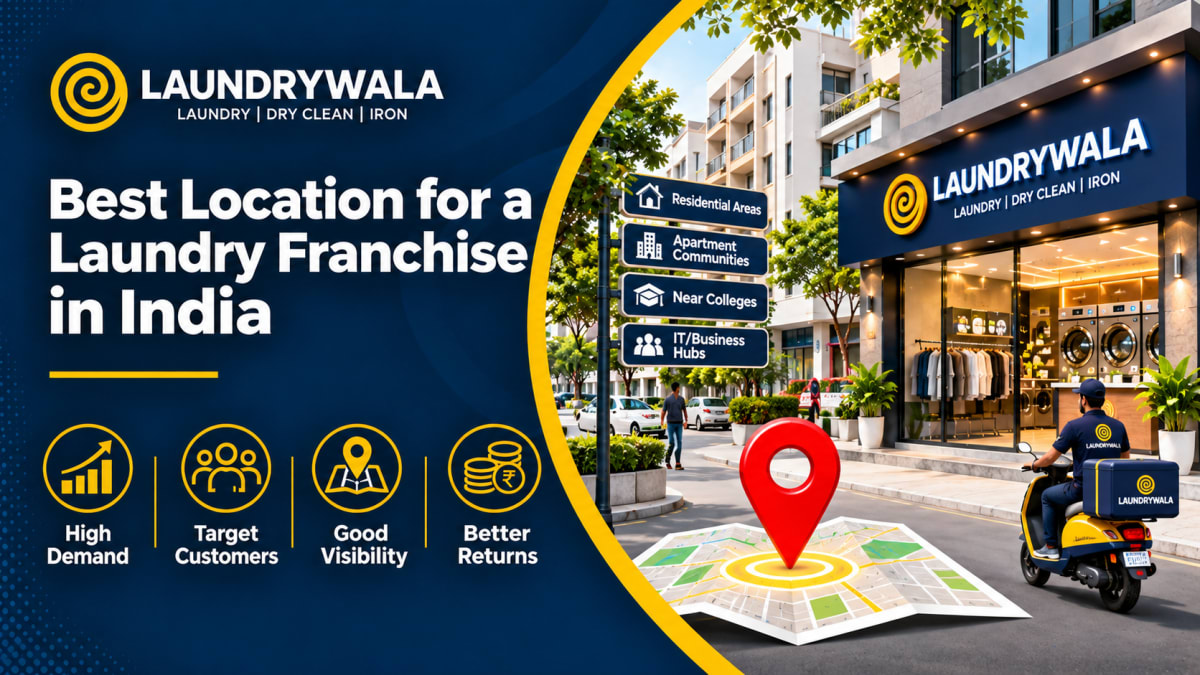
Starting a laundry franchise in India requires more than selecting a popular brand, investing in machinery and opening a store. One of the most important decisions is choosing a location where customer demand, accessibility and operating costs support long-term business growth.
A professionally designed laundry outlet can still struggle if it opens in an area with limited demand, expensive rent or inadequate infrastructure. On the other hand, a compact store in a well-selected residential neighbourhood may attract regular customers without requiring the most expensive commercial property.
Finding the Best Location for a Laundry Franchise involves understanding how people live, work and use laundry services within a specific neighbourhood.
Working professionals may value doorstep pickup and delivery. Families may require regular laundry, steam ironing and occasional dry cleaning. Students living in hostels may prefer convenient laundry packages, while commercial establishments may need reliable garment or linen cleaning.
However, the presence of potential customers does not automatically guarantee business.
Entrepreneurs must investigate whether nearby residents are willing to pay for professional laundry services, how often they might book and which existing businesses already serve them.
The ideal location should also have affordable rent, suitable electrical capacity, dependable water supply, drainage and convenient access for delivery personnel.
This guide explains how to choose the best location for a laundry franchise in India, including customer catchment analysis, residential demand, commercial property evaluation, infrastructure requirements, rental economics and a practical scoring method for comparing shortlisted shops.
Why Location Matters for a Laundry Franchise Business
Location affects almost every aspect of a laundry business, from customer acquisition and delivery efficiency to monthly expenses and service capacity.
Unlike businesses that depend entirely on walk-in customers, modern laundry franchises may receive orders through physical stores, online bookings and scheduled doorstep collection.
Therefore, the best location is not necessarily the busiest shopping street.
Location Influences Customer Demand
A store surrounded by occupied residential apartments may have access to households that require regular garment care.
A location near colleges, hostels and PG accommodation may attract students who need affordable laundry services.
However, a busy commercial market with little nearby residential activity may generate substantial footfall without producing frequent laundry orders.
Understanding the customer profile matters more than simply counting people passing the shop.
Location Affects Operating Costs
Commercial rent is a recurring expense regardless of sales.
A high-rent property increases the revenue required to cover monthly business costs.
Similarly, a location with expensive water arrangements, inadequate electrical infrastructure or difficult delivery access may create additional expenses.
A lower-rent property can offer an advantage, but only if it provides sufficient demand and operational suitability.
Location Determines Pickup and Delivery Efficiency
Doorstep collection is an important convenience feature in organised laundry services.
If customers are spread across distant neighbourhoods, delivery personnel may spend excessive time travelling between orders.
A centrally positioned store serving concentrated residential communities can make route planning more practical.
Location Can Support Repeat Business
Laundry services can attract recurring orders when customers are satisfied with quality and convenience.
A location near suitable households, hostels or workplaces may help the business develop repeat customers within a defined area.
However, retaining customers still requires dependable cleaning, accurate billing and reliable delivery.
What Is the Best Location for a Laundry Franchise in India?
The Best Location for a Laundry Franchise is generally a property that balances measurable customer demand, manageable operating expenses, convenient access and adequate infrastructure.
Rather than choosing a location based on reputation alone, entrepreneurs should evaluate the people and businesses within the practical service area.
Residential Apartment Communities
Apartment societies are useful locations to investigate because they concentrate many potential customers within a limited area.
Families, working couples and professionals may value professional laundry and dry cleaning services that reduce the time spent on household work.
A shop near several occupied apartment complexes may benefit from both walk-in customers and scheduled doorstep pickup.
However, investors should investigate actual occupancy, customer budgets and existing laundry preferences.
A large residential tower does not automatically represent a large number of paying laundry customers.
Gated Societies and Premium Residential Areas
Premium residential communities may support demand for specialised garment care, formal clothing cleaning, shoe care and household textiles.
Customers in these areas may place greater emphasis on fabric safety, service reliability and convenience.
Nevertheless, a high-income location is not automatically profitable.
Rent and customer acquisition costs may also be higher.
Investors should compare likely demand against the total cost of operating in the locality.
Hostels and PG Accommodation
College and university areas can provide opportunities for regular laundry orders.
Students may have limited access to washing machines, drying facilities or ironing equipment.
However, the student segment may be price-sensitive.
A laundry business serving this market should consider realistic pricing, batch collection schedules and service packages that cover processing and delivery costs.
Office and Commercial Neighbourhoods
Areas near offices, banks, hospitals and professional workplaces may attract customers who require regular ironing and garment care.
Formal shirts, trousers, suits and uniforms can create demand for professional services.
However, offices alone may not provide sufficient recurring retail demand.
A mixed residential and commercial catchment can offer a more diversified customer base.
Residential Areas vs Commercial Markets: Which Is Better?
One of the most common decisions facing laundry franchise investors is whether to open inside a residential neighbourhood or a major commercial market.
Both locations can work, but they offer different advantages.
Benefits of Residential Locations
Residential locations may provide convenient access to households that regularly require washing, ironing and dry cleaning.
Customers can arrange collection from their homes or visit a nearby store.
A business serving a concentrated residential area may also organise more efficient delivery routes.
However, residential commercial properties may face restrictions related to noise, operating hours, drainage or equipment installation.
Always check the property's approved commercial use.
Benefits of Commercial Locations
Commercial markets offer visibility and may provide strong walk-in discovery.
A properly branded storefront can help customers recognise the business and understand its services.
Commercial areas may also have established transport connections and available retail infrastructure.
However, high rental costs and limited nearby residential demand can reduce their attractiveness.
Which Option Should You Choose?
For a pickup-and-delivery-focused laundry franchise, a suitable shop near dense residential communities may offer stronger practical advantages than a costly main-road location.
For a walk-in-focused outlet, visibility and convenient customer access may be more important.
The correct decision depends on the approved franchise model and local demand.
How to Analyse Customer Demand Before Finalising a Laundry Location
Choosing a property without understanding nearby customers is one of the most expensive mistakes an entrepreneur can make.
Customer catchment analysis helps estimate the number and characteristics of potential customers surrounding a proposed store.
Step 1: Define the Service Area
Identify the neighbourhoods that can realistically be served through pickup and delivery.
The service radius should reflect road conditions, traffic, travel time and order density.
A three-kilometre route through congested roads may take longer than a five-kilometre journey on a clear road.
Therefore, travel time is often more useful than straight-line distance.
Step 2: Count Occupied Residential Communities
Identify apartment societies, gated communities and major residential clusters.
Estimate occupied households rather than relying on advertised project capacity.
A newly constructed society may contain hundreds of flats but relatively few residents.
Occupancy is more important than total apartment inventory.
Step 3: Identify Customer Categories
Different customer groups have different laundry requirements.
Working professionals may use ironing and dry cleaning. Families may require regular laundry and blanket cleaning. Students may prefer affordable wash-and-fold packages.
Understanding these segments helps the business estimate its potential service mix.
Step 4: Conduct Customer Interviews
Speak with residents, students and local professionals.
Ask how often they outsource laundry, which services they use and what they consider reasonable pricing.
Find out whether existing options create problems related to turnaround, garment care or convenience.
Record responses rather than relying on general impressions.
Step 5: Estimate Realistic Conversion
Not every household within the service area will become a customer.
Some residents prefer washing clothes at home, while others already have trusted laundry providers.
Build conservative estimates of customer acquisition and repeat-order frequency.
Avoid assuming that population growth automatically translates into professional laundry demand.
How to Study Competition Before Opening a Laundry Franchise
Competition is an important part of location analysis.
An area with several laundry providers may already have established demand, but the new store must offer customers a meaningful reason to use its services.
Identify Existing Service Providers
Study local laundry shops, traditional ironing providers, dry cleaners and organised pickup-and-delivery services.
Focus on businesses operating within the proposed catchment.
Compare Their Service Offerings
Observe which services are available and how customers access them.
Consider laundry, dry cleaning, steam ironing, shoe cleaning and household textile care.
Identify any relevant service gaps.
Evaluate Local Pricing
Understand what customers currently pay for commonly requested services.
Your planned pricing should be commercially sustainable and appropriate for local expectations.
A business should not rely entirely on undercutting existing providers.
Review Customer Feedback
Public customer reviews may reveal concerns about delivery delays, cleaning quality, pricing or garment handling.
Treat individual reviews cautiously and look for recurring patterns.
Identify Your Competitive Advantage
A professional laundry franchise may differentiate itself through organised booking, garment tracking, fabric-specific cleaning and predictable turnaround.
However, these advantages must be demonstrated through actual service performance.
Competition research should help refine the business proposition rather than simply discourage investment.
Laundry Franchise Location Requirements: Space and Store Layout
Commercial space requirements depend on the approved franchise format and equipment arrangement.
Laundrywala currently publishes indicative formats requiring approximately 200–350 square feet, although final requirements depend on the proposed configuration.
Entrepreneurs can review the Laundrywala franchise model and setup requirements for current store specifications.
Customer Reception Area
The store should have a convenient place for receiving and returning garments.
The counter should allow employees to inspect clothing, confirm orders and communicate with customers.
Sorting and Processing Space
Garments require organised handling before washing.
Adequate space should be available for sorting, tagging and separating items according to fabric type and processing requirements.
Machinery Installation
Commercial washers, dryers and finishing equipment need suitable clearance for safe installation, ventilation and maintenance.
Machine access should be considered before signing the property agreement.
Ironing and Finishing Area
Where ironing is performed on-site, employees need an appropriate work area with suitable ventilation, equipment access and safety arrangements.
Garment Storage
Clean and unprocessed garments should be organised to reduce mixing and handling errors.
A cramped store may create operational difficulties even if it technically accommodates all the equipment.
Space for Future Demand
Where practical, consider whether the layout can support additional orders without compromising safety or workflow.
However, avoid paying for substantially more space than the business requires during its initial stage.
Electricity, Water and Drainage: Essential Site Requirements
A laundry franchise uses specialised equipment, making infrastructure evaluation essential.
A commercially attractive property may be unsuitable if it cannot support the approved machinery.
Electrical Load Requirements
Commercial washing machines, dryers and ironing boilers can create significant electrical demand.
Laundrywala's published franchise information indicates approximately 8–16 kW of sanctioned electrical capacity, depending on the format.
The exact requirement must be confirmed against the approved equipment schedule.
Check the available electrical connection, sanctioned load, meter arrangement and feasibility of any necessary upgrades.
Reliable Water Supply
Professional laundry services require a dependable water source.
Water demand depends on machine specifications, washing cycles and processing volume.
Laundrywala's indicative setup information refers to water storage capacity of approximately 1,000–2,000 litres, depending on the outlet format.
Water quality may also affect cleaning performance and machinery maintenance.
Proper Drainage
The property must support appropriate wastewater discharge.
Insufficient drainage can interrupt operations and create hygiene or maintenance problems.
Check whether the drainage arrangement can handle the equipment's discharge requirements.
Ventilation and Heat Management
Dryers, boilers and other equipment may generate heat and moisture.
Adequate ventilation helps maintain a suitable working environment.
The property must also comply with applicable fire, electrical, building and environmental requirements.
Maintenance Accessibility
Ensure that technicians can access machines for inspection, repair and servicing.
A store where machinery cannot be moved or maintained safely may create expensive operational problems later.
How Much Rent Should You Pay for a Laundry Franchise?
Rent is one of the most important recurring expenses in a laundry business.
A premium location may offer visibility, but higher rent increases the number of orders required to maintain financial sustainability.
There is no universal rental amount that suits every Indian city.
Evaluate Rent Against Revenue Potential
Instead of selecting a property based only on its monthly rent, estimate the revenue that the location could realistically support.
For example, two properties may have different rental costs and different access to potential customers.
The more expensive property could be worthwhile if it creates enough additional profitable demand.
However, that difference must be supported by realistic assumptions.
Understand Total Occupancy Cost
Monthly rent is not the only property expense.
Investors should also consider maintenance charges, property-related taxes where applicable, security deposits, brokerage, escalation clauses and any required site modifications.
A commercial property with affordable rent but substantial electrical or drainage work may have a higher total setup cost.
Calculate a Rent-to-Revenue Ratio
Rent-to-revenue ratio is calculated by dividing monthly occupancy rent by monthly sales revenue.
For example, if projected monthly sales are ₹3,00,000 and rent is ₹30,000, the rent-to-revenue ratio is 10%.
This is only an illustrative calculation, not a recommended industry benchmark or a revenue forecast.
The acceptable ratio depends on contribution margins, staffing, utilities, delivery costs and other operating expenses.
Avoid Long Leases Before Approval
Do not commit to a long-term lease until the property's infrastructure, local permissions and franchise suitability have been reviewed.
The lease should also be examined for permitted business activities, installation rights and exit conditions.
Ground Floor vs Upper Floor: Which Is Better for Laundry Stores?
Store positioning can affect customer access, deliveries and machinery installation.
Ground-Floor Locations
Ground-floor properties are often convenient for customer entry, garment loading and equipment movement.
Clear frontage can also help customers recognise the business.
However, rent may be higher than upper-floor alternatives.
Upper-Floor Locations
Upper-floor properties may offer lower rent in some markets.
However, carrying garments, moving machines and serving walk-in customers may become more complicated.
The building must have appropriate access, structural capacity and permitted use.
What Does Laundrywala Prefer?
Laundrywala's published setup guidance indicates a preference for visible ground-floor locations with suitable customer access.
Final property suitability should be confirmed through the franchise team's location evaluation.
The decision should balance convenience, safety, visibility and cost.
How Pickup and Delivery Access Affects Laundry Location Profitability
Pickup and delivery can be an important component of organised laundry operations.
The cost of providing this convenience depends on how efficiently orders can be collected and returned.
Evaluate Road Connectivity
Study the roads connecting the proposed store to nearby residential communities.
Check traffic conditions during typical collection and delivery periods.
Consider Parking and Loading
Delivery personnel need safe and practical access to the property.
A shop with difficult stopping arrangements can create delays even when it is located near many customers.
Group Nearby Orders
A concentrated service area may allow multiple pickups or deliveries during one route.
This can reduce unnecessary travel.
However, route efficiency depends on actual booking patterns, not just residential density.
Avoid Excessively Large Service Areas
Expanding the delivery radius may increase potential enquiries but can also increase transportation costs.
Set delivery boundaries according to expected order value, demand and travel time.
Monitor Delivery Economics
Track completed orders per route, travel time and the cost of servicing different neighbourhoods.
Use this information to refine the operational service area.
How to Choose a Laundry Franchise Location in Metro Cities
Metro markets can provide diverse customer groups and established demand for convenience services.
However, commercial rent, traffic congestion and competition may be significant considerations.
Apartment-Dense Neighbourhoods
Look for occupied residential communities with working households and suitable purchasing power.
Investigate how customers currently manage laundry and dry cleaning.
Office and Residential Mixed Areas
Neighbourhoods combining offices and residential buildings may support different service categories.
However, the business should ensure that the proposed catchment contains enough potential regular customers.
Traffic and Delivery Constraints
In metropolitan cities, a short geographical distance may involve substantial travel time.
Prioritise practical route accessibility over a large theoretical delivery radius.
Rent and Property Suitability
Premium commercial frontage may be expensive.
Evaluate whether a compact neighbourhood store could provide better financial efficiency.
Choosing a Laundry Franchise Location in Tier 2 and Tier 3 Cities
Smaller cities may offer commercial properties with relatively manageable rental expenses.
However, local purchasing habits and willingness to outsource laundry services can differ from those in larger metropolitan markets.
Identify Established Residential Neighbourhoods
Focus on occupied areas with regular household activity.
Avoid relying entirely on future property development plans.
Study Student and Professional Demand
Educational institutions, hospitals, government offices and business districts may create specific garment-care requirements.
Investigate whether customers currently use professional laundry services and what improvements they would value.
Evaluate Price Sensitivity
Customers in some smaller markets may be more sensitive to pricing.
A premium laundry service must communicate its value through convenience, quality and consistent handling.
Select the Right Store Capacity
A compact outlet may be appropriate when demand is still developing.
Avoid investing in excessive processing capacity before validating realistic order volumes.
Entrepreneurs evaluating smaller markets can also read Laundrywala's laundry franchise investment and ROI guide to understand how property costs and operating assumptions influence financial planning.
How to Score and Compare Laundry Franchise Locations
A structured scoring method can make property selection more objective.
Instead of choosing a shop because it looks attractive, compare shortlisted locations using consistent criteria.
The following is an illustrative scoring framework created for practical site evaluation.
| Evaluation Factor | Suggested Weight |
|---|---|
| Verified Customer Demand | 25% |
| Rent and Occupancy Cost | 20% |
| Electricity, Water and Drainage | 20% |
| Pickup and Delivery Access | 15% |
| Visibility and Customer Convenience | 10% |
| Competition and Service Opportunity | 10% |
| Total | 100% |
Score each property from 1 to 5 for every factor.
Multiply the score by the factor's weight and compare the weighted totals.
For example, a property with strong residential demand, suitable utilities and manageable rent may rank above a highly visible but expensive main-road shop.
However, the score should not override mandatory requirements.
A property that lacks essential commercial permissions, safe electrical capacity or suitable drainage should not be approved merely because its overall score is high.
This framework is a decision aid, not an official Laundrywala approval standard.
A 7-Day Laundry Franchise Location Research Plan
Entrepreneurs can conduct a preliminary site study before submitting properties for franchise evaluation.
Day 1: Identify Potential Neighbourhoods
Shortlist several residential and commercial areas within the preferred city.
Map apartment societies, hostels, offices and major customer clusters.
Day 2: Visit Existing Laundry Markets
Study the available local cleaning services, pricing and customer convenience.
Identify practical opportunities for differentiation.
Day 3: Interview Potential Customers
Speak with households, students and professionals.
Ask about laundry frequency, service preferences and current pain points.
Day 4: Inspect Commercial Properties
Compare floor area, rent, utilities, access and visible property conditions.
Take photographs and record measurements.
Day 5: Evaluate Delivery Routes
Travel between each shortlisted property and important residential clusters.
Compare realistic journey times and collection access.
Day 6: Prepare Financial Scenarios
Estimate rental costs, potential order volume, initial property modifications and operating requirements.
Prepare conservative assumptions rather than relying on best-case sales projections.
Day 7: Submit the Shortlist
Share the strongest options with the franchise team for technical and commercial evaluation.
Request written feedback before making a lease commitment.
Legal and Commercial Checks Before Signing a Store Lease
Even a location with strong customer demand may be unsuitable if the premises cannot legally or safely support the proposed business.
Verify Permitted Commercial Use
Confirm that the property can be used for the intended laundry activities.
A collection-only shop and a full processing facility may have different requirements.
Review Local Business Approvals
Check applicable trade permissions, establishment registrations, environmental requirements and building conditions.
India's National Single Window System helps entrepreneurs identify potentially relevant central and state approvals.
Local authorities should confirm the exact requirements.
Examine Electricity and Water Permissions
Verify whether the required connections and infrastructure modifications are permitted.
Obtain written confirmation where necessary.
Review the Lease Agreement
Check the lease duration, security deposit, escalation terms, permitted installations, lock-in period and termination conditions.
Understand responsibility for repairs and structural modifications.
Confirm Fire and Safety Requirements
Commercial machinery, electrical equipment and finishing systems may require specific safety arrangements.
Do not begin operations before the relevant requirements have been assessed.
Consider Business Registration
Eligible entrepreneurs may register their enterprise through the official Government of India Udyam Registration portal.
Udyam registration is free on the official portal, but it does not replace other mandatory approvals.
Common Location Selection Mistakes Laundry Franchise Investors Make
Several mistakes can create financial problems even before a laundry store begins operating.
Choosing a Shop Only Because Rent Is Low
Low rent provides little advantage if the property is inaccessible or located far from suitable customers.
Evaluate demand and service convenience alongside cost.
Paying Excessive Rent for Visibility
A prominent shop may attract attention, but high occupancy expenses can reduce financial flexibility.
Assess whether the extra visibility is likely to generate sufficient profitable orders.
Ignoring Residential Occupancy
New apartment developments may appear promising but have relatively few occupied units.
Measure actual households rather than relying on future projections.
Underestimating Infrastructure Expenses
Electrical upgrades, drainage modifications and ventilation work can increase the final setup cost.
Inspect these requirements before finalising the lease.
Selecting an Inconvenient Delivery Location
Poor road access and difficult loading arrangements can increase transportation time and operating costs.
Test actual routes before choosing the property.
Ignoring Local Customer Budgets
A premium service may struggle if local customers do not consider its pricing reasonable.
Study willingness to pay and existing laundry habits.
Signing Before Franchise Approval
Property approval should occur before a major lease commitment whenever possible.
A shop may appear attractive but fail the franchise's operational requirements.
How the Right Laundry Franchise Location Supports ROI
Return on investment depends on the relationship between total capital invested and the cash flow generated by the business.
Location can influence both sides of that relationship.
Lower Fixed Costs
Manageable rent reduces monthly financial commitments.
However, lower rent is beneficial only when the store can attract enough customers.
Better Customer Access
A strong local catchment may improve the opportunities for regular orders and word-of-mouth referrals.
More Efficient Pickup Routes
Concentrated residential demand can support route planning and reduce unnecessary transportation.
Suitable Infrastructure
A property designed around the approved machinery can reduce avoidable installation problems and operational interruptions.
Service Mix Opportunities
Neighbourhoods containing families, professionals and commercial establishments may support demand for laundry, ironing, dry cleaning and selected additional services.
However, these benefits must be validated through actual business performance.
For a broader explanation of franchise financial planning, read Laundrywala's laundry franchise cost guide in India.
How Laundrywala Helps Evaluate Franchise Locations
Laundrywala offers a structured franchise model designed around professional garment-care services and operational processes.
Its published franchise programme includes assistance with location evaluation, store layout, machinery selection, branding, employee training and launch preparation.
Initial City and Territory Discussion
Prospective franchise partners can discuss their preferred city and investment capacity.
Territory availability and specific location requirements must be confirmed with the franchise team.
Store Location Evaluation
Shortlisted properties can be assessed for customer access, infrastructure and operational suitability.
This helps identify obvious issues before significant setup work begins.
Layout and Equipment Planning
The selected format determines the equipment and working areas required.
A suitable layout supports garment sorting, processing, finishing, storage and customer service.
Store Branding and Visibility
Appropriate signage and storefront presentation can help customers identify the service.
The property's frontage and local signage permissions should be considered during selection.
Operational Setup Support
Training and standardised procedures can help franchise partners prepare for daily operations.
However, customer acquisition, financial management and service quality still require active owner involvement.
Prospective entrepreneurs can review Laundrywala's official franchise opportunity and application process before submitting a property for evaluation.
Laundry Franchise Location Checklist Before Final Approval
Before committing to a property, confirm that all essential factors have been reviewed.
Customer Demand: Are there enough occupied residential communities, professionals or other relevant customers nearby?
Local Pricing: Are customers willing to pay for professional laundry and garment-care services?
Competition: Have existing laundry providers and customer expectations been studied?
Rent: Can the business support the total occupancy cost under conservative revenue assumptions?
Store Size: Does the property provide enough usable space for the approved franchise format?
Electricity: Can the premises support the required sanctioned load and equipment?
Water and Drainage: Are reliable supply, storage and suitable wastewater arrangements available?
Ventilation: Can the machinery operate safely within the premises?
Accessibility: Can customers and delivery personnel reach the store conveniently?
Legal Permissions: Is the intended commercial activity permitted at the property?
Lease Conditions: Are deposits, escalation clauses, installation rights and exit terms acceptable?
Franchise Approval: Has the location been reviewed against the franchisor's requirements?
A property should move forward only when mandatory requirements are satisfied and commercial assumptions are realistic.
Why Choose Laundrywala for Your Laundry Franchise in India?
Laundrywala provides franchise formats for entrepreneurs interested in the organised laundry and dry cleaning sector.
Its business model combines professional garment care, technology-enabled operations and customer convenience.
Depending on the approved configuration, outlets may provide laundry, dry cleaning, steam ironing, shoe cleaning and selected additional fabric-care services.
The brand's published franchise offering includes assistance with store planning, machinery, training and operational procedures.
These systems can help entrepreneurs approach store setup more systematically.
However, a franchise location should always be selected through careful demand analysis and financial evaluation.
A recognised brand cannot compensate indefinitely for weak local demand, excessive rent or unsuitable infrastructure.
Entrepreneurs should verify all current commercial terms and location requirements before making an investment decision.
To understand how Laundrywala operates across different markets, explore the Laundrywala store locator and existing outlet network.
Choose the Best Location for a Laundry Franchise with Confidence
Finding the Best Location for a Laundry Franchise requires much more than selecting a busy road or an attractive commercial property.
The ideal location should provide suitable customer demand, manageable rental expenses, reliable utilities and convenient access for pickup and delivery.
Residential communities, student accommodation and professional workplaces can offer opportunities, but every neighbourhood must be evaluated independently.
Entrepreneurs should conduct customer research, inspect existing laundry services, compare several properties and estimate realistic operating costs.
The property should also satisfy essential electrical, water, drainage, ventilation and legal requirements.
Using a structured scoring method can help identify strong options, while professional location assessment can prevent expensive setup mistakes.
Laundrywala offers franchise support covering location evaluation, equipment planning, store setup and operational preparation.
For entrepreneurs planning to enter India's professional laundry sector, selecting the right property is one of the earliest and most important steps toward building a sustainable business.
Planning to Open a Laundry Franchise in Your City?
Explore Laundrywala's available franchise opportunities, share your preferred location and request the latest investment and store setup requirements.
FAQs – India's Best Laundry Franchise Chain
Straight answers for entrepreneurs evaluating Laundrywala as a profitable laundry business and low investment franchise in India.
Still have questions?
Can't find what you're looking for? Our fabric care specialists and franchise advisors are here to help.