The professional laundry industry is attracting entrepreneurs because it serves a recurring requirement rather than a temporary trend. Households, students, working professionals, hotels, salons, clinics and offices regularly need washing, ironing, dry cleaning and specialised fabric care.
However, laundry business profit in India in 2026 cannot be represented by one fixed monthly figure. Two outlets with similar machinery may produce completely different results because of differences in rent, order volume, service mix, delivery cost, competition and operating discipline.
A laundry outlet can become profitable when it builds repeat customers, maintains an appropriate average order value and controls processing expenses. It can also struggle when the owner selects an expensive location, underprices services or depends only on low-margin wash-and-fold orders.
This guide explains how laundry revenue, operating expenses, net margin and investment recovery should be calculated. It also covers Laundrywala’s current franchise models and the factors investors should evaluate before starting a laundry business.
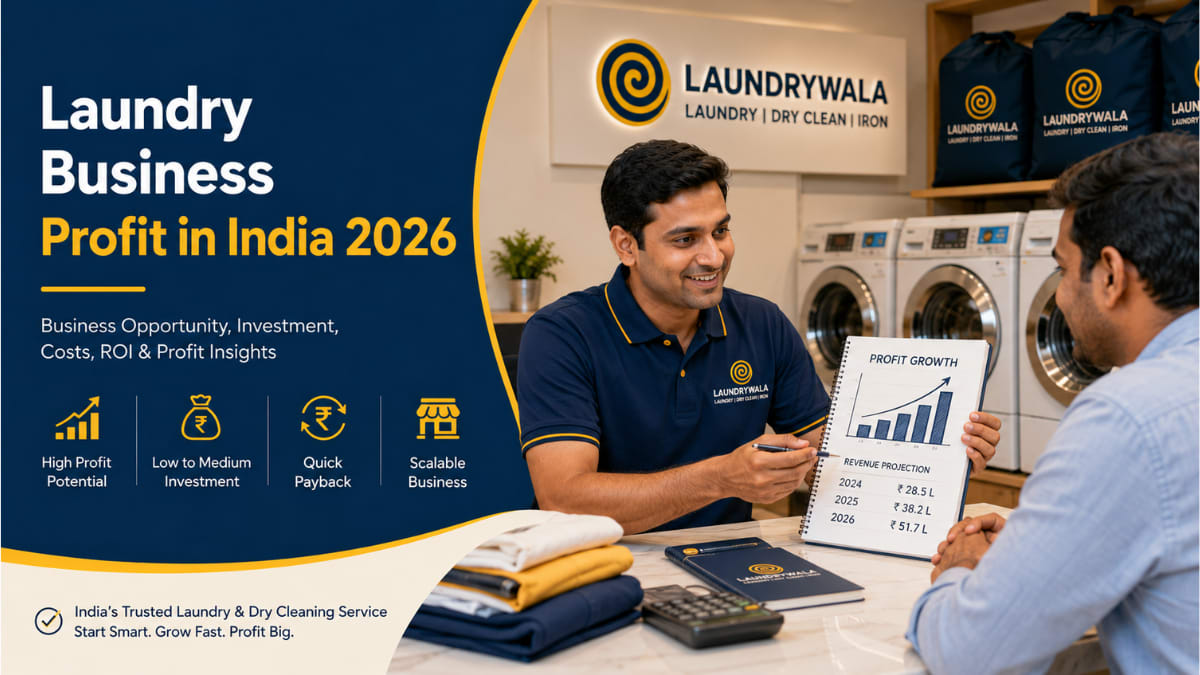
Quick answer: Laundry business profit is calculated by deducting rent, salaries, utilities, consumables, delivery, marketing, maintenance, royalty, loan interest and other expenses from monthly revenue. Laundrywala’s current planning model mentions an indicative net-margin range of 22–30% and an investment-recovery window of 14–20 months. These are planning estimates, not guaranteed returns.
Is the Laundry Business Growing in India?
Professional laundry services are expanding as urban consumers increasingly value convenience, doorstep collection, organised billing and predictable service quality.
The current IMARC India laundry-service market report estimates that the market increased from approximately US$2.7 billion in 2025 to US$2.9 billion in 2026. Market estimates describe the overall industry and should not be interpreted as a projection for an individual outlet.
Several factors support demand for organised laundry services:
- Growth of urban residential communities
- Increasing number of working professionals
- Dual-income households
- Apartment living with limited drying space
- Customer preference for doorstep services
- Demand for premium garment care
- Growth of hotels, hostels, salons and clinics
- App-based booking and digital payments
- Greater awareness of fabric-specific cleaning
The unorganised sector continues to serve a large share of Indian customers. This creates an opportunity for professional outlets that can provide transparent pricing, digital garment tracking, multiple services and reliable pickup and delivery.
What Does Laundry Business Profit Mean?
Investors should understand the difference between revenue, gross profit, operating profit and investment recovery.
Monthly Revenue
Monthly revenue is the total amount collected from laundry, ironing, dry cleaning, shoe care, home-fabric cleaning and other services before deducting expenses.
High revenue does not necessarily mean high profit.
Gross Profit
Gross profit is the amount remaining after deducting direct processing expenses such as detergent, chemicals, packaging and outsourced cleaning charges.
Operating Profit
Operating profit is calculated after deducting regular business expenses:
Operating Profit = Monthly Revenue − Monthly Operating Expenses
Monthly operating expenses may include:
- Rent
- Employee salaries
- Electricity
- Water
- Cleaning chemicals
- Packaging
- Fuel and delivery
- Repairs
- Software charges
- Marketing
- Royalty
- Local administrative expenses
Net Profit
Net profit should account for all applicable expenses, including loan interest, depreciation, taxes and other financial obligations.
A business owner should not describe cash remaining before these expenses as final profit.
Net-Profit Margin
Use the following formula:
Net-Profit Margin = Net Profit ÷ Monthly Revenue × 100
If an outlet generates ₹3 lakh in monthly revenue and retains ₹60,000 after all expenses, its net margin is 20%.
Which Services Generate Laundry Revenue?
A modern laundry business can earn through several service categories.
| Service | Role in the business | Important consideration |
|---|---|---|
| Wash and fold | Creates regular order volume | Requires efficient batching |
| Wash and iron | Combines recurring demand with finishing | Labour and electricity must be controlled |
| Steam ironing | Attracts office wear and uniform orders | Pricing should cover labour |
| Dry cleaning | Can increase average order value | Requires fabric-specific expertise |
| Shoe cleaning | Adds specialised-care revenue | Material and adhesive must be inspected |
| Bag cleaning | Appeals to premium customers | Results depend on material and construction |
| Curtain cleaning | Generates larger seasonal orders | Removal and installation may affect cost |
| Carpet cleaning | Provides higher-value orders | Transport and equipment must be considered |
| Wedding-wear care | Attracts premium garments | Higher responsibility and treatment risk |
| Commercial laundry | Produces recurring bulk volume | Payment terms and capacity require control |
Every outlet should monitor revenue and profit separately for each service. A category that generates substantial sales may still produce a weak margin when labour, transportation or outsourcing expenses are high.
Investors can review Laundrywala’s complete range of professional laundry and fabric-care services before selecting their service mix.
How Much Revenue Can a Laundry Business Generate?
There is no universal revenue figure for a laundry outlet. Revenue depends on five main factors:
- Number of orders
- Average bill value
- Repeat-order frequency
- Service mix
- Commercial or B2B volume
The basic calculation is:
Monthly Revenue = Monthly Orders × Average Bill Value
For example, if an outlet receives 500 orders in one month and the average bill value is ₹500, its monthly revenue will be approximately ₹2.5 lakh.
Increasing revenue does not always require acquiring hundreds of new customers. It may also come from:
- Encouraging existing customers to order regularly
- Promoting dry cleaning and shoe care
- Adding curtain, carpet and blanket cleaning
- Improving residential pickup coverage
- Developing recurring commercial contracts
- Reducing missed pickups and delayed deliveries
Revenue projections should be based on the local catchment rather than national industry figures.
Major Monthly Expenses in a Laundry Business
Understanding expenses is essential when calculating laundry business profit in India in 2026.
Rent
Rent is usually one of the largest fixed expenses. A highly visible store may attract walk-in customers, but excessive rent can delay investment recovery.
A smaller outlet near a strong residential catchment may perform better than a large store in an expensive market.
Salaries
Employee expenses depend on the outlet format and whether washing, finishing, customer service and delivery are handled by separate people.
Hiring too many employees before order volume develops increases early losses. Hiring too few may cause quality problems and delayed delivery.
Electricity and Water
Washers, dryers, steam boilers, irons and other machinery consume electricity. Water consumption varies according to equipment, programme selection and daily volume.
Investors should confirm the required electrical load, local commercial tariff, water supply and drainage before finalising a property.
Detergents and Consumables
This category includes detergents, stain-treatment products, dry-cleaning supplies, garment tags, hangers, covers and packaging.
Correct dosing and batching can reduce waste without compromising cleaning quality.
Pickup and Delivery
Doorstep service can expand the customer base, but fuel, rider salaries, vehicle maintenance and inefficient routing can reduce margin.
Set a practical delivery radius, minimum-order condition and route plan.
Marketing
Local marketing may include:
- Google Business Profile
- Search advertising
- Social-media advertising
- Apartment-society campaigns
- Referral programmes
- Printed material
- Launch offers
- Local business partnerships
Marketing expenditure should be measured against orders and repeat customers rather than likes or impressions alone.
Maintenance and Repairs
Commercial equipment requires preventive maintenance. The financial plan should include a reserve for servicing, replacement parts and unexpected breakdowns.
Sample Laundry Business Profit Calculation
The following example explains how monthly profit may be calculated. It is illustrative and does not represent guaranteed Laundrywala outlet performance.
| Particular | Illustrative monthly amount |
|---|---|
| Total revenue | ₹3,00,000 |
| Rent | ₹30,000 |
| Salaries | ₹65,000 |
| Electricity and water | ₹25,000 |
| Chemicals and packaging | ₹35,000 |
| Pickup and delivery | ₹20,000 |
| Marketing | ₹15,000 |
| Maintenance and software | ₹10,000 |
| Other operating expenses | ₹15,000 |
| Estimated operating profit | ₹85,000 |
In this example:
Operating Margin = ₹85,000 ÷ ₹3,00,000 × 100 = 28.3%
This calculation does not automatically represent final net profit. The owner may still need to account for:
- Loan interest
- Taxes
- Depreciation
- Owner’s salary
- Royalty
- Major equipment replacement
- Outstanding customer payments
Investors should prepare conservative, expected and optimistic projections instead of relying on one scenario.
Laundrywala Franchise Investment in 2026
Laundrywala currently publishes three franchise formats. The appropriate format depends on available capital, store size, local demand and expected order volume.
Alpha Basic
The Alpha Basic format has an indicative investment of ₹13.49 lakh.
Published requirements include:
- Store area: 200–250 sq. ft.
- Team: 2–3 people
- Power: approximately 8 kW
- Water storage: approximately 1,000 litres
- 15 kg washer and dryer
- Ironing setup with a 4 kW boiler
This compact format is designed for a neighbourhood retail laundry and dry-cleaning store.
Classic
The Classic format has an indicative investment of ₹15.99 lakh.
Published requirements include:
- Store area: 250–300 sq. ft.
- Team: 2–3 people
- Power: approximately 15 kW
- Water storage: approximately 1,000 litres
- 15 kg washer-dryer stacker
- 10 kg washer-dryer stacker
- Ironing setup with a 4 kW boiler
It provides additional washing capacity for outlets expecting higher retail order volume.
Combo Premium
The Combo Premium format has an indicative investment of ₹20.99 lakh.
Published requirements include:
- Store area: 300–350 sq. ft.
- Team: 3–4 people
- Power: approximately 16 kW
- Water storage: approximately 2,000 litres
- 18 kg commercial washer and dryer
- Separate 10 kg retail washer and dryer
- Ironing setup with a 6 kW boiler
The model is designed to handle retail customers and selected B2B volume from hotels, salons and institutions.
Investment Comparison
| Franchise model | Indicative investment | Store area | Team size |
|---|---|---|---|
| Alpha Basic | ₹13.49 lakh | 200–250 sq. ft. | 2–3 |
| Classic | ₹15.99 lakh | 250–300 sq. ft. | 2–3 |
| Combo Premium | ₹20.99 lakh | 300–350 sq. ft. | 3–4 |
These are indicative package figures. The final project cost may vary according to GST, transportation, site condition, electrical work, plumbing, rent deposit and working capital.
Read the detailed guide to laundry franchise cost in India before preparing the total budget.
What Is the Break-Even Period?
Break-even can have two different meanings.
Operating Break-Even
Operating break-even occurs when monthly revenue becomes sufficient to cover monthly operating expenses.
Investment Recovery
Investment recovery occurs when accumulated business profit equals the initial capital invested.
Use this basic planning formula:
Estimated Investment-Recovery Period = Total Investment ÷ Average Monthly Cash Profit
If the total investment is ₹15.99 lakh and the average monthly cash profit after stabilisation is ₹80,000, simple recovery would take approximately 20 months.
This calculation is incomplete unless it also considers:
- Lower profit during the launch period
- Loan repayments
- Taxes
- Owner withdrawals
- Machinery replacement
- Seasonal variations
- Additional working capital
Laundrywala’s current planning model indicates a potential net-margin range of 22–30% and an investment-recovery window of 14–20 months. The company clearly states that these ranges are not guaranteed.
For deeper analysis, read the guides on laundry franchise profit margins and laundry franchise ROI in India.
How Does Location Affect Profit?
Location influences rent, order volume, average bill value and delivery efficiency.
Metro Locations
Metropolitan areas may offer:
- Larger premium-customer segments
- Stronger dry-cleaning demand
- Higher average bill values
- More apartment communities
- Greater competition
- Higher rent and salaries
High revenue can be offset by high operating expenses.
Tier-2 and Tier-3 Locations
Smaller cities may offer:
- Lower rent
- Lower employee costs
- Less organised competition
- Growing demand for professional services
- Lower average bill values in some areas
- More time required for customer education
A tier-2 outlet can produce healthy profit when rent is controlled and repeat orders are developed. A metro outlet can struggle when premium rent is based on unrealistic sales projections.
Suitable Catchments
A laundry outlet may benefit from proximity to:
- Apartment societies
- Working professionals
- Hostels and PG accommodation
- Colleges
- Offices and technology parks
- Hotels
- Salons and spas
- Clinics
- High-income residential communities
Ask the franchisor to evaluate the catchment before signing a lease.
What Should Be Checked Before Selecting a Property?
Before finalising a store, verify:
- Monthly rent and deposit
- Ground-floor access
- Signage visibility
- Water availability
- Drainage
- Electrical load
- Ventilation
- Machine-installation space
- Garment-storage capacity
- Delivery parking
- Residential density
- Competition
- Commercial-use permissions
Do not choose a property only because it looks premium. The location must support efficient operations and realistic customer demand.
How Can a Laundry Outlet Improve Profit?
Increase Repeat Orders
Retaining an existing customer is generally more economical than repeatedly acquiring new customers. Use delivery reminders, reliable turnaround and consistent garment quality to encourage repeat business.
Improve Average Bill Value
Inform customers about services relevant to their needs, such as dry cleaning, steam ironing, shoe cleaning, curtain care and carpet cleaning.
Avoid forcing unnecessary services merely to increase the bill.
Control Rewash and Damage
Rewashing consumes water, electricity, chemicals and staff time. Proper sorting, stain inspection and quality checks can reduce costly reprocessing.
Optimise Pickup Routes
Group pickups and deliveries by locality. Poor route planning can make small orders unprofitable.
Track Profit by Service
Record revenue, direct expenses and complaints for each service category. This identifies which services deserve more marketing and capacity.
Develop B2B Accounts Carefully
Hotels, salons, hostels, gyms and clinics may provide regular volume. However, low negotiated prices, delayed payments and additional transport can reduce the benefit.
Calculate capacity and margin before signing a bulk-service agreement.
Common Profitability Mistakes
Laundry-business owners should avoid:
- Selecting a store without catchment analysis
- Spending the entire budget on machinery and interiors
- Keeping insufficient working capital
- Offering permanent heavy discounts
- Underpricing pickup and delivery
- Depending on only one service
- Ignoring electricity and maintenance costs
- Accepting unprofitable B2B contracts
- Failing to track damaged or missing garments
- Mixing business revenue with personal money
- Treating monthly revenue as profit
- Assuming investment recovery is guaranteed
A complete laundry business plan for India can help organise these calculations before launch.
Why Evaluate Laundrywala?
Laundrywala currently describes a network of more than 150 stores across 75+ cities. Its franchise model combines laundry, dry cleaning, steam ironing and specialised fabric-care services with technology-enabled ordering and doorstep pickup.
The company states that its support includes:
- Location and catchment evaluation
- Store-layout guidance
- Machinery selection
- Branding
- Vendor support
- Owner and staff training
- Billing, application and CRM setup
- Launch marketing
- Operational reviews
- Quality-control support
- Customer-retention assistance
Technology can help franchise partners monitor order count, average bill value, pending garments, delivery performance and repeat customers.
However, the brand, software and training cannot replace active management. The franchise owner remains responsible for staff discipline, expense control, service quality and local customer acquisition.
Review the official Laundrywala franchise opportunity and compare a franchise with an independent laundry business before deciding.
Questions to Ask Before Investing
Request written answers to these questions:
- What is included in the quoted investment?
- Which expenses are excluded?
- How much working capital is recommended?
- Is the proposed territory protected?
- Are royalty or recurring fees applicable?
- What training is provided?
- Who handles equipment maintenance?
- What local marketing support is included?
- Can existing franchise partners be contacted?
- What are the renewal and exit conditions?
Also verify applicable registrations through official portals such as Udyam Registration and the GST portal. Requirements depend on the business structure, turnover, activity and location.
FAQs on Entrepreneurship & Business
Insights and strategies for modern entrepreneurs looking to grow in the professional laundry industry.
Still have questions?
Can't find what you're looking for? Our fabric care specialists and franchise advisors are here to help.