
Laundry Franchise vs Independent Laundry Business in India
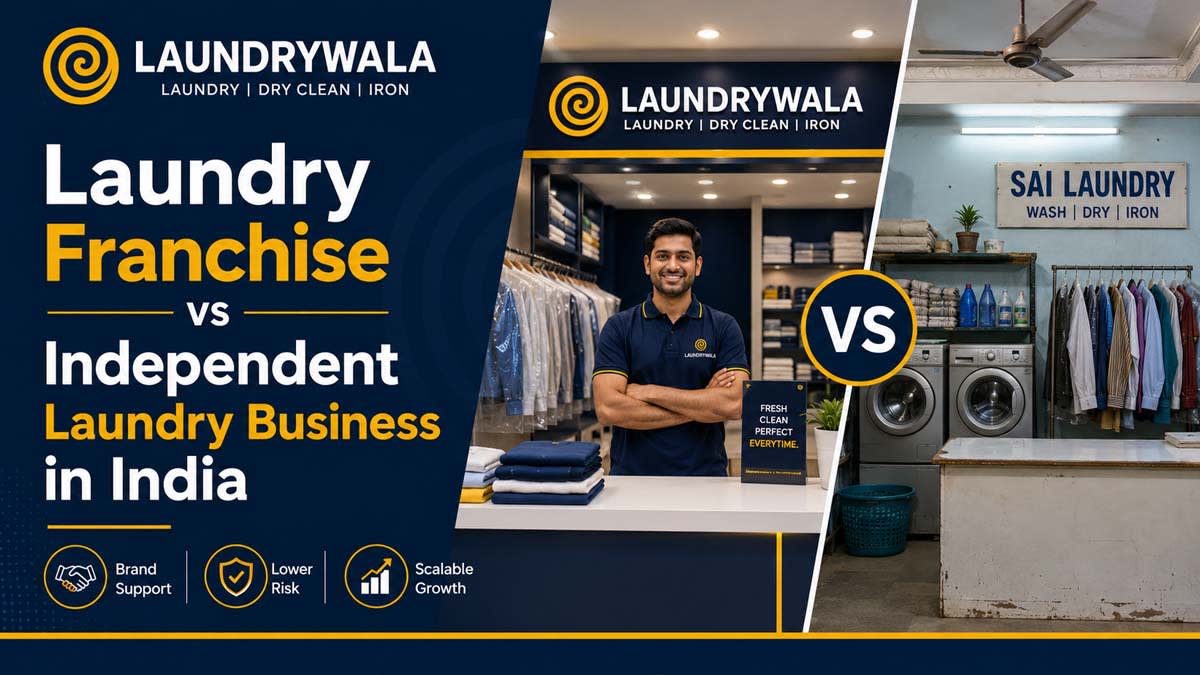
Starting a laundry business in India can look straightforward from the outside: choose a location, install equipment, hire staff and begin accepting garments. In practice, however, a professional laundry and dry-cleaning business involves much more—service design, garment handling, pricing, staff training, technology, customer acquisition, quality control and repeat-order management.
One of the first decisions an entrepreneur must make is whether to start an independent laundry business or invest in an established laundry franchise.
Both approaches can work. A franchise offers an existing brand, systems and support, while an independent business gives the owner greater freedom to create everything from scratch. The right choice depends on your experience, available capital, appetite for experimentation and the amount of operational support you need.
This guide compares laundry franchise vs independent laundry business from a practical Indian entrepreneur’s perspective.
What Is a Laundry Franchise?
A laundry franchise allows an entrepreneur to operate a laundry or dry-cleaning outlet under an established brand and business framework.
Instead of creating every process independently, the franchise partner generally receives support defined by the franchise agreement. Depending on the brand, this may include store design, equipment planning, staff training, operating procedures, technology, marketing guidance and branding.
For example, LaundryWala’s current laundry franchise opportunity includes support around store setup, training, operations and marketing.
A franchise does not remove normal business risk, but it can reduce the amount of trial and error involved in building systems from the beginning.
What Is an Independent Laundry Business?
An independent laundry business is created and operated under the entrepreneur's own brand.
The owner decides the business name, logo, pricing, equipment, service menu, marketing strategy, store format and operating processes. There is no franchisor controlling how the outlet should be presented or operated.
That freedom can be attractive, particularly for entrepreneurs with strong experience in laundry operations, retail management or local marketing.
However, independence also means responsibility. If you need a billing system, garment-tagging process, staff-training programme, delivery workflow or marketing strategy, you must build or source it yourself.
Laundry Franchise vs Independent Laundry Business: Quick Comparison
| Factor | Laundry Franchise | Independent Laundry Business |
|---|---|---|
| Brand | Existing brand identity | Brand built from scratch |
| Operating system | Established framework may be provided | Owner creates processes |
| Training | Usually available as per franchise model | Owner arranges training |
| Marketing | Brand and marketing support may be available | Completely owner-managed |
| Business freedom | Must follow franchise standards | Greater flexibility |
| Initial planning | More structured | Requires more independent research |
| Technology | May be part of the franchise system | Must be selected separately |
| Customer trust | Can benefit from existing brand presence | Must be developed locally |
| Fees | Franchise-related charges may apply | No franchise fee |
| Experimentation | Usually limited by brand standards | Greater freedom to experiment |
The exact terms vary considerably between franchise brands, so the agreement should always be reviewed carefully before investing.
1. Brand Building and Customer Trust
An independent laundry business starts with a blank slate. That gives you complete freedom, but customers initially have little reason to recognise your name.
Building a local brand can require consistent service, customer reviews, digital marketing, signage and months or years of reputation building.
A franchise enters the market using an existing identity. If that brand already operates in multiple locations or has online visibility, the new outlet may benefit from that recognition.
This does not mean customers automatically remain loyal. Service quality still matters. A recognised logo may bring someone through the door once, but consistent garment care and reliable delivery are what encourage repeat business.
2. Operational Setup
Laundry is a process-oriented business.
A single customer order may involve receiving garments, tagging them correctly, identifying stains, sorting fabrics, cleaning, finishing, quality checking, packaging and delivery.
Creating reliable systems for all of these stages takes time.
An independent owner must develop those systems personally or hire professionals to help. A franchise can provide predefined processes and operating standards.
LaundryWala, for instance, describes a technology-enabled operation involving order management, customer booking and structured garment-care processes across its laundry and dry-cleaning services.
For first-time entrepreneurs, this operational framework can be one of the most meaningful differences between the two models.
3. Freedom and Control
This is where independent businesses have a clear advantage.
Independent owners can change prices, introduce new services, redesign the store, change suppliers or experiment with promotions whenever they believe it makes business sense.
Franchisees normally need to follow brand standards.
Those standards help maintain consistency across outlets, but they can also restrict experimentation.
An entrepreneur who enjoys building systems and making every decision independently may prefer their own brand. Someone who prefers following an established operating framework may be more comfortable with a franchise.
4. Equipment and Store Planning
Choosing machinery for a laundry business is not simply about buying the largest or cheapest washing machine available.
Capacity, expected order volume, electricity requirements, water availability, drying systems, finishing equipment, maintenance and store space all matter.
Independent owners must evaluate these requirements themselves.
A structured franchise may provide machinery recommendations and store-layout guidance based on its operating format. LaundryWala states that its franchise programme includes store-setup assistance and training as part of its current offering.
Regardless of the model, equipment decisions should be based on realistic local demand rather than optimistic sales projections.
5. Marketing and Customer Acquisition
A good location alone does not guarantee a steady stream of laundry orders.
Modern laundry businesses may need a combination of local SEO, Google Business Profile optimisation, social media, residential-society marketing, referral programmes, digital advertising and repeat-customer communication.
An independent business must develop this marketing capability itself.
A franchise may provide brand creatives, campaign guidance, launch support or digital infrastructure depending on its agreement.
Entrepreneurs evaluating LaundryWala can review the company’s existing business approach through About LaundryWala.
6. Technology and Order Management
Technology becomes increasingly important as order volume grows.
Manual notebooks may work for a very small operation, but managing hundreds of garments requires accurate tagging, billing, customer records, order status and delivery tracking.
An independent business must select or build these systems separately.
Some franchise systems already incorporate digital order-management tools. LaundryWala’s current franchise material describes CRM, billing, pickup scheduling and technology-enabled operating support.
The value of that technology depends on how well it actually integrates into everyday store operations.
7. Cost: Which Model Is Cheaper?
There is no universal answer.
An independent laundry business avoids franchise fees, but that does not automatically make it cheaper overall. The owner may need to spend separately on branding, consultants, software, marketing, equipment planning, website development and operating systems.
A franchise may charge initial or recurring fees while bundling some of these elements within its model.
Instead of comparing only the franchise fee, compare the total cost of establishing and operating the business.
Calculate machinery, interiors, rent deposits, licences, staff, utilities, marketing, software, consumables and working capital under both scenarios.
Never make the decision based only on advertised investment numbers.
8. Business Registration and Compliance
Whether you choose a franchise or an independent laundry business, you still need to select an appropriate legal structure and understand applicable registrations.
Startup India provides guidance on common Indian business structures including proprietorships, partnerships, LLPs and private limited companies through its official Types of Businesses guide.
Eligible enterprises can also review MSME registration requirements through the official Udyam Registration Portal.
The Ministry of MSME also provides entrepreneurship and skill-development programmes for eligible participants.
Requirements can vary by business structure, state, premises and activities, so professional accounting or legal advice may be appropriate before launch.
Which Option Is Better for a First-Time Entrepreneur?
For someone with limited experience in laundry operations, a franchise may offer a more structured entry point because systems, training and brand standards may already exist.
However, franchise support should never replace due diligence.
A prospective investor should still investigate the location, expected expenses, competition, service demand and franchise agreement.
An independent business may be suitable for someone who already understands laundry operations, has a strong local network or wants complete control over the brand.
Which Option Gives Better Profitability?
Neither structure guarantees higher profits.
Profitability depends on factors such as order volume, average order value, rent, manpower, utilities, equipment efficiency, marketing costs, pricing and customer retention.
A poorly operated franchise can struggle. A well-managed independent laundry can perform strongly.
Similarly, a franchise with efficient systems may reduce costly mistakes, while an inexperienced independent operator may spend more than expected learning through trial and error.
Compare economics at the individual outlet level—not simply “franchise versus independent.”
FAQs – India's Best Laundry Franchise Chain
Straight answers for entrepreneurs evaluating Laundrywala as a profitable laundry business and low investment franchise in India.
Still have questions?
Can't find what you're looking for? Our fabric care specialists and franchise advisors are here to help.
