
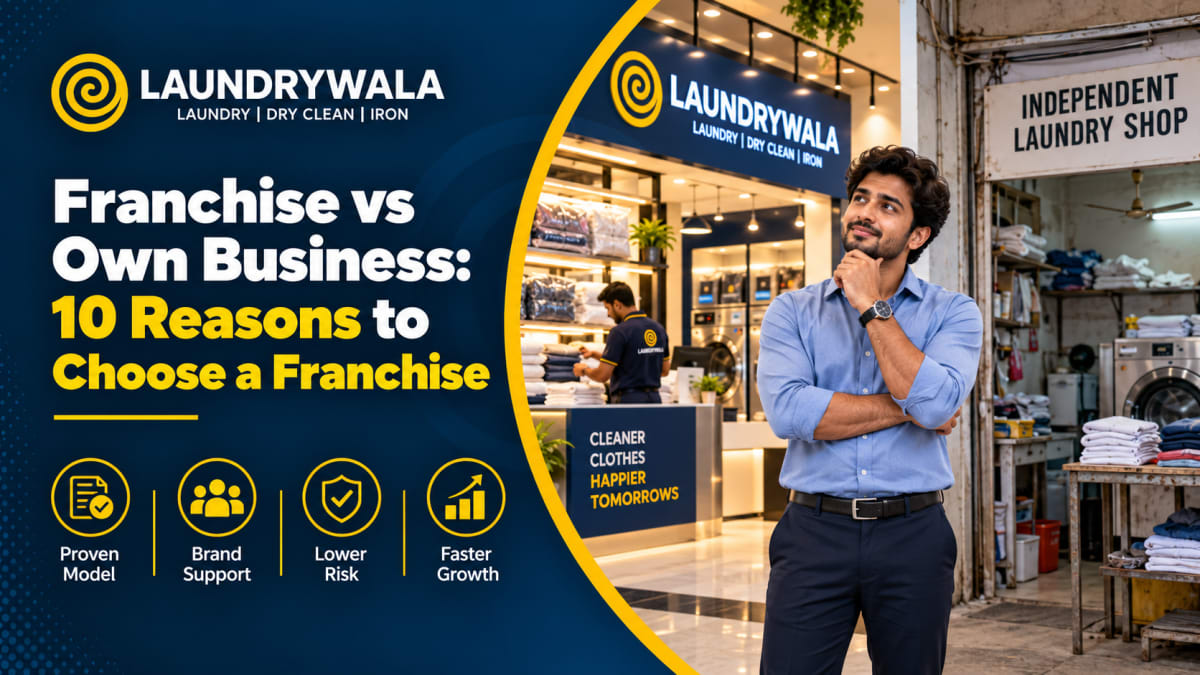
Starting a business is an exciting opportunity, but deciding how to enter the market can be challenging. Should you build a business independently from the beginning, or invest in an established franchise brand?
This is one of the most important decisions aspiring entrepreneurs face.
When comparing a franchise business vs own business, both options offer opportunities for financial independence, business ownership, and long-term growth. However, they involve different responsibilities, investments, operating models, and levels of control.
An independent business allows entrepreneurs to develop their own identity, products, pricing strategies, and operating systems. A franchise, on the other hand, allows investors to operate under an established brand while following its defined business model.
For entrepreneurs entering a new industry, a franchise may provide structure, operational guidance, and access to established systems. Nevertheless, franchising also involves fees, contractual obligations, and business risks.
The right choice depends on your investment capacity, experience, location, goals, and willingness to manage daily operations.
In this comprehensive guide, we explore 10 important reasons to choose a franchise over your own business, compare the two business models, examine potential costs, and explain how to evaluate franchise opportunities in India.
What Is a Franchise Business?
A franchise is a business arrangement in which an entrepreneur receives the contractual right to operate under another company's brand and business system.
The company providing these rights is called the franchisor, while the entrepreneur operating the business is called the franchisee.
Depending on the agreement, the franchisor may provide access to:
- Brand identity and approved marketing materials
- Standard operating procedures
- Equipment and store-layout specifications
- Employee training programmes
- Technology and business-management systems
- Operational guidance
- Product or service standards
- Ongoing business support
In return, franchisees generally make an initial investment and may pay franchise fees, royalties, marketing contributions, technology charges, or other agreed expenses.
The precise obligations depend on the franchise contract.
Franchise opportunities exist across multiple sectors, including food services, education, diagnostics, retail, logistics, fitness, laundry, and professional cleaning.
Entrepreneurs exploring service-based businesses can also review Laundrywala's franchise opportunity in India to understand how a professional garment-care franchise model is structured.
What Is an Independent Business?
An independent business is established and operated under the entrepreneur's own identity.
The owner usually develops the business concept, selects suppliers, determines pricing, establishes processes, and builds the customer base.
For example, an entrepreneur starting an independent laundry shop may need to arrange commercial machines, identify chemical suppliers, hire employees, establish service standards, create marketing campaigns, and develop customer-management systems.
Independent ownership provides greater flexibility, but it also places responsibility for business development and operations directly on the entrepreneur.
The Startup India portal provides resources covering business ideation, validation, early traction, and expansion.
Neither ownership model guarantees profitability. Both require planning, sufficient funding, customer demand, and consistent execution.
Franchise Business vs Own Business: Key Differences
Before exploring the advantages of franchise ownership, it is helpful to compare the two approaches.
| Business Factor | Franchise Business | Independent Business |
|---|---|---|
| Brand identity | Uses an established brand | Creates a new brand |
| Business model | Follows a defined operating model | Developed by the owner |
| Initial investment | Depends on franchise package and setup | Depends on the owner's business plan |
| Training | May receive structured franchisor training | Arranged independently |
| Operating flexibility | Subject to franchise standards | Greater decision-making freedom |
| Marketing | May receive brand-level assistance | Managed by the owner |
| Supplier selection | May involve approved suppliers | Usually selected independently |
| Ongoing fees | May include royalties and other charges | No franchisor royalty |
| Innovation | May require franchisor approval | Owner can usually experiment freely |
| Expansion | May receive expansion guidance | Managed independently |
The most suitable option depends on whether the entrepreneur values established systems or maximum independence.
For a detailed industry-specific comparison, read Laundry Franchise vs Independent Laundry Business in India.
10 Important Reasons to Choose a Franchise Over Your Own Business
1. A More Structured Business Launch Process
One important advantage of franchise ownership is access to a defined launch process.
When starting independently, entrepreneurs must determine how the business will operate before opening.
This may include developing procedures for:
- Property selection
- Equipment procurement
- Store design
- Recruitment
- Pricing
- Inventory management
- Customer service
- Marketing
- Daily reporting
A franchise may provide checklists, approved specifications, and implementation guidance that simplify these decisions.
For example, a professional laundry franchise may have defined requirements for machine placement, garment-handling areas, customer counters, storage, water supply, drainage, and electrical capacity.
This guidance can help entrepreneurs organise the launch more systematically.
However, franchise systems differ significantly. Investors should verify exactly which setup services are included and which remain their responsibility.
Business takeaway: A structured launch process can reduce planning uncertainty, but it does not remove the need for careful execution.
2. More Predictable Operating Responsibilities
Starting a completely new business requires entrepreneurs to design daily workflows while simultaneously serving customers.
Many operational challenges become apparent only after the business opens.
A franchise may provide established procedures for common activities such as customer onboarding, service delivery, billing, quality checks, and complaint resolution.
This allows franchise owners to focus on implementing and managing a defined process.
In a laundry business, operational consistency is particularly important because customers expect careful garment handling, accurate order tracking, suitable cleaning, and timely delivery.
A structured operating framework can help employees understand their responsibilities.
Nevertheless, documented procedures are only useful when staff are properly trained and managers monitor implementation.
Business takeaway: Franchise systems may make operational responsibilities clearer for first-time entrepreneurs.
3. Easier Financial Planning Through Defined Cost Categories
Financial planning is essential for any business.
Independent entrepreneurs must research expenses and develop their own cost estimates.
A franchise provider may offer a commercial proposal identifying major investment categories, including equipment, branding, interiors, software, and training.
This can make initial budgeting more organised.
However, investors should never assume that a franchise package covers every expense.
Additional costs may include:
- GST and applicable taxes
- Rental security deposits
- Electrical and plumbing work
- Working capital
- Local approvals
- Insurance
- Employee salaries before launch
- Initial advertising
- Transportation
- Maintenance and contingency funds
For a practical approach to evaluating investment requirements, explore Laundry Franchise Cost in India.
Example: Calculating Total Project Funding
Consider a hypothetical franchise with the following costs:
| Expense | Illustrative Amount |
|---|---|
| Franchise package and equipment | ₹14,00,000 |
| Rental deposit | ₹1,00,000 |
| Additional setup expenses | ₹75,000 |
| Working capital | ₹2,00,000 |
| Contingency | ₹75,000 |
| Total funding required | ₹18,50,000 |
These figures are purely illustrative, not a quotation or estimate for Laundrywala.
The example demonstrates why investors should calculate total project funding instead of considering only the advertised franchise package.
Business takeaway: A detailed commercial proposal can support better planning, provided every included and excluded expense is verified.
4. Defined Customer-Service and Quality Standards
Customer satisfaction is crucial for repeat-demand service businesses.
When operating independently, entrepreneurs must establish suitable service standards through their own research, experimentation, and training.
Franchise businesses may provide established quality-control procedures.
These can include service checklists, employee responsibilities, complaint-handling protocols, and customer-feedback systems.
In professional garment care, quality standards may address inspection, stain assessment, cleaning procedures, finishing, packaging, and delivery.
Consistent processes can improve accountability and make service problems easier to investigate.
However, franchise ownership does not automatically guarantee better quality. Results depend on staff competence, equipment maintenance, management, and adherence to procedures.
Business takeaway: Defined service standards give entrepreneurs a framework for maintaining consistency.
5. Access to Business Technology and Management Tools
Technology has become an important part of modern service businesses.
Independent entrepreneurs may need to evaluate and purchase software for billing, customer management, inventory tracking, marketing, and performance reporting.
Some franchise brands provide access to technology platforms designed around their business model.
Potential tools include:
- Digital billing systems
- Customer relationship management software
- Order status tracking
- Inventory records
- Sales dashboards
- Customer communication tools
- Pickup and delivery coordination
- Performance reports
These systems may help business owners monitor operations and identify problems.
For example, a laundry store can benefit from tracking order volume, average bill value, delivery timelines, and repeat customers.
Technology alone cannot make a business profitable, but accurate operational information can support better decisions.
Investors should clarify software fees, data access, system ownership, technical support, and what happens to records if the franchise relationship ends.
Business takeaway: Integrated technology can reduce the effort required to build separate management systems.
6. A Clearer Framework for Measuring Business Performance
Many new business owners concentrate primarily on revenue.
However, revenue alone does not show whether a business is financially healthy.
Business performance depends on expenses, customer retention, service mix, and cash flow.
A structured franchise system may provide recommended operating metrics and reporting methods.
Important indicators include:
- Daily completed orders
- Average transaction value
- Monthly revenue
- Gross contribution
- Fixed operating costs
- Customer acquisition cost
- Repeat-customer percentage
- Employee productivity
- Customer complaints
- Cash collection
Consider a hypothetical service business that completes 20 orders daily at an average value of ₹400 for 26 operating days.
Monthly revenue would be:
20 × ₹400 × 26 = ₹2,08,000
Now suppose monthly operating expenses total ₹1,85,000.
The illustrative operating surplus would be ₹23,000 before any additional items not included in those expenses, such as interest, depreciation, or tax.
This example demonstrates that revenue and profit are different.
For more information, see Laundry Business Profit in India.
Business takeaway: Clear performance measurements help entrepreneurs assess whether their business model is financially sustainable.
7. Opportunities for Professional Skill Development
Running a business requires more than an investment.
Owners must understand finance, operations, customer service, hiring, marketing, and business development.
An entrepreneur entering an unfamiliar industry may need time to learn these skills.
A franchise may provide training specific to its operating model.
Depending on the brand, training could cover employee supervision, customer interaction, equipment handling, reporting, and quality standards.
Franchise owners should still develop their own management capabilities.
Useful entrepreneurial learning resources are available through Startup India's online courses, which cover business and management-related subjects.
Investors should ask whether a franchise provides initial training only or ongoing learning opportunities after launch.
They should also confirm who pays for refresher training, replacement staff instruction, and travel.
Business takeaway: Franchise training can create a useful foundation, but long-term business success still depends on the owner's capabilities.
8. Better Preparation for Local Market Expansion
Expanding a business requires an understanding of customer demand, local competition, operating capacity, and funding.
Independent entrepreneurs must develop their own expansion framework.
Some franchisors provide methods for evaluating markets and potential locations.
These may include demographic assessments, catchment analysis, store-size recommendations, and territory planning.
For service businesses, local demand often matters more than the total population of a city.
A laundry outlet, for example, may benefit from proximity to apartment communities, working professionals, student accommodation, or commercial clients.
However, an attractive location does not guarantee sufficient orders.
Investors must consider:
- Rental costs
- Customer accessibility
- Parking and pickup logistics
- Local purchasing behaviour
- Competitive services
- Residential density
- Utility availability
- Expected service demand
Laundrywala's guide to franchise opportunities in small towns explains relevant location and demand considerations.
Business takeaway: A defined market-evaluation process can help entrepreneurs make more informed location decisions.
9. Potential for Multiple Revenue Streams
Some franchise businesses offer several products or services within a single operating model.
This may allow entrepreneurs to serve different customer needs without developing each service category independently.
For example, a professional laundry and dry-cleaning outlet may offer:
- Everyday laundry
- Wash and iron
- Steam ironing
- Dry cleaning
- Shoe cleaning
- Premium garment care
- Curtain and household textile cleaning
- Selected commercial laundry services
A broader service portfolio can create opportunities to serve existing customers in different ways.
However, each additional service introduces its own costs, operational requirements, and quality risks.
Business owners should assess demand and contribution margins before expanding the service mix.
The right approach is to prioritise services that customers need and the outlet can deliver reliably.
A detailed laundry business plan can help entrepreneurs compare service categories and financial assumptions.
Business takeaway: Multiple relevant services can diversify revenue opportunities, but additional services should be supported by genuine demand.
10. A More Defined Framework for Long-Term Business Decisions
Business ownership involves decisions beyond the initial launch.
Owners may eventually consider changing locations, upgrading equipment, hiring additional employees, transferring ownership, or expanding into another territory.
Independent businesses generally have greater flexibility to make these decisions, subject to applicable contracts and regulations.
Franchise owners, however, operate within a contractual framework that may define responsibilities and approval requirements.
This structure can make certain procedures clearer, although it also limits independence.
Before selecting a franchise, investors should understand:
- Agreement duration
- Renewal requirements
- Territory conditions
- Royalty obligations
- Equipment ownership
- Operational restrictions
- Transfer rights
- Exit provisions
- Dispute-resolution procedures
The Startup India legal and regulatory checklist provides general business-compliance guidance.
A qualified legal professional should review the actual franchise agreement before signing.
Business takeaway: A clearly documented relationship helps investors understand their obligations, but restrictive terms must be evaluated carefully.
What Are the Disadvantages of a Franchise Business?
Although there are several benefits of franchise business ownership, franchising is not suitable for everyone.
A balanced decision requires understanding its limitations.
Initial and Ongoing Fees
Franchisees may pay brand fees, royalties, technology charges, or marketing contributions.
These expenses can affect overall profitability.
Reduced Independence
Franchise owners may need approval for changes to pricing, products, suppliers, branding, and business operations.
Contractual Obligations
Franchise agreements may include performance requirements, operating restrictions, renewal conditions, and termination provisions.
Dependence on the Franchisor
A franchise outlet may be affected by the brand's reputation, management decisions, and system-wide operational changes.
No Guaranteed Returns
A recognised brand does not guarantee customers, revenue, profitability, or investment recovery.
Location, competition, expenses, and execution still determine business results.
These disadvantages should be compared with the benefits before making an investment.
When Is Starting Your Own Business a Better Choice?
An independent business may be preferable when the entrepreneur:
- Has strong experience in the target industry
- Wants complete control over the business identity
- Has a distinctive product or service concept
- Prefers to select suppliers independently
- Wants freedom to change pricing and operations
- Can develop internal systems and processes
- Does not want ongoing franchise fees
- Has sufficient resources to build a new brand
For example, an entrepreneur with extensive garment-care experience may prefer developing an independent premium cleaning business with specialised services.
Similarly, someone creating a unique technology product may benefit from the flexibility of independent ownership.
The decision should reflect the entrepreneur's capabilities and long-term plans.
How to Evaluate a Franchise Before Investing
Selecting a franchise is a major financial decision.
Before paying fees or signing documents, complete the following checks.
1. Understand the Complete Investment
Request an itemised cost sheet identifying both included and excluded expenses.
2. Review Business Performance Assumptions
Ask how projected sales, margins, and investment recovery periods were calculated.
Do not rely solely on optimistic forecasts.
3. Speak with Existing Franchise Owners
Where possible, discuss operating costs, training quality, customer demand, support, and challenges with current operators.
4. Evaluate the Location
Assess local demand, competition, rental expenses, and operational feasibility.
5. Understand Ongoing Charges
Review royalties, advertising contributions, software expenses, maintenance costs, and required purchases.
6. Review the Agreement
Have a qualified professional examine the contract, including termination and dispute-resolution terms.
7. Plan Working Capital
Keep sufficient funds for initial operating expenses and unexpected delays.
8. Check Applicable Registrations
Business registration and tax requirements depend on the nature, structure, and location of the enterprise.
The official GST registration guide explains the registration process for relevant applicants.
Entrepreneurs can also review government programmes through the Ministry of MSME.
Eligibility for registrations, schemes, and incentives must be checked individually; franchise ownership does not automatically qualify a business.
Is a Franchise Business Suitable for First-Time Entrepreneurs?
A franchise can be suitable for someone entering business ownership for the first time, particularly when the individual prefers a defined operational system.
However, the assumption that a franchise is effortless or passive is misleading.
Most small-business franchise owners still need to manage people, monitor expenses, maintain service quality, resolve customer issues, and review performance.
Before investing, first-time entrepreneurs should ask themselves:
- Am I comfortable managing daily business operations?
- Do I have sufficient capital beyond the initial package?
- Can I follow established operating standards?
- Do I understand the local customer market?
- Am I prepared for slower-than-expected sales?
- Can I work within contractual restrictions?
- Have I compared alternative business opportunities?
These questions help identify whether franchise ownership aligns with personal and financial expectations.
Why Consider a Laundry and Dry Cleaning Franchise in India?
Laundry and professional garment care are service categories connected to recurring household and commercial needs.
Customers regularly need clothes washed, ironed, dry cleaned, and maintained.
Working professionals, families, students, and commercial organisations may outsource selected garment-care activities for convenience or specialised handling.
Professional laundry businesses can provide several service categories through one outlet, although demand varies significantly by location.
For entrepreneurs evaluating this sector, Laundrywala offers structured franchise formats with guidance related to store setup, equipment, employee training, technology, and operations.
Explore Laundrywala Franchise Opportunities
Laundrywala's published franchise information describes three store formats designed for different investment levels and processing capacities.
Indicative investment generally starts around ₹13 lakh, with larger formats requiring more capital.
The final investment depends on the selected format, property, location, commercial terms, taxes, and additional setup requirements.
Prospective partners should request the latest proposal instead of relying on outdated investment figures.
Investors can also review Laundrywala's franchise investment and business opportunity guide before deciding whether the model suits their goals.
No laundry franchise can promise guaranteed sales or profits. Actual outcomes depend on customer demand, operating expenses, service quality, management, and market conditions.
Final Comparison: Which Business Model Should You Choose?
The comparison between a franchise business vs own business should not be reduced to the question of which model is always more profitable.
Both can succeed, and both can fail.
A franchise may suit entrepreneurs who value operational structure, defined business systems, brand association, and franchisor support.
An independent business may suit entrepreneurs who prioritise flexibility, creativity, direct decision-making, and complete ownership of their business identity.
The most important factors are:
- Financial readiness
- Industry knowledge
- Local customer demand
- Business-management capability
- Operating expenses
- Contractual responsibilities
- Long-term growth objectives
- Personal risk tolerance
Evaluate both options using realistic financial projections rather than assumptions about easy profits or guaranteed success.
FAQs on Entrepreneurship & Business
Insights and strategies for modern entrepreneurs looking to grow in the professional laundry industry.
Still have questions?
Can't find what you're looking for? Our fabric care specialists and franchise advisors are here to help.