
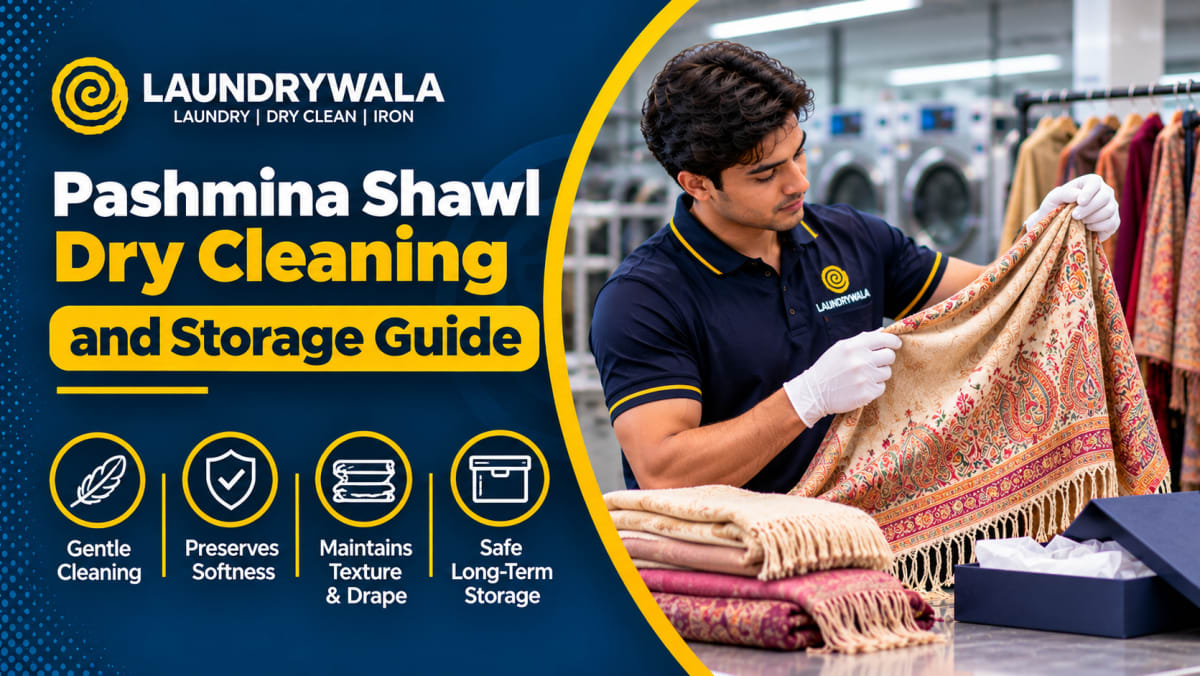
A genuine Pashmina shawl is more than an ordinary winter accessory. Its fine fibres, lightweight warmth, soft surface and traditional craftsmanship can make it financially valuable as well as emotionally significant. Many shawls are received as wedding gifts, inherited from family members or purchased for special occasions and long-term use.
However, fine Pashmina fibres can be damaged by unsuitable detergent, hot water, friction, twisting, aggressive brushing and incorrect storage. Embroidery, woven patterns, fringes, zari, beads and contrasting colours add further cleaning risks.
A professional Pashmina shawl dry cleaning service should begin with careful inspection rather than placing every shawl through the same standard process. The cleaner must examine the fibre, weave, colour, care label, embroidery, stains, fringe and existing damage before selecting a suitable treatment.
Quick answer: Follow the care label attached to your Pashmina shawl. Plain, stable and washable pieces may permit careful hand washing, while dry-clean-only, embroidered, Kani, Sozni, vintage, stained or valuable shawls should receive professional assessment. Avoid machine washing, hot water, strong detergent, wringing and direct heat.
What Is a Pashmina Shawl?
Pashmina is associated with exceptionally fine animal-hair fibre used to create lightweight yet warm shawls, stoles, scarves and other premium textiles.
The term is sometimes used loosely in the retail market. A product sold as Pashmina may be:
- Genuine Kashmir Pashmina
- Pashmina blended with silk
- Pashmina blended with ordinary wool
- Cashmere or fine-wool fabric
- Viscose or synthetic material
- A machine-made imitation
- An embroidered or handwoven shawl
- A Kani-patterned or Sozni-embroidered product
Material identification is important because genuine Pashmina, blended shawls and synthetic imitations may require different cleaning methods.
India’s official Geographical Indications registry lists Kashmir Pashmina as a registered geographical indication associated with Jammu and Kashmir. The official status relates to the identity and origin of the recognised product; it should not be confused with a guarantee that every shawl sold under a similar name is genuine.
If you own an expensive shawl, retain its invoice, authenticity certificate, fibre label and brand-care instructions. These details can help the cleaner understand the item before treatment.
Why Does Pashmina Require Delicate Cleaning?
Pashmina’s fine fibres create softness and warmth, but they can also be sensitive to mechanical action and heat.
Aggressive washing may cause:
- Fibre felting
- Shrinkage
- Loss of softness
- Surface roughness
- Colour bleeding
- Water rings
- Distorted shape
- Uneven texture
- Broken embroidery
- Tangled fringe
- Weakened edges
- Pilling
- Permanent creases
- Loss of woven definition
The complete shawl must be considered. A cleaning method that is suitable for the base fabric may still damage embroidery, zari, silk threads, beads, sequins, tassels or decorative borders.
Older Pashmina shawls may contain weakened fibres, fragile stitching, faded dye or previous repairs. Even gentle treatment can affect these areas if the condition is not documented before cleaning.
Should Pashmina Be Dry Cleaned or Hand-Washed?
There is no single correct method for every Pashmina shawl.
The safest decision depends on:
- Manufacturer’s care label
- Fibre composition
- Plain or embroidered construction
- Dye stability
- Type of stains
- Age and condition
- Decorative elements
- Fringe and tassels
- Previous cleaning
- Financial or sentimental value
The Cashmere and Camel Hair Manufacturers Institute’s garment-care guidance explains that woven cashmere and superfine-wool garments are generally appropriate for dry cleaning, while certain knitted products may allow careful washing. A Pashmina shawl is often woven, but the instructions attached to the individual piece must remain the priority.
| Type of shawl | Safer starting approach | Important risk |
|---|---|---|
| Plain shawl with hand-wash label | Careful hand washing may be allowed | Felting, stretching and dye bleeding |
| Dry-clean-only Pashmina | Professional cleaning | Damage from water-based washing |
| Pashmina-silk blend | Follow exact care label | Water marks and colour change |
| Sozni-embroidered shawl | Professional assessment | Thread bleeding and embroidery damage |
| Kani shawl | Specialist professional care | Distortion of woven patterns |
| Zari-work shawl | Test before professional cleaning | Tarnishing and metallic-thread damage |
| Beaded or sequined shawl | Individual inspection | Loose decorations and adhesive failure |
| Vintage or heirloom Pashmina | Textile-specialist assessment | Weak fibres and old repairs |
| Stained shawl | Professional treatment | Stain spreading and colour loss |
| Unknown material | Identification before cleaning | Incorrect treatment method |
Dry cleaning is not automatically safe merely because a shawl is expensive. The cleaner must still check whether the chosen solvent, moisture level, cycle, drying method and finishing process are compatible with the complete item.
Read the Care Label Before Cleaning
The care label may provide instructions for washing, bleaching, drying, ironing and professional textile care.
Look for directions such as:
- Hand Wash Only
- Dry Clean
- Dry Clean Only
- Professionally Dry Clean
- Mild Process
- Very Mild Process
- Do Not Bleach
- Do Not Tumble Dry
- Dry Flat
- Do Not Wring
- Cool Iron
- No Steam
The circle symbol generally indicates professional textile care. Letters inside the circle and bars below it communicate process restrictions to professional cleaners.
GINETEX’s official guide to textile-care symbols explains that professional-care symbols indicate whether dry or wet cleaning is permitted and whether a mild process is required.
If the label is missing, faded or detached, do not guess. Provide the cleaner with any available invoice, brand name, certificate or packaging information.
For a valuable shawl, photograph the care label and existing condition before handing it over.
When Should You Use a Professional Pashmina Shawl Dry Cleaning Service?
Professional cleaning is advisable when:
- The label states “Dry Clean Only”
- The shawl is genuine or high-value Pashmina
- The material composition is unknown
- Embroidery or zari work is present
- The piece contains beads or sequins
- Contrasting colours may bleed
- Oil, makeup or perfume has stained the shawl
- The shawl has water marks
- The fringe is tangled or damaged
- Mould-like spots are visible
- A musty odour remains after airing
- The shawl is vintage or inherited
- Previous washing has changed its texture
- The item will be placed into long-term storage
- You are uncertain whether hand washing is safe
Laundrywala’s professional dry-cleaning service includes specialised care for shawls, Pashmina, woollens and other delicate garments in serviceable locations.
How Does Professional Pashmina Cleaning Work?
The exact process varies according to the shawl, but responsible professional care should normally include the following stages.
1. Fibre and Construction Assessment
The cleaner identifies whether the shawl appears to be plain Pashmina, a Pashmina blend, fine wool, silk blend or another material.
The weave, weight, fringe, embroidery, lining and decorative components are examined separately.
2. Condition Documentation
The shawl is inspected in suitable light. Existing issues should be recorded, including:
- Stains
- Fading
- Colour variation
- Pilling
- Small holes
- Loose threads
- Snags
- Frayed edges
- Broken embroidery
- Missing beads
- Damaged fringe
- Previous repairs
- Mould-like spots
- Existing shrinkage
Photographs help establish the shawl’s pre-cleaning condition, particularly when it is expensive or sentimental.
3. Care-Label Review
The cleaner checks the permitted process and restrictions.
A label requesting a mild professional process should not be treated as permission for an unrestricted standard cycle. The cleaner may need to reduce moisture, cleaning time, heat or finishing intensity.
4. Colourfastness Testing
A hidden or less visible section may be tested for dye transfer and colour change.
Testing is particularly important when the shawl contains:
- Dark and light contrasting colours
- Hand-dyed sections
- Silk threads
- Embroidery
- Zari
- Printed designs
- Painted detailing
If colour transfers during testing, the cleaner may recommend a modified process or explain that treatment carries increased risk.
5. Stain Identification
The cleaner asks what caused each stain and approximately when it occurred.
Common stains include:
- Makeup
- Perfume
- Hair products
- Food
- Tea and coffee
- Oil
- Mud
- Ink
- Perspiration
- Storage dust
- Water marks
- Mould-related discolouration
Different stains require different treatment. Applying one strong product to every mark may damage the fibre or dye.
6. Controlled Stain Treatment
A compatible treatment is applied carefully to the affected area.
The cleaner must balance stain removal against the risk of:
- Colour loss
- Texture change
- Water rings
- Embroidery damage
- Localised fading
- Fibre weakening
Complete stain removal cannot be guaranteed. Old, oxidised, heat-set or previously treated stains may remain partially visible.
Laundrywala’s guide explaining whether dry cleaning removes stains provides more information about realistic stain-removal results.
7. Material-Appropriate Cleaning
The cleaning process is selected according to the care label, test results and shawl construction.
A plain shawl, embroidered Pashmina and zari-work shawl should not automatically receive identical treatment. Valuable pieces may require gentle or limited processing.
Laundrywala’s guide on how professional dry cleaning works explains the broader process of inspection, stain treatment, cleaning, drying, finishing and quality control.
8. Controlled Drying
Pashmina should be protected from excessive heat and strong mechanical action.
When a permitted water-based process is used, the shawl may require flat or supported drying to prevent stretching. The fringe should be aligned without pulling.
Woolmark’s wool-care guidance recommends following the sewn-in care instructions and keeping wet wool away from direct heat and sunlight.
9. Gentle Finishing
The shawl is reshaped and finished using a technique compatible with its fabric and decoration.
Heavy pressing can flatten texture, create shine or leave marks. Excessive steam may affect sensitive dyes, zari, embroidery or decorative components.
10. Final Quality Inspection
Before packaging, the cleaner checks:
- Stain improvement
- Colour consistency
- Softness
- Shape
- Fringe alignment
- Embroidery
- Edges
- Snags
- Dryness
- Odour
The shawl should be completely dry before it is folded or packaged.
How Are Common Pashmina Stains Handled?
Oil and Grease
Oil may penetrate deeply into fine animal fibres. Do not apply dishwashing liquid, talcum powder, baking soda or household degreaser to a valuable shawl.
Blot fresh surface oil gently without rubbing and arrange professional treatment promptly.
Makeup
Foundation, lipstick and concealer may contain wax, oil and strong pigments.
Do not use makeup wipes, sanitiser, alcohol or micellar water. These products may spread the stain or leave a visible ring.
Perfume
Perfume may contain alcohol, fragrance oils and colourants. Spraying it directly on Pashmina can leave residue or discolouration.
Apply perfume before wearing the shawl and allow it to dry on the skin first.
Tea, Coffee and Food
Blot liquid spills immediately with a clean, light-coloured, absorbent cloth. Do not scrub the area.
Carefully lift solid food using a blunt spoon. Inform the cleaner what caused the stain.
Mud
Allow surface mud to dry naturally. Remove only loose particles without brushing aggressively.
Embedded mud or a resulting water ring should be professionally assessed.
Ink
Avoid nail-polish remover, rubbing alcohol, sanitiser and hairspray. These products can affect both the ink and the shawl’s dye.
Water Marks
Blot excess moisture and allow the shawl to dry away from direct heat. Do not wet a larger area in an attempt to blend the mark.
Mould-Like Spots
Isolate the shawl from other clothing and inspect the wardrobe for dampness.
Do not brush suspected mould inside the home because particles may spread. Professional cleaning will not solve the issue unless the moisture source is corrected.
Can a Pashmina Shawl Be Washed at Home?
Home washing may be considered only when the manufacturer’s care instructions clearly permit it.
If hand washing is allowed:
- Use the water temperature stated on the label.
- Use a detergent approved for delicate wool.
- Dissolve the detergent before adding the shawl.
- Wash the shawl separately.
- Minimise soaking and movement.
- Do not scrub or brush the fabric.
- Rinse without sudden temperature changes.
- Support the complete shawl when lifting it.
- Press water out gently without wringing.
- Roll it inside a clean towel to absorb moisture.
- Reshape it on a flat surface.
- Dry away from sunlight and direct heat.
Do not machine-wash a Pashmina shawl unless the manufacturer explicitly allows it.
Home washing should be avoided when the shawl is embroidered, vintage, heavily stained, colour-unstable, dry-clean-only or highly valuable.
Pashmina Cleaning Mistakes to Avoid
Avoid these common mistakes:
- Assuming every Pashmina can be hand-washed
- Using hot water
- Using ordinary biological detergent
- Adding bleach
- Soaking for several hours
- Scrubbing stains
- Twisting or wringing the shawl
- Hanging it while heavily wet
- Tumble drying
- Using a hair dryer
- Drying on a radiator
- Exposing it to strong sunlight
- Ironing directly at high heat
- Spraying perfume onto the fabric
- Pulling pills with fingers
- Cutting loose threads without inspection
- Storing the shawl while damp
- Placing mothballs directly against it
- Keeping it folded with food or makeup stains
Repeated home treatments can reduce the professional cleaner’s options. Always disclose which products have already been applied.
How Should Embroidered Pashmina Be Cleaned?
Embroidery creates additional risk because the decorative thread may respond differently from the base fabric.
A Sozni-embroidered, hand-embroidered or embellished shawl should be checked for:
- Loose threads
- Dye transfer
- Metallic yarn
- Weak stitches
- Missing beads
- Previous repairs
- Adhesive
- Colour contrast
- Heavy decorative panels
Water may cause embroidered colours to bleed onto the lighter Pashmina base. Cleaning solvents, heat or steam may affect metallic threads and attached decorations.
Laundrywala’s guide on cleaning expensive designer clothes safely explains why the base fabric and decoration must be evaluated together.
How Should Kani Pashmina Be Handled?
Kani shawls contain detailed woven patterns rather than surface printing. The design itself forms part of the fabric construction.
The cleaner should avoid:
- Strong mechanical action
- Aggressive brushing
- Excessive stretching
- High heat
- Heavy pressing
- Pulling the fringe
- Treating one colour without testing adjacent shades
An authentic or valuable Kani shawl should receive individual professional assessment. Preserve purchase documents and authenticity information when available.
How Often Should a Pashmina Shawl Be Cleaned?
A Pashmina shawl does not need cleaning after every brief wear.
Arrange cleaning when:
- Visible stains are present
- Makeup has transferred
- Food or drink has spilled
- The shawl smells of perfume, smoke or perspiration
- Dust has accumulated
- It was exposed to rain
- The fabric feels sticky or soiled
- It will be stored for several months
After light wear, air the shawl briefly in a shaded, ventilated room before folding it.
Laundrywala’s guide on how often clothes should be dry cleaned explains why frequency should depend on use, stains, odour and care instructions rather than a fixed schedule alone.
What Affects Pashmina Dry Cleaning Cost?
The cost of professional cleaning depends on more than the item’s name.
Important factors include:
- Plain or embroidered construction
- Shawl size
- Fibre composition
- Colour
- Stain type
- Stain age
- Fringe condition
- Zari or metallic work
- Beads or sequins
- Existing holes
- Previous cleaning attempts
- Need for repair
- Restoration requirements
- Pickup and delivery location
Cleaning, stain treatment, fringe repair, invisible mending and restoration may be priced separately.
You can review Laundrywala’s current laundry and dry-cleaning pricing, but an expensive or heavily embellished Pashmina may require inspection before the final price is confirmed.
How Long Does Pashmina Cleaning Take?
Pashmina cleaning may take longer than ordinary garment care because it requires inspection, testing, controlled treatment, drying and finishing.
Turnaround time depends on:
- Shawl condition
- Stain severity
- Colour stability
- Embroidery
- Drying requirements
- Repairs or restoration
- Outlet workload
- Specialist-service availability
Do not submit an important shawl immediately before a wedding, journey or event. Confirm the estimated completion date after the cleaner has examined it.
Express processing may not be appropriate for delicate, embroidered or vintage Pashmina.
How Should a Pashmina Shawl Be Stored?
Correct storage is as important as correct cleaning.
Clean Before Long-Term Storage
Do not store a Pashmina containing food, makeup, perfume residue or body oils. These substances can darken during storage and may attract fabric pests.
The shawl must be completely dry before it is folded.
Fold Instead of Hanging
Long-term hanging may stretch fine fibres and distort the shawl’s shape.
Fold it loosely without creating sharp, permanent creases. Change the fold position periodically when storing it for a long time.
Use a Suitable Cover
Wrap the shawl in clean, unbleached muslin, cotton cloth or acid-free tissue. A breathable cotton storage bag may also be suitable.
The Canadian Conservation Institute’s basic textile-storage guidance recommends supporting flat textiles and storing them clean and dry with suitable protective materials.
Keep the Storage Area Cool and Dry
Store Pashmina away from:
- Damp walls
- Bathrooms
- Leaking pipes
- Direct sunlight
- Strong heat
- Attics
- Basements
- Cooking fumes
- Overcrowded drawers
Check the wardrobe during humid or monsoon weather.
Protect Against Clothes Moths
Pashmina is an animal-based protein fibre and can be damaged by clothes-moth and carpet-beetle larvae.
The Canadian Conservation Institute’s guidance for textile collections recommends regularly inspecting woollen and other protein-based materials for insect pests.
Look for:
- Small irregular holes
- Webbing
- Larvae
- Cases
- Shed skins
- Powder-like debris
- Damaged fringe
- Thin patches
If activity is found, isolate the shawl and inspect all nearby wool, cashmere, silk, fur and feather products. Cleaning cannot repair holes that have already formed.
Avoid Direct Contact With Mothballs
Do not place naphthalene balls or oily cedar products directly against Pashmina.
Strong products may leave odour, residue or stains. Follow professional pest-control advice when dealing with an active infestation.
When Should You Consider Professional Restoration?
Cleaning and restoration are different services.
Professional restoration may be required when:
- Small holes are visible
- Fringe has broken
- Edges are frayed
- Embroidery is loose
- Threads have snapped
- A previous repair is failing
- Colour has faded unevenly
- The shawl has become distorted
- Moth damage is present
- The piece is vintage or inherited
Cleaning can remove soil and improve selected stains, but it cannot replace missing fibres or recreate severely damaged embroidery.
Ask the provider whether repair or restoration will be completed before or after cleaning.
Why Choose Laundrywala for Pashmina Shawl Care?
Laundrywala provides specialised garment care for Pashmina, woollen shawls, cashmere, silk, designer wear and other delicate items in serviceable locations.
A professional process may include:
- Material identification
- Care-label assessment
- Condition documentation
- Colourfastness testing
- Stain treatment
- Suitable cleaning
- Controlled drying
- Gentle finishing
- Quality inspection
- Protective packaging
Before booking, share clear photographs of the shawl, care label, stains, embroidery, fringe and damaged areas.
Use the Laundrywala store locator to identify your nearest outlet and confirm whether Pashmina cleaning is available locally.
For assistance, call Laundrywala at 1800 889 3225.
FAQs about best Dry Cleaning Tips
Get answers about premium dry cleaning processes, delicate garment handling, and how we care for your fabrics.
Still have questions?
Can't find what you're looking for? Our fabric care specialists and franchise advisors are here to help.