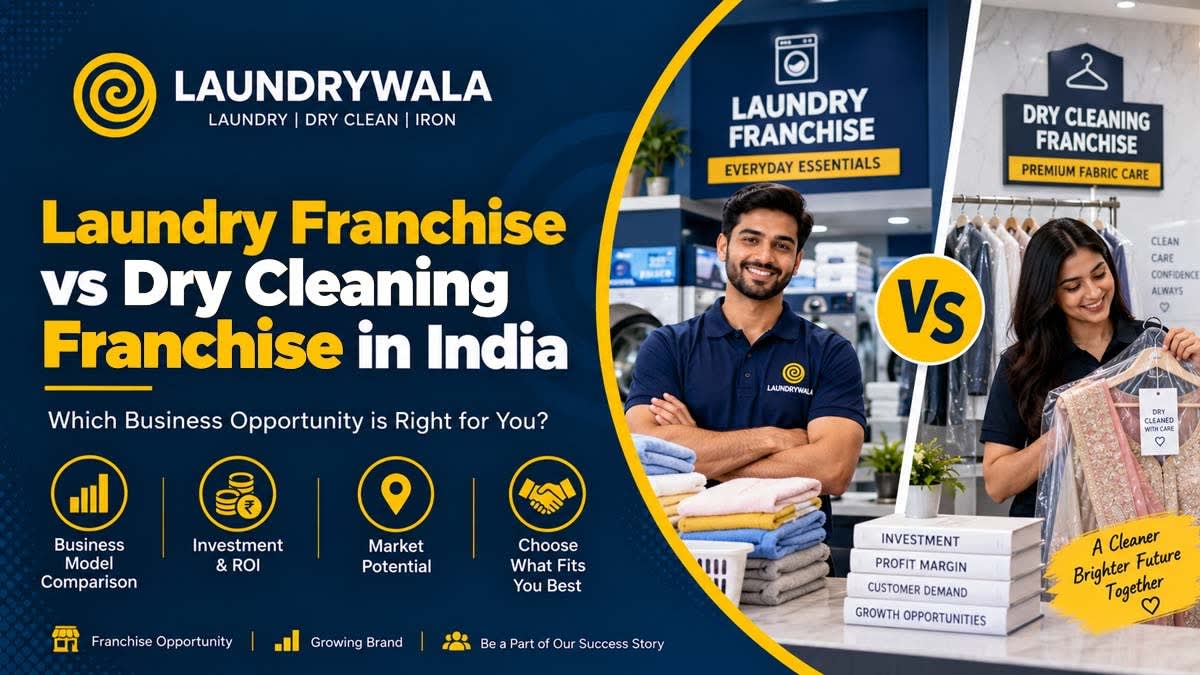
Starting a professional garment-care business in India in 2026 presents opportunities for entrepreneurs looking for recurring service demand and long-term business growth. However, one important question often arises before investing: should you choose a laundry franchise or a dry cleaning franchise?
Although both businesses operate in the garment-care industry, they differ in customer requirements, equipment, cleaning procedures, pricing and order frequency. A laundry franchise primarily serves customers requiring regular washing and ironing, while a dry cleaning franchise focuses on specialised care for formal, premium and delicate garments.
Today, many organised brands combine these services into one business model. This allows entrepreneurs to serve everyday laundry customers alongside individuals requiring dry cleaning, steam ironing and specialist fabric care.
When comparing laundry franchise vs dry cleaning franchise, investors should evaluate initial investment, operating expenses, customer demand, service profitability and franchise support rather than relying solely on advertised returns.
Laundrywala offers integrated laundry and dry cleaning franchise opportunities with updated investment plans starting at ₹13.49 lakh in 2026.
This guide compares both business models, explains investment requirements, provides a practical profitability example and helps entrepreneurs understand which opportunity may suit their budget and location.
What Is a Laundry Franchise?
A laundry franchise allows an entrepreneur to operate a professional garment-cleaning business under an established company's brand and operational framework.
The business generally provides washing, drying, folding, ironing and garment finishing. Depending on the franchise, services may also include dry cleaning, household fabric care and doorstep pickup and delivery.
Typical customers include families, students, working professionals, apartment residents and commercial establishments.
How Does a Laundry Franchise Work?
Customers submit garments through a store, website, mobile application or scheduled pickup service.
Employees inspect and tag the clothing before sorting it according to fabric type and cleaning requirements. Garments are processed using appropriate washing and drying equipment, followed by ironing, quality inspection and packaging.
A structured franchise may provide billing software, operational procedures, staff training and customer-management systems.
Some outlets process garments on-site, while others use centralised facilities. Investors should confirm the actual processing arrangement before selecting a franchise.
Main Advantages
Laundry services offer repeat-customer potential because clothing requires regular maintenance. An outlet may receive weekly household orders alongside occasional larger orders.
This recurring requirement can help develop customer relationships, although revenue depends on service quality, pricing, convenience and competition.
What Is a Dry Cleaning Franchise?
A dry cleaning franchise focuses on professional garment care, particularly clothing requiring specialised cleaning or finishing.
Common items include suits, blazers, coats, sarees, lehengas, wedding outfits and delicate fabrics.
Professional dry cleaning may involve suitable solvents, specialist equipment or alternative cleaning processes depending on the garment. Not every garment requires the same treatment.
How Does a Dry Cleaning Franchise Work?
Employees inspect garments to identify stains, care labels, fabric construction and existing damage.
Suitable cleaning procedures are selected before the garments undergo processing, finishing and quality inspection.
Some franchises operate specialist machinery within their premises, while others transfer garments to central processing facilities.
Main Advantages
Customers may pay more for specialist garment care than ordinary washing, although processing costs can also be higher.
Dry cleaning may attract demand during weddings, festivals, formal events and seasonal wardrobe changes.
However, customer trust is essential because incorrect handling can damage valuable clothing and harm the business's reputation.
Laundry Franchise vs Dry Cleaning Franchise: Key Differences
Both models share the objective of professional garment maintenance, but their primary customer requirements differ.
| Factor | Laundry franchise | Dry cleaning franchise |
|---|---|---|
| Core service | Washing and ironing | Specialist garment care |
| Customers | Families, students, professionals | Formal and premium garment owners |
| Order frequency | Often recurring | Regular or occasion-based |
| Pricing | Per kg or garment | Usually per garment |
| Equipment | Washers, dryers, ironing systems | Specialist processing and finishing |
| Main revenue | Household laundry orders | Premium garment cleaning |
| Challenges | Volume and delivery management | Fabric assessment and quality control |
| Demand pattern | Everyday requirements | Everyday and seasonal requirements |
These differences are general rather than universal. Many organised businesses offer both laundry and dry cleaning.
Entrepreneurs should therefore evaluate the actual services provided under each franchise agreement.
Which Business Has More Customer Demand?
Laundry demand is influenced by regular household clothing requirements. Working professionals, students and families may use professional washing services because of limited time, convenience or garment volume.
Dry cleaning demand is influenced by customers owning clothing requiring specialist treatment.
A professional may regularly dry clean formal wear, while another customer may use the service primarily after weddings or festivals.
Residential Customers
Apartment communities and working households can provide recurring laundry opportunities.
Convenient pickup and delivery, transparent pricing and reliable turnaround times can influence customer decisions.
Premium Garment Customers
Customers with suits, sarees, delicate clothing and premium outfits may prefer specialist garment care.
The frequency of these orders depends on clothing habits and local purchasing behaviour.
Commercial Customers
Hotels, salons, hostels and other establishments may require recurring laundry processing.
Commercial contracts can generate volume, but transport, processing and payment terms must be considered.
A combined franchise may attract customers from all three segments.
Laundry Franchise vs Dry Cleaning Franchise: Investment Requirements
The investment required depends on the operating model rather than the business name alone.
A collection centre outsourcing garment processing may require less equipment than a fully operational processing outlet.
Similarly, a specialist dry cleaning facility may involve significant machinery and technical infrastructure.
Common Startup Expenses
- Franchise fees and brand licensing
- Commercial property deposit
- Store interiors and signage
- Washing, drying or specialist equipment
- Electricity, plumbing and drainage
- Garment-finishing equipment
- Employee recruitment and training
- Billing and order-management software
- Cleaning consumables and packaging
- Launch marketing and working capital
Investors should compare complete project costs rather than advertised franchise fees.
The Laundrywala guide to laundry franchise investment and setup expenses explains the main budgeting considerations.
Updated Laundrywala Franchise Cost in India 2026
Laundrywala offers a combined laundry and dry cleaning franchise business with three published investment formats.
| Franchise model | Investment | Required area |
|---|---|---|
| Alpha – Basic | ₹13.49 lakh | 200–250 sq. ft. |
| Classic | ₹15.99 lakh | 250–300 sq. ft. |
| Combo – Premium | ₹20.99 lakh | 300–350 sq. ft. |
These are indicative prices. Final investment depends on approved commercial terms, GST applicability, site conditions, rent deposits and additional working-capital requirements.
Alpha – Basic: ₹13.49 Lakh
Alpha – Basic is designed for compact retail laundry operations.
The published configuration includes a 15 kg LG washer and dryer, basic ironing equipment and a 4 kW boiler.
It requires approximately 8 kW electrical capacity, 1,000 litres of water storage and two to three employees.
This format may suit neighbourhoods with consistent everyday laundry demand.
Classic: ₹15.99 Lakh
Classic offers additional retail processing capacity.
Its equipment includes 15 kg and 10 kg LG washer-dryer stackers, ironing equipment and a 4 kW boiler.
Published requirements include 15 kW electricity, 1,000 litres of water storage and two to three employees.
Entrepreneurs targeting larger residential communities may consider this format when projected demand justifies the additional investment.
Combo – Premium: ₹20.99 Lakh
Combo – Premium supports retail operations alongside selected commercial laundry requirements.
Its equipment includes an 18 kg Fabcare washer and dryer for commercial processing, a 10 kg LG washer and dryer for retail processing, and an ironing arrangement with a 6 kW boiler.
The model specifies 16 kW electricity, 2,000 litres of water storage and approximately three to four employees.
Commercial demand must be evaluated before committing to greater processing capacity.
Investors can review the official Laundrywala franchise plans and current investment details.
Laundry Franchise vs Dry Cleaning Franchise: Profit Potential
Neither business model guarantees greater profitability.
A laundry outlet may receive frequent orders but must manage processing costs, deliveries and competitive pricing.
A dry cleaning outlet may charge more for individual garments, although specialist treatment can involve higher costs and additional quality-control requirements.
A combined model can potentially earn revenue from both regular laundry and premium services.
Major Profitability Factors
Order volume determines how many transactions a business completes.
Average order value indicates customer spending, while the service mix influences processing expenses.
Rent, salaries, utilities, chemicals, packaging and transportation also affect the operating margin.
Customer retention matters because repeat orders can reduce dependence on continual promotional spending.
For additional information, read the laundry franchise ROI and investment recovery guide.
Practical Monthly Profit Calculation
Consider a hypothetical garment-care outlet completing 25 orders daily at an average customer bill of ₹400.
Over 30 operating days, monthly sales would total ₹3,00,000.
| Financial component | Illustrative monthly amount |
|---|---|
| Revenue | ₹3,00,000 |
| Property rent | ₹35,000 |
| Employee salaries | ₹60,000 |
| Electricity and water | ₹25,000 |
| Consumables and packaging | ₹30,000 |
| Pickup and delivery | ₹25,000 |
| Marketing and administration | ₹30,000 |
| Maintenance | ₹15,000 |
| Operating surplus | ₹80,000 |
The illustrative operating surplus is approximately 26.7% of revenue.
These numbers are hypothetical and do not represent actual Laundrywala franchise earnings.
Applicable royalties, financing expenses, depreciation, taxes and other costs may reduce the final net profit.
Investors should prepare financial projections using conservative and expected sales assumptions rather than treating one illustration as a forecast.
Understanding ROI and Break-Even
Return on investment measures financial performance relative to capital invested.
However, operating break-even and investment recovery are different concepts.
Operating break-even occurs when business revenue covers relevant operating costs.
Investment recovery requires the business to generate sufficient cumulative cash flow to recover the initial capital committed.
A simplified annual ROI formula is:
Annual ROI = Annual Net Profit ÷ Total Investment × 100
For example, annual net profit of ₹3 lakh on an investment of ₹15 lakh would represent a hypothetical 20% return.
Actual returns depend on customer demand, pricing, operating expenses and financing arrangements.
Which Model Offers Better Repeat-Customer Potential?
Everyday laundry may encourage regular customer visits because clothing requires repeated washing and ironing.
Dry cleaning can also attract repeat customers, especially those who regularly wear formal clothing.
However, some customers may use specialist cleaning only for weddings, festivals or important occasions.
A combined service offering may allow one outlet to address both frequent and occasional garment-care needs.
Importance of Customer Retention
Customer retention depends on consistent cleaning quality, suitable pricing and timely delivery.
Businesses should monitor repeat orders and customer complaints instead of relying exclusively on new customer enquiries.
Strong service standards can encourage referrals and help establish a positive local reputation.
Equipment and Operational Differences
Laundry businesses generally use washing machines, dryers, ironing systems, garment racks and sorting equipment.
Dry cleaning operations may require specialist cleaning machinery, stain-treatment equipment and appropriate finishing systems.
Some dry cleaning franchises use central facilities, meaning individual outlets may not require every processing machine.
Quality-Control Requirements
Both models require careful garment inspection and accurate order records.
Laundry operations must control washing procedures, colour separation and finishing quality.
Dry cleaning operations require detailed assessment of fabric characteristics, stains and garment construction.
Incorrect processing can create re-cleaning expenses, complaints or compensation claims.
Equipment Maintenance
Equipment downtime can delay deliveries and reduce processing capacity.
Franchise investors should confirm warranty provisions, servicing arrangements, repair costs and technical support responsibilities.
Which Franchise Is Better for Beginners?
First-time entrepreneurs may benefit from franchise training, established operational procedures and access to technology.
However, both laundry and dry cleaning require daily management.
A laundry outlet must manage cleaning volume, delivery scheduling, employee productivity and customer satisfaction.
A dry cleaning outlet requires accurate garment assessment and careful specialist processing.
Beginners should compare training programmes, investment requirements, processing arrangements and franchise agreements.
Laundrywala describes assistance with store setup, employee training, branding, technology and operational procedures.
The exact support included should be confirmed in writing.
Best Locations for Laundry and Dry Cleaning Franchises
Location selection should be based on customer demand and operating feasibility.
Residential Areas
Neighbourhoods with apartments, families and working professionals may support regular laundry services.
A concentrated customer base can make pickup and delivery more efficient.
Student and Hostel Locations
Students and paying guests may require affordable washing and ironing.
However, smaller average bills and price sensitivity must be considered.
Premium Residential Areas
Locations with demand for professional care of formal clothing, sarees and occasion wear may support dry cleaning services.
Commercial Locations
Hotels, hostels, gyms and salons may provide business opportunities.
Commercial contracts should be accepted only when pricing covers the full cost of service.
Delhi NCR, Mumbai, Bengaluru, Pune, Hyderabad, Ahmedabad and other cities contain different customer segments, but actual feasibility must be assessed locally.
Benefits of Offering Both Laundry and Dry Cleaning
A combined model can serve more customer requirements through one business.
Someone using regular laundry may also need professional dry cleaning for formal clothing.
Similarly, a customer visiting for saree cleaning may begin using the outlet for washing and ironing.
Multiple Service Categories
An integrated garment-care outlet may offer laundry, dry cleaning, steam ironing, shoe cleaning, curtain cleaning and selected household fabric care.
Laundrywala provides information about its professional laundry services and dry cleaning services.
Actual services depend on the franchise configuration and processing arrangements.
Seasonal Business Opportunities
Wedding seasons may increase demand for premium garments.
Festivals can generate additional orders for occasion wear, while changing weather conditions may influence household fabric-cleaning needs.
Offering different services can broaden the potential customer base, although every service requires suitable operating procedures.
How to Start a Laundry or Dry Cleaning Franchise in India
The process should begin with research rather than immediately purchasing machinery.
Step 1: Research Customer Demand
Identify household demographics, existing competitors and the services customers require.
Speak with potential customers to understand their priorities.
Step 2: Compare Franchise Models
Evaluate investment packages, equipment, technology, support and processing arrangements.
Request detailed written commercial proposals.
Step 3: Prepare Financial Projections
Calculate total setup costs, rent, salaries, utilities, marketing and working capital.
Develop realistic revenue scenarios.
Step 4: Finalise a Suitable Location
Confirm property dimensions, electricity, water, drainage and customer accessibility.
Step 5: Review the Franchise Agreement
Examine royalty terms, territory rights, training, renewal provisions and operating responsibilities.
Step 6: Complete Setup and Training
Install equipment, configure billing systems and train employees in cleaning procedures and customer service.
Step 7: Launch Local Marketing
Use appropriate local advertising, apartment society outreach, referrals and business partnerships.
Step 8: Monitor Performance
Track daily orders, average order value, customer retention, operating expenses and service complaints.
Use this information to improve profitability and customer satisfaction.
The guide to starting a laundry business in India explains additional setup considerations.
Legal Requirements for Laundry and Dry Cleaning Businesses
Compliance requirements vary by state, municipality and operating activity.
Entrepreneurs may need to evaluate applicable business registration, GST, labour obligations, local trade permissions and environmental requirements.
Eligible businesses can review the official Udyam MSME registration process.
Business guidance and entrepreneurship resources are also available through the Government of India's Startup India initiative.
Specialist cleaning processes involving solvents or industrial equipment may require additional safety and environmental compliance.
Investors should verify these obligations before installing equipment or opening the outlet.
Common Mistakes Entrepreneurs Should Avoid
One major mistake is selecting a franchise based only on advertised ROI.
Other risks include underestimating rent, staffing, electricity and delivery expenses.
Choosing a costly property without confirming local customer demand can create financial pressure.
Entrepreneurs should also avoid investing in unnecessary machine capacity or relying exclusively on introductory discounts.
Poor garment inspection, incorrect cleaning procedures and delayed deliveries can harm customer trust.
A successful operation requires realistic financial planning, appropriate employee training and continuous service monitoring.
Why Consider Laundrywala for a Combined Franchise?
Laundrywala offers professional laundry and dry cleaning services through an organised franchise framework.
The company's published network information describes more than 150 stores across over 75 cities.
Its three current investment formats allow entrepreneurs to compare compact retail operations with higher-capacity configurations.
The brand describes assistance with store planning, equipment selection, branding, employee training, order-management technology and operational guidance.
However, investors must confirm exact inclusions, processing arrangements, territory conditions and recurring charges in the approved franchise proposal.
FAQs – India's Best Laundry Franchise Chain
Straight answers for entrepreneurs evaluating Laundrywala as a profitable laundry business and low investment franchise in India.
Still have questions?
Can't find what you're looking for? Our fabric care specialists and franchise advisors are here to help.