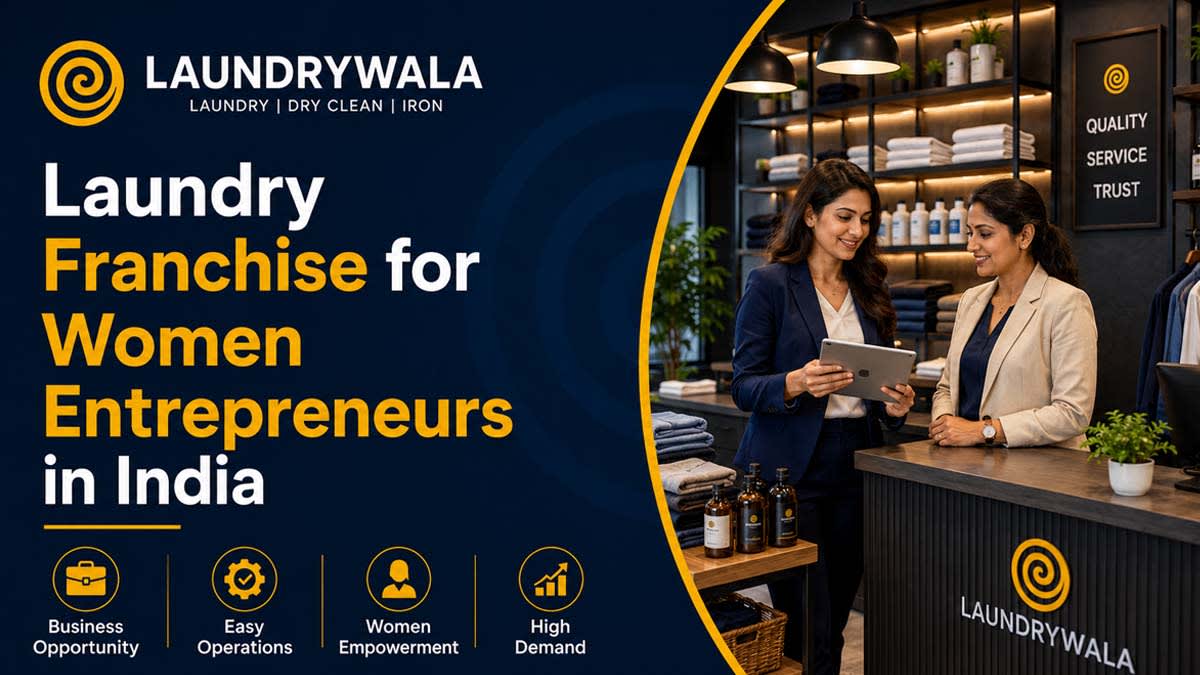
Women entrepreneurs are building successful businesses across retail, services, food, healthcare, education, beauty and technology. However, selecting the right business requires more than following a popular trend. An entrepreneur must evaluate investment, customer demand, daily operations, competition, recurring expenses and the support available after launch.
A laundry franchise for women entrepreneurs in India can be considered because professional garment care serves a regular household and commercial requirement. Families, working professionals, students, hotels, salons, clinics and offices may need laundry, ironing, dry cleaning and home-fabric cleaning throughout the year.
A franchise model provides an established brand, operating procedures, machinery guidance, training and technology support. This structured framework can make business entry easier for first-time entrepreneurs, although it does not eliminate financial or operational risk.
This guide explains how women can evaluate a laundry franchise, compare Laundrywala’s available investment models, explore financing options and prepare for daily business management.
Why Consider a Laundry Franchise Business?
Laundry and garment care are repeat-demand services. Unlike a product that customers may purchase only occasionally, clothes, bedsheets, towels, uniforms and household fabrics require regular cleaning.
An organised laundry outlet can earn revenue from several service categories, including:
- Wash and fold
- Wash and iron
- Steam ironing
- Dry cleaning
- Shoe cleaning
- Bag cleaning
- Curtain cleaning
- Carpet cleaning
- Blanket and comforter cleaning
- Wedding-wear care
- Pickup and delivery
- Commercial laundry orders
A diversified service portfolio reduces dependence on one service. Everyday laundry can create recurring order volume, while specialised garment care may increase the average order value.
Customers increasingly value convenience. A laundry outlet that combines walk-in orders with doorstep pickup and delivery can serve households located beyond the immediate market surrounding the store.
Women considering this opportunity should still evaluate the local market carefully. Business performance depends on customer demand, pricing, competition, service quality, operating expenses and active management.
Why Can a Franchise Help First-Time Women Entrepreneurs?
Starting an independent laundry business requires the owner to create almost every system from the beginning. This includes brand identity, machinery selection, store design, cleaning processes, software, pricing, staff training, packaging and customer acquisition.
A franchise provides an established framework. Depending on the agreement, the franchisor may assist with:
- Location assessment
- Outlet layout
- Machinery selection
- Brand signage
- Operating procedures
- Staff training
- Billing and order-management technology
- Service pricing guidance
- Launch marketing
- Packaging and supplies
- Quality-control procedures
- Ongoing operational support
Women deciding between both models can compare a laundry franchise and an independent laundry business before investing.
The franchise model does not make the business passive or risk-free. The owner remains responsible for staff, customer service, expenses, quality, delivery timelines and local marketing. Its primary advantage is access to an existing system instead of developing every process independently.
Who Can Start a Laundry Franchise?
A laundry franchise may be suitable for women from different professional and personal backgrounds.
Potential entrepreneurs include:
- First-time business owners
- Working professionals planning a career transition
- Homemakers seeking an independent source of income
- Boutique or salon owners looking for an additional business
- Family-business operators
- Retail entrepreneurs
- Women interested in a service-based business
- Investors seeking a manager-operated outlet
Previous laundry-industry experience may not be essential when appropriate technical and operational training is available. However, the owner should be prepared to manage staff, follow processes, monitor finances and address customer concerns.
A franchise can also be managed with a store manager and trained employees. Even in a manager-operated model, the owner should regularly review revenue, order volume, complaints, delivery performance, expenses and customer retention.
How Does a Laundry Franchise Generate Revenue?
A professional laundry outlet can develop several income streams.
Everyday Laundry
Wash-and-fold and wash-and-iron services can generate repeat demand from households, students and working professionals. Customers may place orders weekly or monthly, helping the outlet build recurring business.
Dry Cleaning
Suits, blazers, sarees, lehengas, coats and structured garments may require professional dry-cleaning services. These services can increase the average order value compared with ordinary washing.
Steam Ironing
Some customers wash clothes at home but prefer professional ironing. Steam pressing can attract office-goers, families and customers with uniforms or formal wear.
Shoe and Bag Cleaning
Shoes and handbags made from leather, suede, canvas and synthetic materials require material-specific care. These specialised services can expand the outlet’s customer base.
Home-Fabric Cleaning
Curtains, carpets, blankets, quilts and comforters are difficult to wash and dry at home. Professional care for these products can create seasonal and higher-value orders.
Pickup and Delivery
Doorstep collection makes the service convenient and expands the outlet’s effective coverage area. Delivery charges, minimum-order conditions and service radius should be planned carefully.
Commercial Laundry
Hotels, hostels, salons, spas, restaurants, clinics and offices may require regular linen or uniform cleaning. Commercial contracts can create recurring volume, but the outlet must calculate capacity, transport, payment terms and operating margins before accepting large orders.
A balanced service mix is important. Everyday laundry creates volume, while dry cleaning and specialised services may help improve revenue per customer.
Laundrywala Franchise Investment Plans
Laundrywala currently publishes three franchise formats. The appropriate model depends on the entrepreneur’s budget, proposed location, available space and expected order volume.
Alpha Basic Franchise
The Alpha Basic format has a published investment of approximately ₹13.49 lakh.
Its listed requirements include:
- Store area: 200–250 sq. ft.
- Manpower: 2–3 employees
- Electricity requirement: approximately 8 kW
- Water requirement: approximately 1,000 litres
- Machinery: 15 kg washer and dryer
- Finishing equipment: basic ironing setup with a 4 kW boiler
This compact format may suit neighbourhood retail operations and entrepreneurs starting with a smaller processing requirement.
Classic Franchise
The Classic format has a published investment of approximately ₹15.99 lakh.
Its listed requirements include:
- Store area: 250–300 sq. ft.
- Manpower: 2–3 employees
- Electricity requirement: approximately 15 kW
- Water requirement: approximately 1,000 litres
- Machinery: 15 kg and 10 kg washer-dryer stackers
- Finishing equipment: ironing setup with a 4 kW boiler
This format may be considered by entrepreneurs seeking additional processing capacity for regular retail orders.
Combo Premium Franchise
The Combo Premium format has a published investment of approximately ₹20.99 lakh.
Its listed requirements include:
- Store area: 300–350 sq. ft.
- Manpower: 3–4 employees
- Electricity requirement: approximately 16 kW
- Water requirement: approximately 2,000 litres
- Machinery: 18 kg commercial washer and dryer with a separate 10 kg retail setup
- Finishing equipment: ironing setup with a 6 kW boiler
This format is designed for higher processing capacity and may suit entrepreneurs planning to serve both retail and selected commercial customers.
Franchise Model Comparison
| Franchise model | Published investment | Store area | Suggested staff |
|---|---|---|---|
| Alpha Basic | ₹13.49 lakh | 200–250 sq. ft. | 2–3 |
| Classic | ₹15.99 lakh | 250–300 sq. ft. | 2–3 |
| Combo Premium | ₹20.99 lakh | 300–350 sq. ft. | 3–4 |
These prices should be treated as published package figures, not guaranteed all-inclusive project costs.
Before making a payment, request a current written quotation explaining:
- Franchise or brand fee
- Machinery and equipment
- Transportation
- Installation
- GST and applicable taxes
- Interiors and civil work
- Electrical and plumbing modifications
- Property security deposit
- Initial consumables
- Software charges
- Marketing expenses
- Working capital
- Recurring fees
Read the detailed laundry franchise cost in India guide before preparing the final budget.
How Much Working Capital Should Be Planned?
Entrepreneurs sometimes spend most of their available money on the franchise package, machinery and interiors. This can create cash-flow pressure after opening.
Working capital may be required for:
- Monthly rent
- Employee salaries
- Electricity
- Water
- Fuel and delivery
- Detergents and chemicals
- Packaging material
- Repairs and maintenance
- Local marketing
- Software or service subscriptions
- Unexpected expenses
The amount required depends on the city, team size, rent and anticipated sales. Prepare conservative, expected and optimistic cash-flow projections.
Keep a reasonable operating reserve instead of assuming the outlet will become profitable immediately. Customer acquisition and repeat-order development generally require time.
Government Financing Options for Women Entrepreneurs
Women entrepreneurs may explore government-backed business-loan and support programmes. Eligibility and approval depend on the applicant, project report, repayment capacity, lender assessment and current scheme rules.
Stand-Up India
The official Stand-Up India Scheme supports eligible women and SC/ST entrepreneurs establishing greenfield businesses.
The scheme currently describes composite loans between ₹10 lakh and ₹1 crore for eligible projects in manufacturing, services, trading and certain agriculture-allied activities.
For a non-individual enterprise, an eligible woman or SC/ST entrepreneur should generally hold at least 51% of the shareholding and controlling stake.
Loan tenure may extend up to seven years, including an eligible moratorium period, subject to the bank’s assessment and prevailing scheme conditions.
Pradhan Mantri MUDRA Yojana
The official Pradhan Mantri MUDRA Yojana information covers eligible micro-enterprise funding requirements through participating banks and financial institutions.
MUDRA categories include:
- Shishu
- Kishor
- Tarun
- Tarun Plus
Tarun Plus covers eligible funding above ₹10 lakh and up to ₹20 lakh, but it is intended for entrepreneurs who have previously taken and successfully repaid a Tarun-category loan.
Applicants should confirm their eligibility with an authorised bank or lending institution instead of assuming that the maximum amount will automatically be approved.
Women Entrepreneurship Platform
NITI Aayog’s Women Entrepreneurship Platform provides access to entrepreneurship information, resources, mentorship and ecosystem support.
Women planning a laundry franchise can use such platforms to improve their understanding of funding, business development, compliance and networking.
Government schemes should be viewed as possible support options, not guaranteed funding. Prepare a detailed project report, cost sheet, identity documents, bank statements and financial projections before approaching a lender.
How to Choose the Right Location
Location can influence customer acquisition, delivery efficiency and operating cost.
A suitable catchment may include:
- Apartment societies
- Gated residential communities
- Working professionals
- Hostels and PG accommodation
- Colleges
- Corporate offices
- Hotels and guest houses
- Salons and spas
- Clinics
- High-income residential areas
Do not evaluate only the entire city. Study the neighbourhood and practical delivery radius surrounding the proposed outlet.
Residential Catchment
Check the number of households, apartment density, customer profile and demand for doorstep services. A locality with repeat household demand may be more useful than a premium market with limited residential activity.
Competition
Identify nearby laundries, dry cleaners and app-based providers. Compare their prices, reviews, services, delivery timelines and positioning.
Competition does not automatically make a location unsuitable. It may demonstrate that demand exists, but the new outlet needs a clear service and quality advantage.
Rent and Visibility
A laundry outlet benefits from visibility, but the most expensive high-street property may not always provide the best economics.
Compare monthly rent with expected order volume. Convenient pickup access, parking, water, drainage and electrical capacity may be more important than luxury frontage.
Infrastructure
Before signing a lease, verify:
- Electrical load
- Water availability
- Drainage
- Ventilation
- Machine installation space
- Garment-sorting area
- Customer reception area
- Storage and packaging space
- Delivery access
- Local commercial-use rules
Ask the franchisor to review the location before signing a long-term property agreement.
What Support Should a Franchise Provide?
A franchise relationship should involve more than permission to use a brand name.
Women entrepreneurs should request written details about pre-opening and post-opening support.
Pre-Opening Support
This may include:
- Location review
- Store planning
- Machinery guidance
- Brand design
- Vendor coordination
- Staff recruitment guidance
- Training
- Technology setup
- Pricing assistance
- Launch planning
Post-Opening Support
This may include:
- Operational guidance
- Cleaning-process updates
- Customer-service procedures
- Marketing material
- Technology assistance
- Supply-chain support
- Quality-control reviews
- Complaint-resolution guidance
Before signing, speak with existing franchise partners. Ask them about actual support, daily operating challenges, local marketing, repeat orders and the time required to build a stable customer base.
How Can Women Manage Daily Operations?
The owner’s daily responsibilities may include:
- Reviewing incoming orders
- Monitoring staff attendance
- Checking garment tagging
- Supervising cleaning quality
- Tracking pickup and delivery
- Handling customer complaints
- Reviewing payments and expenses
- Checking consumable inventory
- Monitoring machine maintenance
- Planning local promotions
Technology can help record customer information, garment counts, payments, order status and delivery updates. However, software cannot replace supervision.
Quality control remains one of the most important responsibilities. Garments should be inspected before processing, tagged correctly, cleaned according to their material and checked before packaging.
Women who prefer a manager-led model can appoint trained employees, but they should continue monitoring financial and operational reports.
Important Risks and Challenges
A laundry franchise should not be treated as an assured-return or passive-income scheme.
Potential challenges include:
- Staff turnover
- Inconsistent cleaning quality
- Machinery breakdowns
- Delivery delays
- Customer complaints
- Garment-damage claims
- High rent
- Seasonal demand
- Rising electricity or fuel costs
- Slow customer acquisition
- Competition from informal providers
- Delayed commercial payments
Entrepreneurs should also review the franchise agreement carefully.
Important terms include:
- Franchise duration
- Territory protection
- Renewal charges
- Royalty or recurring fees
- Mandatory vendors
- Equipment ownership
- Marketing obligations
- Performance conditions
- Exit clauses
- Transfer rights
- Dispute-resolution process
Consider asking a qualified lawyer and financial adviser to review the agreement and project economics before signing.
Why Consider Laundrywala?
Laundrywala offers a multi-service laundry and dry-cleaning franchise model combining retail orders with doorstep pickup and delivery.
Its service portfolio includes laundry, dry cleaning, steam ironing, shoe and bag cleaning, curtain and carpet cleaning and wedding-wear care. This allows franchise partners to address different customer requirements through one outlet.
Laundrywala also describes support in areas such as:
- Location evaluation
- Store setup
- Machinery planning
- Staff training
- Technology
- Marketing
- Operations
- Supply management
Entrepreneurs can review the official Laundrywala franchise opportunity and the Laundrywala company profile before requesting commercial details.
Investment, revenue, profit and ROI figures should always be verified in writing. Actual performance depends on location, rent, order volume, service quality, customer retention and owner involvement.
Steps to Start a Laundry Franchise
Step 1: Decide the Total Budget
Calculate how much money is available for the franchise package, property, setup and working capital. Do not invest the entire amount in equipment and interiors.
Step 2: Choose a City and Catchment
Study residential density, working population, competition, rent and delivery feasibility.
Step 3: Request the Franchise Proposal
Ask for current investment plans, inclusions, recurring charges, agreement terms and location availability.
Step 4: Arrange Location Assessment
Shortlist properties but avoid signing a long lease before receiving location approval and confirming infrastructure requirements.
Step 5: Prepare Funding Documents
Create a project report and gather identity, address, income, banking and business documents. Approach authorised lenders if finance is required.
Step 6: Review the Agreement
Understand the territory, fees, obligations, duration, renewal, exit and dispute provisions. Obtain professional advice where necessary.
Step 7: Complete Setup and Training
Coordinate machinery installation, interiors, software, staff recruitment and operational training.
Step 8: Plan the Local Launch
Promote the outlet through apartment societies, Google Business Profile, social media, referral programmes, local partnerships and pickup awareness campaigns.
Step 9: Monitor the First 90 Days
Track daily orders, revenue, customer acquisition cost, repeat customers, complaints, delivery performance and monthly expenses.
FAQs – India's Best Laundry Franchise Chain
Straight answers for entrepreneurs evaluating Laundrywala as a profitable laundry business and low investment franchise in India.
Still have questions?
Can't find what you're looking for? Our fabric care specialists and franchise advisors are here to help.