
FOFO vs FOCO Laundry Franchise Models: Which Is Better in India?
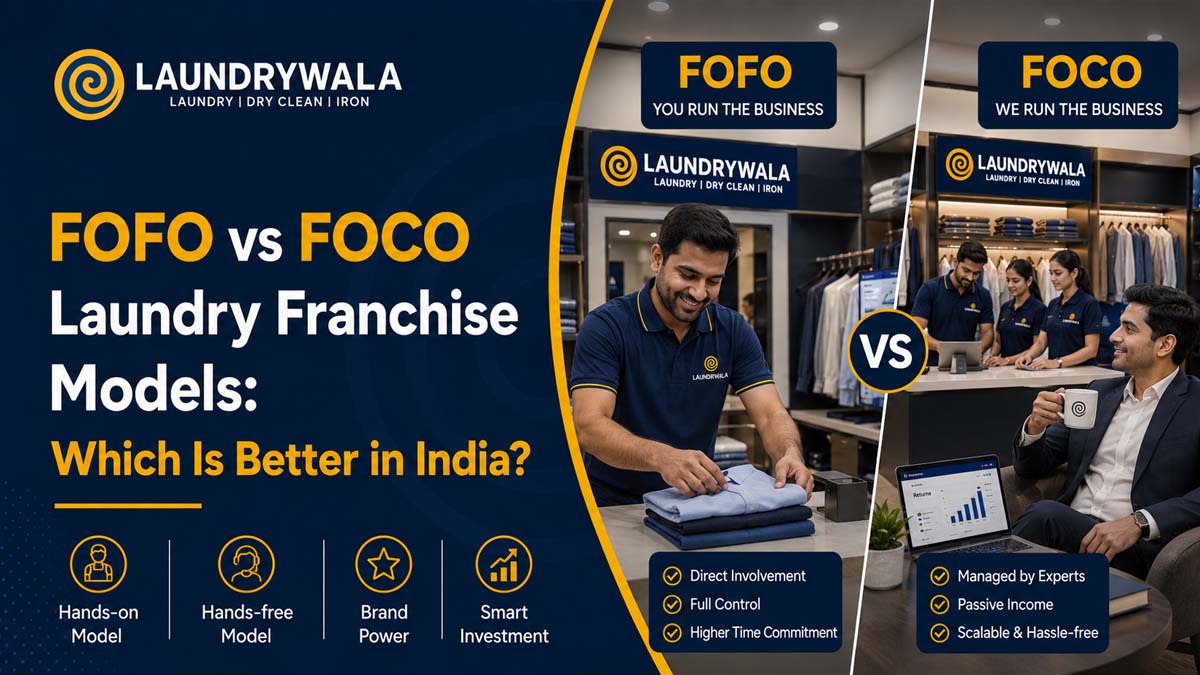
India’s professional laundry and dry-cleaning sector is attracting entrepreneurs who want to build a service business under an established brand. But before choosing a laundry franchise, there is an important question beyond investment and location: who will actually operate the outlet?
That is where FOFO and FOCO franchise models differ.
FOFO means Franchise Owned, Franchise Operated. FOCO means Franchise Owned, Company Operated. In both structures, the franchise partner generally funds or owns the outlet, but day-to-day responsibility is different. Industry usage describes FOFO as a model in which the franchisee owns and runs the unit, while FOCO places routine operation with the franchisor or company.
For someone comparing a laundry franchise in India, this distinction affects control, workload, staffing, decision-making and risk. The better model depends on how actively you want to participate in the business.
What Is the FOFO Franchise Model?
In a FOFO model, the franchise partner invests in the outlet and also manages it. The franchisor provides the brand, operating framework, training, systems and support defined in the agreement, while the franchisee handles local execution.
In a laundry business, that can include supervising staff, monitoring garment intake, maintaining service standards, coordinating pickup and delivery, controlling expenses and resolving customer issues.
The exact division of responsibilities varies by brand and agreement. Therefore, investors should not assume that every FOFO franchise works in exactly the same way.
How FOFO Works in a Laundry Business
Laundry is an operations-driven business. Customers expect garments to be correctly tagged, processed, packed and returned on time. A FOFO franchisee therefore needs to understand daily operations, not only sales.
The franchise partner may handle manpower, local marketing, customer relationships and store management. The franchisor may provide SOPs, technology, brand standards, training and operational guidance.
This gives the franchisee more involvement in business performance, but it also means local execution matters greatly.
Advantages and Challenges of FOFO
The main advantage of FOFO is control. A hands-on entrepreneur can closely monitor service quality, staffing, local expenses and customer experience. The franchisee may also use local market knowledge to build relationships with residential societies, offices or other customer groups while following brand guidelines.
FOFO can suit someone who wants to build and manage a business personally.
The trade-off is responsibility. Hiring employees, managing complaints, controlling costs and maintaining operational discipline can demand considerable time. In laundry, small process failures—incorrect tagging, delayed delivery or poor quality checks—can quickly affect customer trust.
FOFO therefore works best for investors who are prepared to manage people and processes consistently.
What Is the FOCO Franchise Model?
In a FOCO model, the franchise partner owns or funds the unit, while the company operates it under the agreed arrangement. This usually reduces the investor’s involvement in routine store management.
The company may manage staffing, training, operating procedures, technology and customer-service standards. The investor’s role is therefore more ownership-focused than operational.
Commercial arrangements vary. Revenue sharing, management charges, profit-sharing structures and expense responsibilities should always be confirmed in the franchise agreement rather than assumed.
Advantages and Challenges of FOCO
FOCO may appeal to investors who have capital but do not want to become full-time outlet managers. Because the company operates the unit, responsibilities such as staff supervision and routine service management may remain with the franchisor, depending on the agreement.
For a process-sensitive business, central operational control can also help standardise service. Customers using a professional Laundry Service or Dry Cleaning Service expect consistent garment handling regardless of the outlet.
The trade-off is reduced direct control. The investor depends more heavily on the company’s operating capability. That makes reporting, expense allocation and performance accountability especially important.
Before investing, ask who controls collections, who approves operating expenses, how revenue is reported and what happens if the outlet does not meet expectations.
FOFO vs FOCO: Key Differences
| Factor | FOFO | FOCO |
|---|---|---|
| Outlet ownership | Franchise partner | Franchise partner |
| Daily operations | Franchisee manages | Company manages |
| Investor involvement | High | Usually lower |
| Operational control | More with franchisee | More with company |
| Staff management | Usually franchisee | Usually company |
| Local execution | Franchisee-led | Company-led |
| Best suited to | Hands-on entrepreneurs | Investors seeking less daily involvement |
These are general characteristics, not fixed legal rules. The signed agreement determines the actual relationship between the parties.
Which Model Gives You More Control?
FOFO generally gives the franchisee more direct operational control. If you want to supervise employees, monitor customer service and remain closely involved in local growth, this may be valuable.
This matters in laundry because the customer journey involves several connected steps. Businesses offering Laundry Pickup & Delivery, for example, need coordination between collection, processing, quality checking and dispatch.
FOCO places more operating authority with the company. This can reduce your routine workload, but it can also limit your influence over daily staffing and operational decisions.
So the question is not simply, “Which model gives more control?” It is, “How much control do you actually want?”
Which Model Has More Risk?
Neither model removes business risk.
In FOFO, the franchisee carries more execution responsibility. Weak staff management, poor service quality or inadequate cost control can hurt performance.
In FOCO, the investor may have less operating responsibility, but the business still depends on location, demand, costs, the commercial agreement and the company’s ability to execute effectively.
That is why investors should be cautious about any franchise proposal presented as “risk-free” or one that promises guaranteed profits. No operating model can remove normal business uncertainty.
What Should You Check Before Choosing FOFO or FOCO?
Start with the franchise agreement. Clearly identify who pays for equipment, interiors, security deposits, rent, salaries, utilities, consumables, maintenance, technology, marketing and delivery operations.
Then examine the financial reporting system. Who controls billing? How is revenue recorded? What reports will you receive? How frequently will performance be reviewed?
You should also understand renewal terms, exit clauses, territorial rights, brand standards, training responsibilities and the consequences if either party fails to meet agreed obligations.
The legal structure of the franchisee entity also matters. Startup India’s official guide to business structures covers structures such as proprietorships, partnerships, LLPs and private limited companies.
Eligible enterprises can also check the Government of India’s official Udyam Registration portal for MSME registration requirements. The Ministry of MSME’s PMEGP portal provides information on support for eligible new micro enterprises; eligibility should be verified against the current scheme rules.
FOFO or FOCO: Which Is Better for a Laundry Franchise?
There is no universal winner.
FOFO may suit you better if you want to run the business personally, are comfortable managing employees and customers, understand local marketing and can spend meaningful time on the outlet.
FOCO may suit you better if you prefer the company to manage routine operations and are comfortable allowing the franchisor greater day-to-day control.
A first-time entrepreneur who wants to learn the business from the ground up may prefer the involvement offered by FOFO. An investor already managing another business or profession may find FOCO more compatible with limited available time.
Your decision should therefore be based on your role, not only on projected financial returns.
Why the Operating Model Matters More in Laundry
A laundry franchise is not simply a retail counter. It involves garment collection, tagging, sorting, cleaning, finishing, quality checks, packaging and delivery.
A strong franchise system should clearly define responsibility at each stage. Customers judge the service by practical outcomes: Was the garment cleaned properly? Was it returned safely? Was it delivered on time? Was a problem handled professionally?
That is why prospective franchisees should understand the operating system behind the brand before investing.
If you are evaluating LaundryWala, you can first learn about the company and service approach through About LaundryWala. Then discuss the current franchise format, support system and division of responsibilities directly with the team.
FAQs about best Laundry Tips
Everything you need to know about expert fabric care, stain removal, and maintaining your garments like a pro.
Still have questions?
Can't find what you're looking for? Our fabric care specialists and franchise advisors are here to help.
