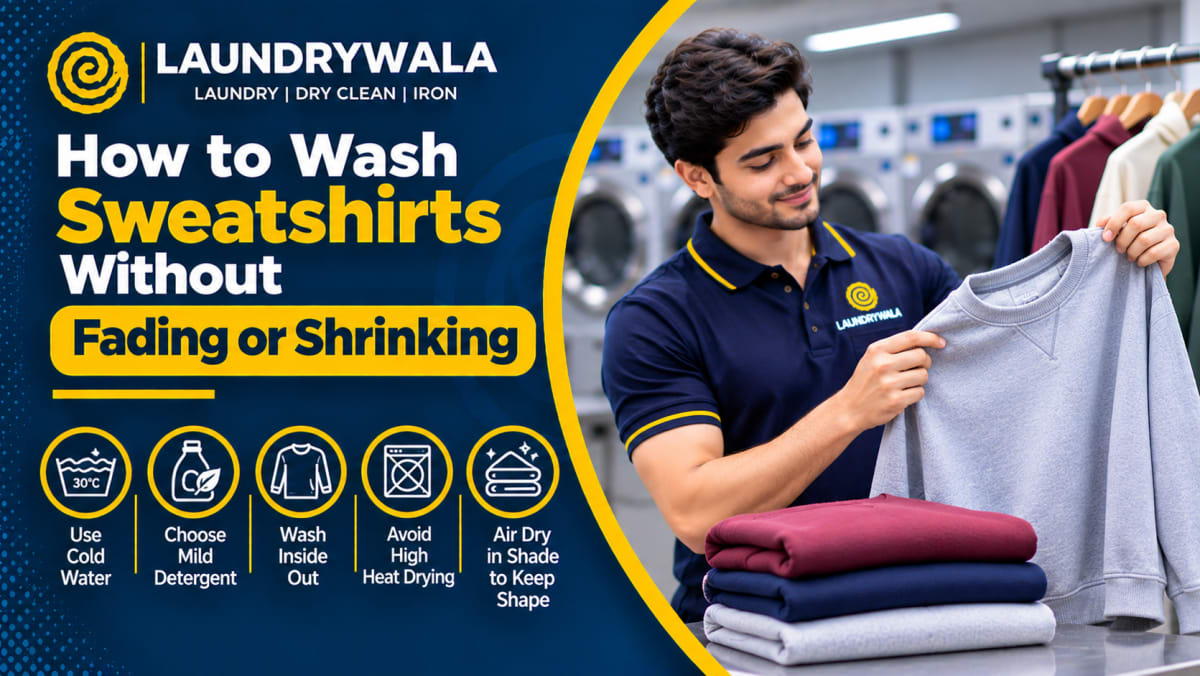
A comfortable sweatshirt can quickly become a wardrobe favourite, but repeated washing may make it look faded, feel rough or fit smaller than before. Printed designs may crack, fleece interiors may flatten, ribbed cuffs may stretch and the outer surface may begin developing small fabric pills.
These problems are not always caused by poor-quality fabric. Hot water, excessive detergent, overloaded machines, harsh wash cycles and high dryer heat can also affect a sweatshirt’s colour, size, softness and surface.
Learning how to wash sweatshirts correctly can help them retain their shape, colour and comfortable feel for longer.
Quick answer: Check the care label, turn the sweatshirt inside out, close zips and wash it with similar colours and fabrics. Use a label-approved gentle cycle, suitable detergent and the recommended water temperature. Avoid overloading the washing machine and excessive dryer heat. Reshape the sweatshirt after washing and dry it according to its care instructions.
Why Do Sweatshirts Fade, Shrink or Become Rough?
Sweatshirts are often made from cotton, polyester, fleece or blended fabrics. Many also contain ribbed cuffs, printed graphics, embroidery, zips, drawstrings and brushed inner surfaces.
Every part may respond differently to washing, detergent, friction and heat.
A sweatshirt may fade, shrink or lose softness because of:
- Hot water
- High dryer temperature
- Strong detergent
- Excess detergent
- Frequent washing
- Hard machine agitation
- Washing with rough garments
- Overloading the washing machine
- Long exposure to harsh sunlight
- Chlorine bleach
- Fabric-softener buildup
- Unnecessary ironing
- Washing printed sweatshirts right-side out
- Leaving stains untreated
- Using the wrong wash cycle
Cotton-rich sweatshirts may be more likely to change size when exposed to unsuitable washing or drying conditions. Polyester-rich sweatshirts may resist some shrinkage but can still develop pilling, static, odour buildup or flattened fleece.
The correct method depends on the sweatshirt’s fibre content, construction and care label.
Identify the Sweatshirt Material Before Washing
Check the label before selecting a cleaning method. The fabric name can help explain why two sweatshirts require different treatment.
Cotton Sweatshirts
Cotton sweatshirts are breathable and comfortable but may shrink or fade when exposed to unsuitable heat and washing conditions.
Pre-shrunk cotton may still experience some dimensional change. Follow the care label instead of assuming that every cotton sweatshirt can be washed or dried at a high temperature.
Cotton-Polyester Blends
Blended sweatshirts combine cotton comfort with synthetic durability. They may shrink less than some pure-cotton garments but can still lose colour, develop pilling or become rough.
Polyester Fleece
Polyester fleece is lightweight and warm. It can attract lint, build static and develop surface pills through friction.
High heat may affect synthetic fibres, so always check the drying instructions.
Brushed Fleece
Many sweatshirts have a brushed interior that creates a soft, warm surface. Excessive washing, hard agitation and unsuitable drying may flatten or roughen this texture.
French Terry
French-terry sweatshirts usually have a smooth outer surface and looped interior. The loops can snag on hooks, rough zips or sharp accessories.
Wool-Blend Sweatshirts
Some premium sweatshirts contain wool, cashmere or other delicate fibres. These garments may require a wool cycle, hand washing or professional cleaning.
Printed or Embroidered Sweatshirts
Printed graphics, vinyl designs, screen printing, embroidery and patches may require lower heat and reduced friction.
A washing method that is safe for the base fabric may still damage the decoration.
Read the Care Label First
The care label should determine the washing, drying and ironing method.
Check for instructions about:
- Machine washing
- Hand washing
- Water temperature
- Gentle or normal cycle
- Bleaching
- Tumble drying
- Flat drying
- Line drying
- Ironing
- Dry cleaning
- “Do Not Wash” warnings
The FTC’s garment-care labelling guidance explains that care instructions address washing, drying, bleaching, ironing and dry-cleaning requirements.
If you find the symbols confusing, Laundrywala’s guide to understanding fabric-care labels explains the most common garment-care symbols.
Do not copy the wash routine of another sweatshirt simply because both garments look similar. Fibre content, dye, printing method and fabric finishing may differ.
What Should You Do Before Washing a Sweatshirt?
Preparing the sweatshirt correctly reduces fading, snagging and shape damage.
Empty the Pockets
Remove tissues, paper, coins, keys and other items. A forgotten tissue can break apart and leave lint across the sweatshirt.
Close Zips
Close the main zip and pocket zips to reduce snagging. Secure any hook-and-loop fasteners so they do not catch on the fabric.
Loosen Drawstrings Carefully
Check whether the drawstring ends are secure. Tie them loosely when necessary to prevent them from disappearing inside the hood channel.
Do not make a tight knot that may be difficult to open after washing.
Turn the Sweatshirt Inside Out
Turning the sweatshirt inside out can reduce direct friction against the visible surface and printed design.
This is particularly useful for:
- Dark sweatshirts
- Printed sweatshirts
- Embroidered sweatshirts
- Sweatshirts with vinyl graphics
- Brushed-fleece garments
- Sweatshirts prone to pilling
Separate Colours
Wash whites, lights and dark colours separately.
New sweatshirts may release loose dye during their first few washes. Laundrywala’s guide on washing new clothes before wearing them explains why a careful first wash is important.
Check for Stains
Inspect:
- Collars
- Cuffs
- Underarms
- Pocket openings
- Front panels
- Sleeve ends
- Drawstrings
- Hood edges
Treat stains before placing the sweatshirt in the machine. Dryer heat may make untreated marks more difficult to remove.
How to Wash Sweatshirts in a Washing Machine
Machine washing is suitable only when the care label permits it.
Step 1: Sort the Laundry
Wash sweatshirts with similar colours, weights and fabric types.
Avoid washing them with:
- Towels
- Rough denim
- Heavy blankets
- Clothes with open hooks
- Garments with exposed zips
- Heavily soiled workwear
- Lint-producing items
Rough, heavy garments can create friction and increase surface wear.
Step 2: Turn the Sweatshirt Inside Out
Keep the visible outer surface and printed design away from direct contact with the drum and other garments.
Close zips before turning a zip-up sweatshirt inside out.
Step 3: Select the Correct Water Temperature
Use the temperature shown on the care label.
Cool or cold water may help reduce colour loss and heat-related shrinkage for many washable sweatshirts, but the garment’s instructions should remain the deciding factor.
The American Cleaning Institute’s dark-clothing guidance recommends considering cold washing and air drying for dark garments when their labels permit those methods.
Step 4: Use the Correct Detergent Quantity
Use detergent suitable for the sweatshirt’s colour and fabric.
Measure it according to:
- Product instructions
- Washing-machine load
- Water conditions
- Soil level
- Detergent concentration
Too much detergent can remain inside thick fabric and make the sweatshirt feel stiff or sticky. Too little detergent may fail to remove body oil and odour.
The American Cleaning Institute’s detergent guidance recommends following both detergent and garment-care instructions.
Step 5: Choose a Suitable Cycle
Use the normal, gentle or delicate cycle specified by the care label.
A gentle cycle may be useful for:
- Printed sweatshirts
- Embroidered sweatshirts
- Brushed fleece
- Dark colours
- Lightweight blends
- Older garments
Do not automatically choose the strongest cycle because the sweatshirt looks thick. Hard agitation can increase friction, fading and pilling.
Step 6: Avoid Overloading the Machine
Sweatshirts need enough space for water and detergent to move through the fabric.
An overloaded drum may result in:
- Poor cleaning
- Incomplete rinsing
- Detergent residue
- Excessive friction
- Deep wrinkles
- Uneven washing
- Persistent odour
Wash bulky sweatshirts in smaller loads.
Step 7: Remove the Sweatshirt Promptly
Take the sweatshirt out after the cycle ends.
Leaving it wet and crumpled inside the drum may create wrinkles, odour and uneven drying.
Shake it gently and reshape the body, sleeves, cuffs, hood and waistband before drying.
How to Hand-Wash a Sweatshirt
Hand washing may be suitable when the label permits it and the sweatshirt requires gentler handling.
- Fill a clean basin with label-approved water.
- Add a small amount of suitable detergent.
- Turn the sweatshirt inside out.
- Submerge it gently.
- Press the water through the fabric.
- Focus lightly on collars, cuffs and underarms.
- Avoid scrubbing or twisting.
- Rinse with water at a similar temperature.
- Support the sweatshirt while lifting it.
- Press out water without wringing.
A wet sweatshirt can become heavy. Lifting it by the hood, sleeves or waistband may stretch those sections.
Place it on a clean towel and roll the towel gently to absorb excess water when appropriate.
How to Prevent Sweatshirts From Fading
Fading can occur because of dye characteristics, repeated washing, friction, heat and light exposure.
To protect colour:
- Wash only when necessary.
- Follow the care label.
- Turn the sweatshirt inside out.
- Separate dark and light colours.
- Use an appropriate detergent.
- Avoid chlorine bleach unless permitted.
- Select a suitable cycle.
- Avoid unnecessary soaking.
- Remove the sweatshirt promptly.
- Dry dark garments away from prolonged harsh sunlight.
- Do not iron directly over prints.
- Avoid excessive dryer heat.
Laundrywala’s guide on washing black clothes without fading provides additional guidance for dark sweatshirts and other black garments.
Some colour loss is a normal result of repeated wear and washing. Correct care can reduce unnecessary fading but cannot guarantee that every dye will remain unchanged indefinitely.
How to Prevent Sweatshirts From Shrinking
Shrinkage depends on the fibre, yarn, construction, manufacturing finish and care process.
Cotton-rich sweatshirts may change size when exposed to unsuitable heat or agitation. However, synthetic and blended sweatshirts can also become distorted.
CottonWorks’ information about fabric shrinkage and garment construction explains that dimensional change can be influenced by fibre, yarn, fabric structure, processing and garment care.
To reduce shrinkage risk:
- Check the fibre content.
- Follow the care label.
- Avoid hotter water than permitted.
- Use an appropriate wash cycle.
- Do not leave the sweatshirt soaking unnecessarily.
- Reshape it after washing.
- Avoid high dryer heat unless allowed.
- Do not place it directly on a heater.
- Do not iron at excessive temperature.
- Avoid washing a dry-clean-only sweatshirt at home.
Laundrywala’s guide on why clothes shrink after washing explains common washing and drying mistakes that cause dimensional change.
Cleaning cannot always restore a severely shrunken sweatshirt. Prevention is more reliable than attempting to stretch damaged fabric back into shape.
How to Keep Sweatshirts Soft
Softness depends on the fibre, fabric finish, detergent, water quality and drying method.
Use the Correct Detergent Amount
Excess detergent may remain inside the sweatshirt, especially when the machine is overloaded or the rinse cycle is insufficient.
If a sweatshirt feels stiff after washing, detergent residue may be one reason.
Do Not Overwash
A sweatshirt does not always require washing after a short, clean wear. Frequency depends on sweat, stains, odour, weather and how closely the garment touches the skin.
Air it in a clean, shaded and ventilated area between suitable wears.
Avoid Excessive Heat
High dryer heat may affect softness, elastic ribbing, prints and garment dimensions.
Use only the drying method permitted by the label.
Rinse Thoroughly
An extra rinse may be useful when permitted if the sweatshirt feels soapy or stiff. However, do not repeatedly run unnecessary cycles.
Use Fabric Softener Carefully
Do not assume that fabric softener is suitable for every sweatshirt.
Some fleece, technical, moisture-wicking or specially finished garments may have manufacturer restrictions. Follow the garment label and fabric-softener instructions before use.
Separate Rough Fabrics
Washing soft sweatshirts with towels, heavy jeans and rough garments creates more surface friction.
A fabric-appropriate laundry load can help reduce unnecessary wear.
How to Prevent Pilling on Sweatshirts
Pilling occurs when loose fibres become tangled into small balls on the surface. Friction from wear and washing can contribute to the problem.
The American Cleaning Institute’s laundering-problem guide notes that pilling is a wear-related problem that may not be completely preventable.
To reduce pilling:
- Turn the sweatshirt inside out.
- Use a suitable gentle cycle.
- Avoid overloading the machine.
- Separate rough and heavy fabrics.
- Close open zips and fasteners.
- Avoid hard scrubbing.
- Follow drying instructions.
- Do not repeatedly wash a lightly worn sweatshirt.
- Store it away from rough surfaces.
- Remove pills with a suitable fabric tool carefully.
Do not pull pills off with your fingers. Pulling may damage the fibres and create a larger rough area.
Laundrywala already provides a detailed guide to preventing and removing pilling from clothes.
How to Wash Printed Sweatshirts
Printed sweatshirts may contain screen printing, heat-transfer vinyl, rubberised graphics, digital prints or decorative patches.
To protect the design:
- Read the care label.
- Turn the sweatshirt inside out.
- Use the recommended temperature.
- Avoid bleach unless permitted.
- Select a suitable gentle cycle.
- Do not scrub the print.
- Avoid prolonged soaking.
- Do not place a hot iron directly on the graphic.
- Avoid high dryer heat when prohibited.
- Do not fold the garment while the print is hot.
If ironing is permitted, iron the sweatshirt inside out or use a suitable protective pressing cloth according to the manufacturer’s instructions.
Do not apply stain remover directly to a print without testing it on a hidden area.
How to Wash Fleece Sweatshirts
Fleece sweatshirts can lose softness, attract lint and develop pills when washed with rough or lint-producing garments.
Before washing:
- Empty the pockets.
- Close zips.
- Turn the sweatshirt inside out.
- Separate it from towels.
- Check the care label.
- Use the permitted cycle and temperature.
- Measure detergent carefully.
- Avoid high heat unless allowed.
Do not brush a wet fleece surface aggressively. Allow it to dry according to the label before assessing its texture.
Fleece containing specialised coatings, bonded layers or technical finishes may require different care from an ordinary polyester sweatshirt.
How to Treat Common Sweatshirt Stains
Sweat and Deodorant Marks
Underarms, collars and cuffs may contain sweat, body oil and deodorant residue.
Apply a label-approved pre-treatment product and test it on a hidden section first. Avoid hard brushing because it may roughen the surface.
Food Stains
Remove solids using a blunt spoon and blot liquid without spreading it.
Treat the stain before washing. Do not place the sweatshirt in a heated dryer until the stain has been checked.
Oil and Grease
Blot excess oil with a clean absorbent cloth. Use a fabric-safe pre-treatment product if permitted.
Oil marks on premium or delicate sweatshirts may require professional treatment.
Ink
Avoid acetone, nail-polish remover and untested solvents. These may remove both the ink and the sweatshirt’s colour or print.
Mud
Remove loose surface mud carefully when appropriate. Treat the remaining mark according to the care label and stain-product instructions.
Laundrywala’s guide on removing stains from clothes provides general stain-treatment guidance for washable garments.
How to Dry Sweatshirts Without Damage
The correct drying method is essential for preventing shrinkage and maintaining softness.
Air Drying
If the label permits air drying:
- Shake the sweatshirt gently.
- Reshape the body and sleeves.
- Straighten the cuffs and waistband.
- Arrange the hood correctly.
- Place it on a suitable drying surface or hanger.
- Keep it away from harsh sunlight when colour fading is a concern.
- Ensure air can circulate around the garment.
A heavy wet sweatshirt may stretch on a narrow hanger. Flat drying may be more suitable for some heavy or delicate garments.
Tumble Drying
Tumble-dry only when permitted.
Use the heat level stated on the label. High heat can affect cotton fibres, polyester fleece, elastic ribbing, prints and glued decorations.
Remove the sweatshirt promptly when dry to reduce deep wrinkles.
Avoid Direct Heat
Do not place a sweatshirt:
- On a radiator
- Against a room heater
- Under a hairdryer
- On a hot metal surface
- Directly beneath intense heat
Direct heat may create uneven shrinkage, stiffness, colour changes or surface damage.
Should Sweatshirts Be Ironed?
Many sweatshirts do not require ironing when they are reshaped and dried correctly.
If ironing is permitted:
- Check the temperature symbol.
- Turn the sweatshirt inside out.
- Use a suitable pressing cloth.
- Avoid stretching the fabric.
- Do not iron directly over prints, embroidery or rubberised designs.
- Keep high heat away from polyester fleece.
Steam may not be suitable for every print or synthetic fabric. Follow the care instructions.
Laundrywala’s comparison of steam ironing and normal ironing can help explain which finishing method suits different fabrics.
How Often Should You Wash a Sweatshirt?
There is no fixed schedule for every sweatshirt.
Consider washing when:
- It has visible stains.
- The underarms smell.
- The collar looks oily.
- It was worn during exercise.
- It was exposed to smoke or pollution.
- Food or drink was spilled.
- It has been worn repeatedly.
- It is being prepared for storage.
If the sweatshirt was worn briefly over another garment and remains clean, airing it may be enough before another suitable wear.
Washing too frequently can increase fading, fibre wear and pilling. Washing too rarely can allow sweat, body oil and stains to build up.
Common Sweatshirt-Washing Mistakes
Avoid these common mistakes:
- Ignoring the care label
- Washing every sweatshirt in hot water
- Using too much detergent
- Mixing lights and darks
- Washing with rough towels and jeans
- Leaving zips open
- Washing printed sweatshirts right-side out
- Overloading the machine
- Using chlorine bleach without approval
- Scrubbing fleece aggressively
- Wringing the garment
- Using high dryer heat
- Ironing directly over prints
- Storing the sweatshirt while damp
- Pulling fabric pills by hand
Laundrywala’s guide to common laundry mistakes that damage clothes explains how everyday washing errors affect colour, shape and fabric life.
When Should You Choose Professional Cleaning?
Professional garment care may be suitable when:
- The label says “Dry Clean Only.”
- The sweatshirt contains wool or cashmere.
- Leather, suede or fur details are present.
- The garment has embroidery, beads or glued patches.
- Colour transfers during testing.
- A persistent oil or ink stain remains.
- The sweatshirt has a specialised coating.
- Home washing has already caused shrinkage.
- The print is delicate or damaged.
- The item is expensive, vintage or sentimental.
- You cannot identify the fabric.
- Strong odour remains after appropriate washing.
Laundrywala’s professional laundry service provides washing, drying and finishing for suitable everyday garments. Premium or dry-clean-only sweatshirts can be inspected through the professional dry-cleaning service.
Use the Laundrywala store locator to check service availability near you.
How Laundrywala Can Help
Laundrywala provides laundry, dry cleaning, stain treatment and garment-finishing services across serviceable locations.
Depending on the sweatshirt, the cleaning process may include:
- Care-label inspection
- Fabric identification
- Colourfastness testing
- Print and decoration assessment
- Stain pre-treatment
- Fabric-appropriate cleaning
- Controlled drying
- Reshaping
- Finishing
- Final quality inspection
- Doorstep pickup and delivery
Before booking, share photographs of the care label, print, stains and damaged areas. Mention any home-cleaning products already applied.
To request assistance, contact Laundrywala.
Laundrywala FAQs
Find answers to commonly asked questions about our services, processes, and how we deliver quality across India.
Still have questions?
Can't find what you're looking for? Our fabric care specialists and franchise advisors are here to help.