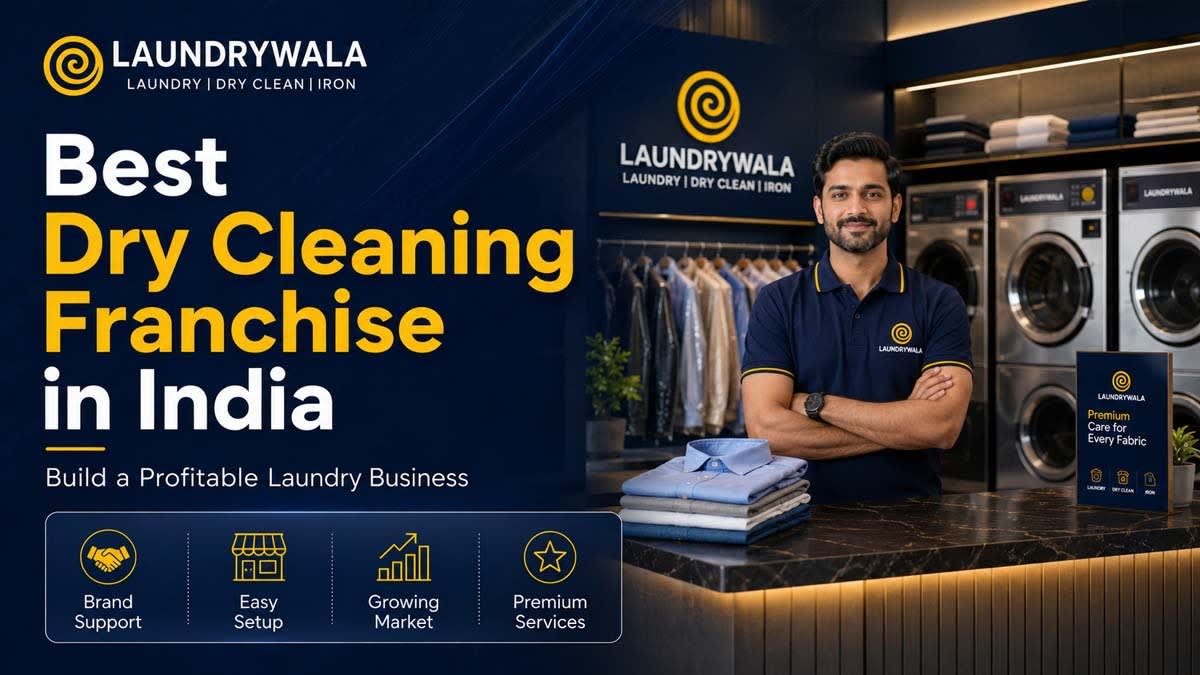
India’s garment-care industry is gradually shifting from unorganised neighbourhood cleaners to professional laundry and dry-cleaning brands. Customers now expect transparent pricing, reliable fabric care, hygienic processing, professional finishing, digital billing, order tracking and doorstep pickup and delivery.
This changing customer behaviour has created opportunities for entrepreneurs looking to enter a recurring-demand service business. However, selecting the best dry cleaning franchise in India requires much more than comparing the lowest investment or the highest advertised return.
An investor must evaluate the complete setup cost, franchise model, processing system, machinery, available services, working capital, location potential, operational support and franchise-agreement terms.
A dry-cleaning franchise is an operations-driven business. Every garment must be inspected, tagged, sorted, treated, cleaned, finished, checked and delivered correctly. A recognised brand and attractive store design can support the business, but long-term success depends on service quality, customer retention, expense control and daily management.
Quick answer: Laundrywala offers three organised laundry and dry-cleaning franchise formats with published investment levels ranging from approximately ₹13.49 lakh to ₹20.99 lakh. Depending on the selected model, the store may require approximately 200–350 sq. ft., suitable utility infrastructure and a team of two to four people. Final investment, profitability and break-even depend on the location, rent, order volume, service mix and franchise agreement.
What Is a Dry Cleaning Franchise?
A dry-cleaning franchise allows an entrepreneur to operate a professional garment-care business under an established brand.
Instead of creating everything independently, the franchise partner receives access to an existing business framework. Depending on the selected company and agreement, this framework may include:
- Brand identity and store signage
- Location-evaluation assistance
- Store layout and design guidance
- Machinery and equipment recommendations
- Garment-cleaning procedures
- Staff training
- Service-pricing guidance
- Billing and order-management technology
- Packaging standards
- Marketing materials
- Vendor coordination
- Quality-control processes
- Post-launch operational support
The franchise partner generally invests in the outlet, manages employees, controls daily expenses and builds the local customer base.
The exact operating model should be confirmed before investing. Some outlets process laundry and selected garment categories inside the store, while specialised dry-cleaning orders may follow a different approved process. Other franchise models work mainly as collection centres connected to a central processing facility.
An investor must understand where garments will be processed, who will manage transportation and how complaints, reprocessing and delayed orders will be handled.
Why Is Dry Cleaning a Growing Business Opportunity?
Clothing is a continuing household requirement. Everyday garments, office wear, uniforms, sarees, suits, wedding outfits, curtains, carpets and winter clothing all require regular or specialised care.
Many urban customers do not have sufficient time, space or equipment to manage every type of garment at home. Apartment living, demanding work schedules and increasing awareness of professional fabric care are supporting demand for organised laundry and dry-cleaning services.
The business can also generate revenue from several customer segments:
- Working professionals
- Families living in apartments
- Students and PG residents
- Hotels and guest houses
- Salons and spas
- Clinics and healthcare facilities
- Restaurants
- Corporate offices
- Boutiques and fashion stores
- Schools and institutions
- Wedding and event customers
A professionally managed outlet can combine recurring household laundry with higher-value dry cleaning and specialised services. This balance can help the business avoid depending only on occasional premium orders.
How Does the Dry-Cleaning Business Process Work?
Understanding the operational workflow is essential before choosing the best dry cleaning franchise in India.
Order Booking and Collection
Customers may book through a website, mobile application, phone call, WhatsApp or store visit. Doorstep pickup allows the business to serve customers beyond walk-in traffic.
Pickup operations must be planned carefully. Widely scattered orders can increase fuel and rider costs, while a well-defined delivery radius can improve route efficiency.
Garment Inspection
Every garment should be inspected before processing.
The inspection may include:
- Fabric and care-label check
- Stain identification
- Colourfastness assessment
- Existing damage
- Missing or weak buttons
- Loose stitching
- Embroidery and embellishments
- Lining condition
- Previous home treatments
- Customer instructions
The FTC’s garment-care labelling guidance explains why care instructions should consider the complete garment, including fabric, trims, lining and attached components.
Although these guidelines relate to the US market, the core principle remains useful: the cleaning process should be selected according to the construction and care requirements of the complete garment.
Garment Tagging
Each garment should be tagged and linked to the correct customer order. Accurate tagging helps prevent garment mixing, billing mistakes and delivery disputes.
The order record should mention the garment type, colour, quantity, selected service, stains, existing damage and expected delivery date.
Sorting
Garments must be separated according to:
- Fabric
- Colour
- Care instructions
- Cleaning process
- Stain type
- Construction
- Customer priority
- Drying and finishing requirements
Every garment should not be treated with the same detergent, solvent, temperature or mechanical action.
Cleaning and Stain Treatment
Dry cleaning does not mean that no liquid is used. It generally involves an appropriate professional cleaning process using a non-water-based solvent or another fabric-specific method.
Stain treatment should be selected after identifying the stain and garment material. Ink, oil, makeup, food, blood and dye-transfer stains cannot all be treated identically.
Complete stain removal cannot always be guaranteed. Results depend on the fabric, dye, stain age, heat exposure and any products previously applied at home.
Finishing and Quality Inspection
After cleaning, garments may require:
- Steam finishing
- Pressing
- Reshaping
- Lint removal
- Button inspection
- Stain rechecking
- Odour inspection
- Final quality control
The garment should then be packaged and matched with the correct invoice before delivery.
Dry Cleaning Franchise vs Regular Laundry Business
A laundry business primarily handles washable everyday clothing, while dry cleaning focuses more heavily on delicate, structured or premium garments.
However, many modern garment-care outlets combine both categories.
| Business factor | Laundry-focused service | Dry-cleaning-focused service | Combined garment-care outlet |
|---|---|---|---|
| Main demand | Everyday washable clothes | Premium and delicate garments | Regular and premium clothing |
| Order frequency | Usually frequent | Usually occasional or seasonal | Repeat demand with seasonal peaks |
| Common items | T-shirts, shirts, trousers and bedsheets | Suits, sarees, coats and wedding wear | Laundry, dry cleaning and specialised items |
| Average order value | Generally lower | Generally higher per garment | Balanced through multiple services |
| Customer segment | Households, students and professionals | Premium, formal and occasion-wear customers | Wider residential and business market |
| Operational requirement | Washing and drying efficiency | Fabric knowledge and stain treatment | Broader equipment and staff training |
A combined outlet can serve more requirements for the same customer. A household may place regular wash-and-fold orders while also sending suits, silk sarees, shoes, curtains or blankets for specialised cleaning.
Laundrywala follows this multi-service approach through its professional laundry services and dry-cleaning services.
Laundrywala Dry Cleaning Franchise Investment Plans
Laundrywala currently publishes three franchise formats. The appropriate option depends on the investor’s budget, proposed property, local demand and expected processing volume.
These are indicative package figures. Investors should request a current written commercial proposal before making a payment.
Alpha Basic Franchise
The Alpha Basic model has a published investment of approximately ₹13.49 lakh.
Its listed requirements include:
- Store area: Approximately 200–250 sq. ft.
- Suggested manpower: Two to three employees
- Electricity requirement: Approximately 8 kW
- Water requirement: Approximately 1,000 litres
- Machinery: 15 kg washer and dryer
- Finishing setup: Basic ironing arrangement with a 4 kW boiler
This compact format may be suitable for a neighbourhood outlet serving apartment societies, working professionals and regular household customers.
The owner should still evaluate whether the proposed area has enough repeat orders to support rent, salaries, utilities and local marketing.
Classic Franchise
The Classic model has a published investment of approximately ₹15.99 lakh.
Its listed requirements include:
- Store area: Approximately 250–300 sq. ft.
- Suggested manpower: Two to three employees
- Electricity requirement: Approximately 15 kW
- Water requirement: Approximately 1,000 litres
- Machinery: 15 kg and 10 kg washer-dryer stackers
- Finishing setup: Ironing arrangement with a 4 kW boiler
This model provides additional processing capacity and may suit residential markets with stronger regular laundry demand.
Combo Premium Franchise
The Combo Premium model has a published investment of approximately ₹20.99 lakh.
Its listed requirements include:
- Store area: Approximately 300–350 sq. ft.
- Suggested manpower: Three to four employees
- Electricity requirement: Approximately 16 kW
- Water requirement: Approximately 2,000 litres
- Machinery: 18 kg commercial washer and dryer with a separate 10 kg retail setup
- Finishing setup: Ironing arrangement with a 6 kW boiler
This model may suit investors planning to combine household orders with selected commercial laundry requirements.
Laundrywala Franchise Plan Comparison
| Franchise format | Published investment | Store area | Suggested team | Potential use |
|---|---|---|---|---|
| Alpha Basic | ₹13.49 lakh | 200–250 sq. ft. | 2–3 people | Compact neighbourhood outlet |
| Classic | ₹15.99 lakh | 250–300 sq. ft. | 2–3 people | Higher retail processing capacity |
| Combo Premium | ₹20.99 lakh | 300–350 sq. ft. | 3–4 people | Retail and selected commercial volume |
Package pricing may change. Final project cost may also vary according to taxes, rent, property condition, interiors, transportation, installation and working capital.
Review the detailed guide to laundry franchise costs in India before preparing the final budget.
What Should the Total Project Budget Include?
The franchise-package price and the complete cost of opening the store may not be identical.
An investor should request an itemised cost sheet covering:
- Franchise or brand fee
- Machinery and equipment
- Boiler and ironing setup
- Transportation
- Machinery installation
- GST and other applicable taxes
- Interior work
- Electrical upgrades
- Plumbing and drainage
- Water-storage arrangements
- Store signage
- Garment racks
- Reception counter
- Billing and CRM software
- Initial cleaning supplies
- Packaging material
- Security deposit
- Advance rent
- Staff recruitment
- Training-related expenses
- Delivery vehicle or rider setup
- Launch marketing
- Working capital
For example, the published investment may cover core equipment but exclude the property deposit, civil work or recurring operational expenses.
Always calculate the complete cost to launch, rather than planning only around the headline franchise price.
How Much Working Capital Is Required?
Working capital is the money required to operate the outlet before it develops consistent order volume.
Monthly expenses may include:
- Rent
- Staff salaries
- Electricity
- Water
- Cleaning chemicals
- Packaging
- Pickup and delivery
- Fuel
- Software charges
- Machine servicing
- Local marketing
- Repairs
- Reprocessing
- Customer complaint resolution
- Taxes and professional fees
The required reserve depends on the city, rent, team size, business format and expected sales.
Prepare three projections:
- Conservative order volume
- Expected order volume
- Optimistic order volume
Do not spend the complete budget on machinery and interiors. A well-designed outlet can still face financial pressure if insufficient funds remain for salaries, utilities and customer acquisition.
How Can a Dry Cleaning Franchise Generate Revenue?
The best dry cleaning franchise in India should provide multiple revenue opportunities rather than depending on only one service.
Regular Laundry
Wash-and-fold and wash-and-iron services can generate recurring demand from households, students and working professionals.
Professional Dry Cleaning
Suits, blazers, silk sarees, woollen coats, formal dresses and wedding outfits may generate a higher value per garment.
Steam Ironing
Customers who wash clothes at home may still require professional pressing for office wear, uniforms, sarees and formal garments.
Shoe and Bag Cleaning
Shoes and handbags made from leather, suede, canvas, mesh and synthetic materials require specialised care. These services can increase the average customer bill.
Curtain and Carpet Cleaning
Curtains and carpets can be difficult to wash and dry at home. Professional cleaning can generate seasonal and higher-value orders.
Blanket and Comforter Cleaning
Heavy blankets, quilts and comforters require sufficient washing capacity and complete drying. Demand may increase before and after the winter season.
Wedding-Wear Care
Lehengas, sherwanis, sarees and embellished outfits require careful inspection, cleaning and finishing. Wedding seasons can create demand for premium garment care.
Pickup and Delivery
Doorstep service expands the customer base, but the delivery radius and minimum-order policy should be planned carefully.
Commercial Laundry
Hotels, clinics, salons, hostels, restaurants and offices may require regular cleaning of uniforms, towels, bedsheets or linen.
Commercial orders can add volume, but the owner should calculate processing capacity, transport costs, payment terms and profit margins before accepting a contract.
Is a Dry Cleaning Franchise Profitable?
A dry-cleaning franchise can become profitable when the outlet develops sufficient order volume, maintains repeat customers and controls operating costs.
Laundrywala’s current franchise information presents an illustrative planning range of approximately:
- Net margin after key expenses: 22–30%
- Break-even period: 14–20 months
These figures should not be treated as guaranteed returns. Actual results depend on the location, rent, service prices, customer demand, order volume, delivery cost, staff productivity and owner involvement.
Main Profitability Factors
Monthly Order Volume
The outlet needs enough regular orders to cover fixed expenses such as rent, salaries and utilities.
Average Bill Value
An order containing laundry, dry cleaning, shoes and home fabrics may have a higher value than an order containing only everyday clothes.
Customer Retention
Repeat customers reduce dependence on continuous paid advertising and can create more predictable revenue.
Service Mix
Regular laundry can generate frequency, while dry cleaning and specialised care may improve revenue per order.
Pickup Density
Serving several customers within the same residential area is generally more efficient than collecting small orders across distant locations.
Expense Control
High rent, unnecessary staff, inefficient routes and excessive discounting can reduce profitability even when revenue appears strong.
How Should Monthly Profit Be Calculated?
Use a location-specific estimate instead of relying only on national projections.
Estimated monthly revenue = Number of monthly orders × Average order value
Deduct:
- Rent
- Salaries
- Electricity and water
- Chemicals and consumables
- Packaging
- Delivery expenses
- Marketing
- Software fees
- Royalty or recurring charges, if applicable
- Maintenance
- Taxes
- Reprocessing and complaint costs
The remaining amount represents the operating profit before considering applicable tax and financing obligations.
Revenue should never be confused with profit.
Operating Break-Even vs Investment Recovery
These two terms are different.
Operating Break-Even
The outlet reaches operating break-even when its monthly revenue covers its monthly operating expenses.
Investment Recovery
Investment recovery occurs when cumulative profits recover the initial franchise, equipment, property, setup and launch investment.
A store may cover its monthly expenses before the investor has recovered the original capital.
Whenever a break-even period is presented, ask whether it refers to monthly operational break-even or complete investment recovery.
How to Select the Right Location
The micro-location is usually more important than selecting a famous city.
A promising catchment may include:
- Apartment societies
- Gated residential communities
- Working professionals
- High-income households
- Hostels and PGs
- Hotels
- Salons and spas
- Clinics
- Offices
- Gyms
- Wedding markets
- Fashion boutiques
Residential Density
Estimate the number of occupied households within the practical pickup radius. A dense residential catchment can support recurring laundry orders.
Customer Profile
Understand whether the area contains families, students, office workers or premium-garment customers. The local customer profile should match the proposed service range and prices.
Existing Competition
Study local laundries and dry cleaners. Compare their prices, ratings, services, delivery times and customer complaints.
Competition does not automatically make an area unsuitable. It may indicate that demand exists. However, the new outlet must offer a meaningful quality or convenience advantage.
Rent and Visibility
A visible ground-floor outlet can improve walk-in enquiries, but expensive frontage may affect profitability.
Balance visibility with affordable rent, pickup access, machinery installation and utility availability.
Delivery Access
The location should allow riders to collect and return orders efficiently. Difficult parking and congested routes may increase costs and delays.
Technical Infrastructure
Before signing the lease, confirm:
- Sanctioned electrical load
- Water supply
- Water-storage capacity
- Drainage
- Ventilation
- Machinery space
- Sorting area
- Garment-storage area
- Finishing station
- Customer counter
- Delivery access
- Local commercial-use permissions
Request written location approval from the franchisor before entering a long-term rental agreement.
What Support Should Laundrywala Provide?
Franchise support should continue beyond selling the franchise and installing machines.
Pre-Opening Support
Depending on the final agreement, support may include:
- Location evaluation
- Property review
- Store-layout planning
- Machinery selection
- Branding guidance
- Vendor coordination
- Staff-hiring assistance
- Owner and employee training
- Technology setup
- Service-menu guidance
- Launch planning
Post-Opening Support
Ongoing assistance may include:
- Operational reviews
- Cleaning-process guidance
- Marketing material
- Technology assistance
- Supply coordination
- Quality-control support
- Customer-service procedures
- Complaint-resolution guidance
- Local growth planning
Before signing, speak with existing Laundrywala franchise partners. Ask about actual operating costs, training, support, order development and common challenges.
You can review the Laundrywala company profile to understand the brand and its garment-care services.
Technology and Order Management
A professional franchise should have a reliable system for recording and monitoring orders.
Useful technology features may include:
- Customer profiles
- Garment counts
- Service selection
- Digital invoices
- Pickup scheduling
- Delivery status
- Payment records
- Order history
- Discount management
- Complaint tracking
- Store-performance reports
- Repeat-customer information
Technology reduces manual errors, but it cannot replace physical inspection and quality control.
Every outlet should have a clear process for garments received, sent for processing, returned for finishing and delivered to the customer.
What Should Be Checked in the Franchise Agreement?
The franchise agreement should be reviewed carefully before paying a franchise fee.
Important terms include:
- Total investment and exclusions
- Franchise fee
- GST and taxes
- Royalty or recurring charges
- Marketing contribution
- Territory boundaries
- Agreement duration
- Renewal charges
- Mandatory vendors
- Equipment ownership
- Software charges
- Performance requirements
- Transfer rights
- Exit conditions
- Termination clauses
- Complaint liability
- Garment-damage policy
- Dispute-resolution procedure
Important verbal commitments should be included in writing.
A qualified lawyer and financial adviser can help review the agreement and financial projections. Entrepreneurs can also consult official Startup India business resources, the Udyam Registration portal and the GST portal for general business-registration information.
Important Risks to Consider
No franchise should be treated as a guaranteed-income or passive-investment scheme.
Potential challenges include:
- Slow customer acquisition
- High commercial rent
- Staff turnover
- Inconsistent cleaning quality
- Machinery breakdown
- Delivery delays
- Garment-damage complaints
- Reprocessing costs
- Seasonal demand
- Rising electricity and fuel expenses
- Discount-based competition
- Delayed commercial payments
- Poor customer retention
The owner should remain actively involved in service quality, finances and customer experience, even when a store manager handles daily operations.
Why Consider Laundrywala?
Laundrywala operates a multi-service laundry and dry-cleaning franchise model that combines professional garment care with doorstep convenience.
Its service portfolio includes:
- Laundry
- Wash and iron
- Dry cleaning
- Steam ironing
- Shoe cleaning
- Bag cleaning
- Curtain cleaning
- Carpet cleaning
- Blanket and comforter cleaning
- Wedding-wear care
- Pickup and delivery
- Selected commercial laundry services
Laundrywala currently presents:
- More than 150 stores
- Presence across more than 75 cities
- Three published franchise formats
- Store requirements starting from approximately 200 sq. ft.
- Technology for billing and order management
- Location and store-setup guidance
- Staff training
- Marketing assistance
- Operational support
The availability of different formats allows investors to select a model according to their capital, location and processing requirements.
However, investors should verify every commercial claim through the latest official proposal and franchise agreement.
The official Laundrywala franchise opportunity provides details about available models and the enquiry process.
Steps to Start a Laundrywala Dry Cleaning Franchise
Step 1: Decide the Complete Budget
Calculate the amount available for the franchise package, taxes, property, infrastructure and working capital.
Step 2: Select the Appropriate Format
Compare Alpha Basic, Classic and Combo Premium according to local demand, property size and expected order volume.
Step 3: Choose a City and Catchment
Study residential density, customer profile, competition, rent and delivery feasibility.
Step 4: Request the Latest Proposal
Ask for current investment figures, inclusions, exclusions, recurring charges, equipment and available territories.
Step 5: Shortlist Properties
Identify properties that meet space, electricity, water, drainage and delivery-access requirements.
Step 6: Arrange Location Evaluation
Obtain approval before signing a long lease or paying a large property deposit.
Step 7: Review the Agreement
Understand the fees, territory, support, obligations, renewal, exit and dispute conditions.
Step 8: Complete Store Setup
Coordinate the interiors, machinery, electrical work, plumbing, signage and technology installation.
Step 9: Recruit and Train the Team
Employees should receive training in garment inspection, tagging, sorting, processing, finishing and customer handling.
Step 10: Launch Local Marketing
Promote the outlet through:
- Apartment societies
- Google Business Profile
- Social media
- Local influencers
- Referral programmes
- Resident welfare associations
- Offices and hotels
- Pickup and delivery campaigns
Step 11: Monitor Performance
Track:
- Daily and monthly orders
- Average bill value
- Repeat customers
- Customer acquisition cost
- Delivery time
- Rewash rate
- Complaints
- Utility expenses
- Monthly profit and loss
FAQs – India's Best Laundry Franchise Chain
Straight answers for entrepreneurs evaluating Laundrywala as a profitable laundry business and low investment franchise in India.
Still have questions?
Can't find what you're looking for? Our fabric care specialists and franchise advisors are here to help.