
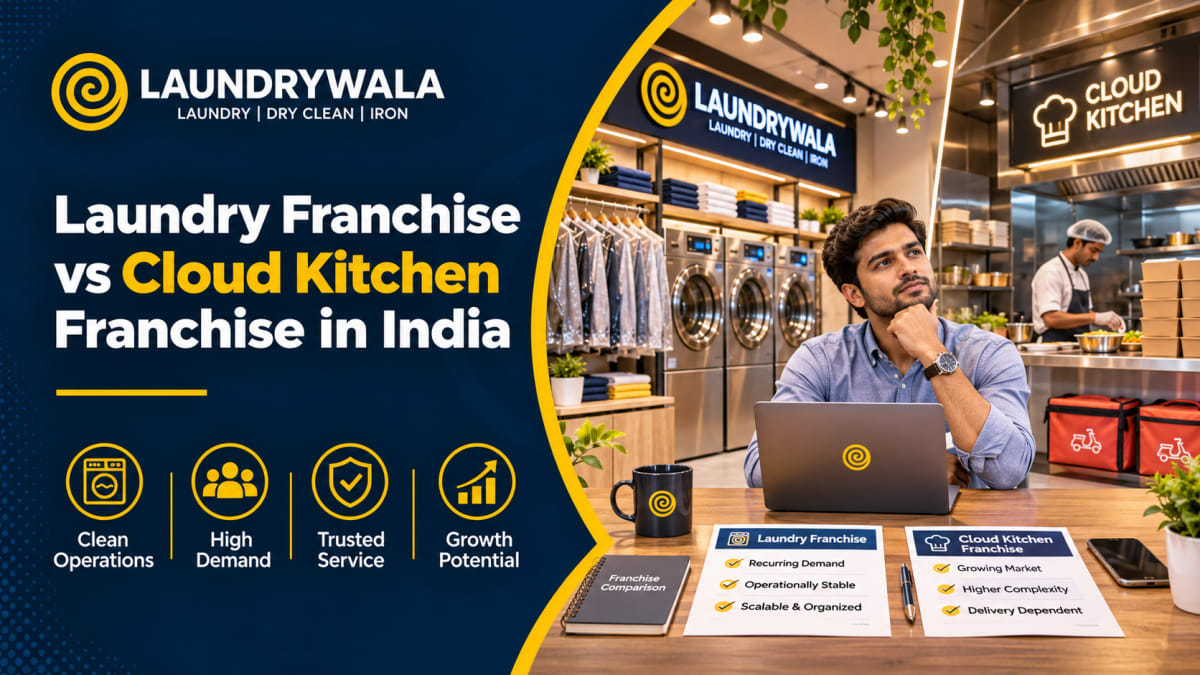
Starting a franchise business is one of the most important financial decisions for a first-time entrepreneur. With several opportunities available across India's service and food industries, selecting the right business model requires careful research, realistic investment planning and an understanding of everyday operational responsibilities.
Two business opportunities frequently considered by new investors are laundry franchises and cloud kitchen franchises. Both address recurring consumer needs, offer opportunities for local expansion and can operate without the large customer seating areas associated with conventional restaurants.
However, their business models are significantly different.
A laundry franchise provides professional garment-care services, including washing, dry cleaning, ironing and doorstep pickup and delivery. A cloud kitchen prepares food primarily for takeaway or delivery, often receiving orders through online food delivery platforms.
When comparing Laundry Franchise vs Cloud Kitchen Franchise, first-time entrepreneurs must look beyond initial investment and projected sales. Staffing requirements, inventory management, customer retention, operating costs, service quality and business risks can all influence long-term performance.
A cloud kitchen may attract entrepreneurs who enjoy the food industry and understand kitchen operations. A laundry franchise may appeal to investors interested in structured service delivery, recurring household requirements and technology-supported operations.
Neither model guarantees profitability, and the most suitable choice depends on the entrepreneur's capital, location, experience and ability to manage the business.
This detailed guide compares laundry franchises and cloud kitchen franchises in India, helping first-time entrepreneurs understand their advantages, challenges, investment requirements and long-term business potential.
What Is a Laundry Franchise Business?
A laundry franchise is a service-based business that operates under an established brand and provides professional garment-cleaning solutions.
Customers submit clothes for washing, dry cleaning, ironing or other fabric-care services. The garments are inspected, sorted, cleaned, finished, packaged and returned according to the required service.
Many organised laundry businesses also provide doorstep pickup and delivery.
The franchise partner generally receives training, branding guidance, operating procedures and assistance with store setup, depending on the franchise agreement.
How Does a Laundry Franchise Generate Revenue?
A laundry outlet can earn revenue through several services, depending on its approved capabilities.
Regular laundry services may attract customers who need frequent washing and finishing. Dry cleaning can serve customers with formal clothing, expensive garments and delicate fabrics.
Steam ironing, shoe cleaning, blanket cleaning and household textile care may provide additional service opportunities.
The main advantage of this model is that customers can return regularly for services they need throughout the year.
However, repeat business depends on cleaning quality, reasonable pricing, garment safety and reliable delivery.
How Does Laundrywala's Franchise Model Work?
Laundrywala offers an organised laundry and dry cleaning franchise model designed around professional fabric care, standardised processes and customer convenience.
Its published franchise programme includes assistance with store setup, machinery planning, branding, employee training and technology-enabled operations.
Entrepreneurs can explore the Laundrywala franchise business opportunity to understand available formats and partnership requirements.
A structured system can simplify the initial setup process, although franchise owners must still supervise employees, control expenses and develop local customer demand.
What Is a Cloud Kitchen Franchise?
A cloud kitchen is a food preparation business that primarily serves customers through takeaway and delivery orders.
Unlike a traditional restaurant, a cloud kitchen generally does not require a full dining area.
Customers place orders through digital platforms, the brand's own ordering channels or direct communication.
The kitchen prepares the meals, packages them and arranges delivery or collection.
How Does a Cloud Kitchen Franchise Work?
A cloud kitchen franchise allows an entrepreneur to operate a delivery-focused food business under an established food brand.
The franchisor may provide recipes, menu specifications, packaging standards, branding and operational training.
The franchise owner typically manages kitchen staff, ingredient purchasing, food preparation, hygiene, inventory and order fulfilment.
Daily performance depends on food quality, order volume, preparation time and customer satisfaction.
Why Are Cloud Kitchens Attractive to Entrepreneurs?
Cloud kitchens may require less customer-facing retail space than conventional dine-in restaurants.
This can reduce expenditure on dining furniture, customer interiors and front-of-house service staff.
The delivery-focused format also allows businesses to serve customers within a defined geographical area.
However, the absence of a dining area does not eliminate major operating expenses.
Kitchen equipment, refrigeration, ingredients, trained cooks, packaging, delivery-related charges and marketing can still represent significant costs.
Laundry Franchise vs Cloud Kitchen Franchise: Key Differences
Both businesses serve customers through a combination of local demand and organised service delivery, but their daily operations and risk profiles are different.
| Comparison Factor | Laundry Franchise | Cloud Kitchen Franchise |
|---|---|---|
| Business Type | Garment-care services | Food preparation and delivery |
| Primary Customers | Households, students, professionals | Individuals, families, office workers |
| Core Equipment | Washing machines, dryers, finishing equipment | Cooking equipment, refrigeration, ventilation |
| Inventory | Cleaning chemicals and packaging | Perishable ingredients and packaging |
| Repeat Demand | Laundry and garment-care requirements | Regular meal and snack orders |
| Staffing | Laundry operators, finishers, delivery personnel | Cooks, kitchen helpers, packing staff |
| Main Quality Risk | Garment damage or incorrect processing | Food safety, taste and consistency |
| Key Operating Challenge | Garment tracking and delivery accuracy | Food freshness and peak-hour fulfilment |
| Major Compliance Focus | Local business, labour and facility requirements | Food safety licensing, hygiene and business requirements |
| Expansion Potential | Additional service areas and outlets | Additional kitchens, menus and delivery markets |
This comparison highlights the importance of selecting a business based on operational suitability rather than assuming that one industry is automatically more profitable.
Laundry Franchise vs Cloud Kitchen Franchise Investment in India
Investment is often the first factor considered by new entrepreneurs.
However, comparing only the advertised franchise price can be misleading.
The complete investment should include equipment, interiors, deposits, installation, licensing, initial staffing and working capital.
Laundry Franchise Investment in India
Laundry franchises require professional cleaning equipment, suitable commercial space and basic operational infrastructure.
Laundrywala currently publishes three indicative franchise formats.
| Laundrywala Franchise Model | Indicative Package Investment | Suggested Store Area |
|---|---|---|
| Alpha Basic | ₹13.49 lakh | 200–250 sq. ft. |
| Classic | ₹15.99 lakh | 250–300 sq. ft. |
| Combo Premium | ₹20.99 lakh | 300–350 sq. ft. |
These are published indicative package prices rather than guaranteed total project budgets.
Actual investment may vary because of property conditions, rental deposits, site modifications, taxes, transportation, installation and working capital.
Investors should request a written quotation identifying included and excluded expenses.
For additional financial information, read the Laundrywala franchise investment and ROI guide.
Cloud Kitchen Franchise Investment in India
Cloud kitchen investment varies considerably according to the food concept and operating format.
A compact kitchen preparing a limited menu may have different requirements from a multi-brand kitchen offering several cuisines.
Investment categories commonly include commercial cooking equipment, refrigeration, food storage, ventilation, preparation tables and packaging facilities.
Franchise fees, technology charges, property deposits and operating cash reserves must also be considered.
A delivery-only business may avoid expensive dining interiors, but food preparation infrastructure and hygiene requirements can still create substantial setup costs.
There is no single reliable investment figure that applies to every cloud kitchen franchise in India.
Which Business Requires Lower Investment?
Neither model is automatically cheaper.
A compact independent cloud kitchen may cost less to establish than an equipment-intensive laundry franchise.
Conversely, a large branded cloud kitchen with expensive equipment and franchise charges may require significant investment.
First-time entrepreneurs should compare actual proposals with similar operating capacities rather than relying on promotional entry prices.
Which Business Has More Predictable Operating Expenses?
A business becomes easier to manage financially when its expenses can be estimated and controlled.
Both laundry franchises and cloud kitchens have fixed and variable operating costs.
However, the nature of those costs differs.
Operating Costs in a Laundry Franchise
Laundry businesses typically incur expenses related to rent, employees, electricity, water, cleaning chemicals, packaging, maintenance and transportation.
Machinery capacity and processing efficiency directly affect operating economics.
For example, repeatedly running underloaded machines may increase resource consumption relative to the amount of laundry processed.
Incorrect sorting, damaged garments and unnecessary rewashing can also create additional costs.
A well-managed store therefore focuses on machine utilisation, staff productivity and delivery planning.
Operating Costs in a Cloud Kitchen Franchise
Cloud kitchens must manage ingredients, cooking fuel or electricity, employee salaries, refrigeration, packaging, cleaning and order fulfilment.
When orders are generated through delivery platforms, commission structures, promotions and advertising expenditure may influence the amount retained from each sale.
Ingredient prices can change, while food prepared in excess of demand may become unsaleable.
Kitchen managers need to monitor portion sizes, preparation quantities, food waste and inventory turnover regularly.
Which Model Is Easier to Budget?
Laundry franchises may offer an advantage in controlling perishable inventory because detergents and packaging materials generally have longer usable storage periods than fresh food ingredients.
Cloud kitchens can also manage costs effectively through disciplined purchasing and accurate demand forecasting.
The important distinction is that food businesses often face additional complexity from freshness requirements and spoilage.
Inventory Management: Laundry vs Cloud Kitchen
Inventory management is one of the biggest operational differences between these two businesses.
Laundry Franchise Inventory
Laundry outlets primarily manage detergents, stain-treatment products, packaging materials and related consumables.
These items require proper storage and stock control, but many are not as time-sensitive as fresh food.
Garments belonging to customers must also be accurately identified and tracked.
Lost clothing, mixed orders or incorrect delivery can lead to customer complaints and compensation claims.
Therefore, laundry inventory management involves both consumables and customer-owned items.
Cloud Kitchen Inventory
Cloud kitchens frequently handle vegetables, dairy products, meat, sauces, prepared ingredients and other food items.
Many products have limited shelf lives and require temperature-controlled storage.
Poor stock rotation can increase wastage and food-safety risks.
Over-purchasing may cause spoilage, while under-purchasing can interrupt service during peak demand.
A cloud kitchen must balance food availability with freshness and inventory efficiency.
Which Model Has Lower Wastage Risk?
Laundry businesses generally avoid the routine spoilage risks associated with fresh food.
However, they face different losses, including wasted consumables, damaged garments and costly reprocessing.
A cloud kitchen's wastage risk may be higher when demand is unpredictable or the menu relies heavily on perishable ingredients.
Neither business eliminates operational losses.
Customer Demand: Which Franchise Has Better Repeat Business Potential?
Recurring customers are essential for long-term franchise sustainability.
Both laundry and food businesses can attract repeat purchases, but the reasons customers return are different.
Repeat Demand in Laundry Services
Clothes require regular cleaning, regardless of changing consumer trends.
Households may need weekly laundry services, professionals may require frequent ironing, and premium clothing may require occasional dry cleaning.
A satisfied customer may continue using the same laundry provider because of convenience, garment safety and reliable delivery.
However, many households still wash clothes at home, so professional laundry demand must be validated locally.
Repeat Demand in Cloud Kitchens
Food is a daily necessity, creating opportunities for frequent orders.
Customers may purchase breakfast, lunch, dinner or snacks from delivery-focused restaurants.
However, repeat orders are influenced by taste preferences, pricing, menu variety, delivery experience and customer budgets.
Consumers may alternate between several restaurants rather than ordering consistently from one kitchen.
Which Business Has Stronger Customer Loyalty?
Neither model automatically produces stronger loyalty.
Laundry customers may develop long-term relationships when they trust a provider with valuable clothing.
Cloud kitchens may build strong loyalty through distinctive food quality, consistent recipes and reliable service.
For first-time entrepreneurs, the important question is how easily the chosen business can convert first-time buyers into repeat customers.
Daily Operations: Which Business Is Easier for Beginners?
A franchise business should be evaluated based on the responsibilities required every day.
A model that appears simple during the planning stage may involve considerable operational pressure once customer orders begin.
Daily Operations in a Laundry Franchise
A laundry store typically follows a sequence of garment collection, inspection, sorting, cleaning, drying, finishing, packaging and delivery.
Employees must understand fabric characteristics and cleaning procedures.
The business also needs systems to identify customer garments and monitor pending orders.
Daily operational planning can be organised around batch processing and committed delivery schedules.
However, urgent orders, equipment breakdowns and customer complaints can still disrupt operations.
Daily Operations in a Cloud Kitchen
Cloud kitchens operate around food orders and meal preparation.
Staff must prepare ingredients, cook meals, maintain hygiene, package orders and coordinate dispatch.
Demand may increase sharply during lunch, dinner and weekends.
A kitchen can receive several orders simultaneously, requiring rapid coordination without compromising food quality or safety.
Incorrect preparation, delayed orders or unavailable ingredients can immediately affect the customer experience.
Which Business Is More Manageable?
Laundry operations may be more suitable for an entrepreneur who prefers documented workflows, equipment management and scheduled processing.
Cloud kitchens may appeal to entrepreneurs comfortable with fast-paced food preparation, kitchen staffing and short order fulfilment windows.
Both require active supervision.
Staff Requirements and Employee Management
The success of a service business depends heavily on employee performance.
Laundry and cloud kitchen franchises require different technical skills.
Laundry Franchise Staffing
A laundry outlet may employ machine operators, ironing specialists, garment handlers and pickup-and-delivery staff.
Training should cover fabric identification, stain assessment, machine operation and customer service.
Digital garment tracking can support accuracy when used consistently.
Employee productivity depends on proper workload planning and suitable machine capacity.
Cloud Kitchen Staffing
A cloud kitchen generally requires cooks, food preparation assistants, packing personnel and operational supervision.
Staff must maintain recipe consistency, food hygiene and preparation speed.
The business may become dependent on experienced cooks, particularly when menu items require specialised preparation.
Employee absence during a busy meal period can affect daily operations.
Which Model Requires More Specialised Skills?
Both businesses require skilled employees.
A laundry business requires technical fabric-care knowledge, while a cloud kitchen requires food preparation and hygiene expertise.
For beginners, franchisor training and the local availability of suitable staff should be major decision factors.
Laundry Franchise vs Cloud Kitchen Franchise Profit Margin
Profit potential is often the most attractive part of a franchise advertisement.
However, revenue and profitability should never be treated as the same thing.
Both models can generate substantial sales without necessarily producing strong net profits.
Laundry Franchise Profit Potential
Laundry revenue depends on order volume, average transaction value, processing costs and customer retention.
A store may generate income through regular laundry, steam ironing, dry cleaning and approved additional services.
Profitability can improve when machinery is used efficiently, delivery routes are organised and repeat customers reduce acquisition costs.
However, expensive rent, low customer demand, machinery repairs or operational mistakes may reduce profitability.
Cloud Kitchen Profit Potential
Cloud kitchen profitability depends on menu pricing, ingredient costs, preparation efficiency, staffing, packaging and delivery-related expenses.
A kitchen with a popular menu can generate frequent orders, but high revenue does not guarantee strong net margins.
Platform charges, promotions, food waste and rising ingredient costs may reduce earnings.
How Should First-Time Entrepreneurs Compare Profit?
Instead of accepting advertised profit percentages, ask each franchisor for a realistic financial model.
The model should identify projected monthly sales, direct service costs, fixed expenses, continuing franchise charges and any financing obligations.
It should also explain whether the stated profit figure represents gross margin, operating profit or net profit.
An investor should test whether the business remains viable if order volumes are lower than expected.
The more conservative the initial assumptions, the easier it becomes to identify financial risks before investing.
Break-Even and Return on Investment: Which Business Performs Better?
Break-even and return on investment are important indicators, but they measure different aspects of business performance.
Operating break-even occurs when revenue is sufficient to cover relevant operating costs.
Investment recovery occurs when cumulative business cash flow has recovered the initial capital invested.
A business may cover its monthly operating expenses long before recovering the original investment.
Laundry Franchise Break-Even
A laundry outlet's break-even depends on fixed expenses, average order value, service contribution and monthly order volume.
Recurring customers can support revenue consistency, but customer retention must be earned through reliable service.
Machinery capacity, location selection and employee productivity also affect financial performance.
Cloud Kitchen Break-Even
Cloud kitchens depend on the contribution earned from food orders after relevant variable costs.
Ingredient expenses, packaging, delivery-platform charges and promotions may influence the required order volume.
Peak-hour demand can create strong sales opportunities, but slower periods still need to be considered.
Which Has a Faster ROI?
There is no universal winner.
A well-operated cloud kitchen can outperform a poorly located laundry outlet, while an efficient laundry store can perform better than a kitchen facing high food waste and acquisition costs.
The actual payback period depends on capital investment, operating cash flow, local competition and business execution.
For further analysis of laundry investment planning, see Laundrywala's laundry franchise cost guide in India.
Business Risks: Laundry Franchise vs Cloud Kitchen Franchise
Every franchise carries financial and operational risks.
Understanding these risks before investing is essential, especially for entrepreneurs using personal savings or borrowed capital.
Major Risks in a Laundry Franchise
Garment damage is a significant concern because customers entrust businesses with their personal clothing.
Incorrect washing, lost garments and delivery errors may lead to complaints or compensation claims.
Machinery breakdowns can interrupt operations and affect turnaround commitments.
Poor location selection may result in insufficient orders, while high utility expenses can reduce profitability.
These risks require preventive maintenance, trained employees, suitable insurance and effective quality control.
Major Risks in a Cloud Kitchen
Food safety is a critical operational responsibility.
Improper storage, contamination or unsuitable cooking practices can create serious customer health risks.
Food spoilage and ingredient price fluctuations may increase expenses.
Dependence on delivery platforms can also create commercial exposure if fees, visibility or promotional requirements change.
Inconsistent recipes, negative customer reviews and delayed food preparation can affect repeat business.
Which Model Has Lower Risk?
Laundry franchises may have less exposure to perishable food inventory and food-safety incidents.
However, they involve equipment investment, customer property handling and specialist fabric-care responsibilities.
Cloud kitchens may have comparatively flexible menus but require rigorous food hygiene and demand forecasting.
The lower-risk option depends on the entrepreneur's experience and ability to control the relevant operational challenges.
Licences and Legal Requirements in India
Both businesses require appropriate registration and compliance before operations begin.
Requirements vary depending on the business structure, location and operating processes.
Laundry Franchise Compliance
A laundry business may require business registration, applicable tax registration, Shops and Establishments compliance and local trade permissions.
Depending on the facility, environmental, wastewater, fire-safety and other permissions may also apply.
Investors should verify requirements with the relevant local authorities before signing a property lease.
Cloud Kitchen Compliance
Cloud kitchens must comply with applicable food-safety regulations.
The Food Safety and Standards Authority of India requires eligible food businesses to obtain the appropriate registration or licence.
Entrepreneurs should consult the official FSSAI licensing and registration guidance and check the relevant category for their proposed operation.
Food preparation facilities must also follow applicable hygiene and sanitary requirements.
The FSSAI food hygiene requirements provide guidance on food safety management and sanitary practices.
MSME Registration
Eligible entrepreneurs in either industry may consider registering their business through the official Government of India Udyam Registration portal.
The government provides Udyam registration free of charge, subject to eligibility.
Registration does not replace other mandatory business permits or licences.
Which Business Is Better for Tier 2 and Tier 3 Cities?
Smaller Indian cities can offer opportunities for both laundry and food delivery businesses.
However, the local market characteristics that support each model can differ.
Laundry Franchise Opportunities in Smaller Cities
Residential societies, hostels, working professionals and educational institutions may create demand for professional garment care.
A suitable location should provide access to customers willing to pay for convenience and reliable cleaning.
In some smaller cities, commercial rents may be more manageable than in major metropolitan locations.
However, many households use traditional laundry providers or wash clothes at home, making local demand research essential.
Cloud Kitchen Opportunities in Smaller Cities
Cloud kitchens may attract customers in neighbourhoods with active food delivery demand.
Students, office workers and families may order meals through delivery channels.
However, local spending habits, delivery coverage, cuisine preferences and order frequency determine feasibility.
A city with a large population does not automatically have sufficient demand for premium delivery-only food.
Which Business Should You Choose?
A laundry franchise may be suitable when the location contains a concentrated customer base interested in regular professional garment care.
A cloud kitchen may be suitable when strong delivery demand exists and the entrepreneur understands local food preferences.
Both require neighbourhood-level feasibility studies rather than decisions based on city population alone.
Marketing Strategies: Laundry vs Cloud Kitchen
Customer acquisition is essential for both businesses.
However, the marketing methods used to attract and retain customers can be different.
Marketing a Laundry Franchise
Laundry businesses can focus on local Google visibility, apartment communities, referral programmes and convenient pickup services.
Customers searching for nearby laundry and dry cleaning services should be able to find accurate contact information and service details.
Residential society partnerships and repeat-customer programmes may support long-term growth.
Transparent pricing and dependable service are particularly important for building trust.
Marketing a Cloud Kitchen
Cloud kitchens often rely on food photography, menu presentation, customer ratings and digital promotions.
Delivery platforms may provide access to potential customers, but paid visibility and discounting can increase acquisition costs.
Direct ordering channels may help businesses develop customer relationships, although building independent demand requires sustained effort.
Which Has Lower Marketing Dependence?
Neither business can operate successfully without marketing.
A laundry franchise may gradually develop repeat household customers within a defined service area.
A cloud kitchen may attract frequent orders, but competition for customer attention can be intense.
Marketing performance should be assessed by customer acquisition cost, order frequency and contribution margin rather than impressions alone.
Scalability and Long-Term Growth Potential
Entrepreneurs should consider whether their chosen business can expand beyond a single outlet.
Scaling a Laundry Franchise
A successful laundry business may expand by serving additional residential areas, increasing processing capacity or opening more outlets.
Growth can also come from approved additional services such as premium garment care and household textile cleaning.
However, expansion requires consistent service standards, adequate infrastructure and effective customer management.
Scaling a Cloud Kitchen
Cloud kitchens can expand through additional kitchens, new menus or multiple food concepts.
A delivery-focused model may allow operators to test different neighbourhoods without investing in full-service restaurants.
However, each additional kitchen requires food-safety compliance, staffing, equipment and quality control.
Which Business Is Easier to Scale?
Laundry franchises may benefit from repeat-service relationships and standardised processing systems.
Cloud kitchens may offer flexibility in product offerings and delivery markets.
The more scalable business is the one that can maintain quality while expanding without allowing costs to grow faster than revenue.
How First-Time Entrepreneurs Should Evaluate Both Franchise Models
Choosing a franchise should involve more than comparing brochures.
A structured evaluation process can help identify whether the business suits your financial capacity and operational preferences.
Step 1: Set a Realistic Investment Budget
Include the full project cost, not just the advertised franchise fee.
Account for equipment, property expenses, installation, licensing and working capital.
Avoid committing funds that are needed for essential personal obligations.
Step 2: Understand Your Skills and Interests
Consider whether you enjoy managing a process-based service business or a fast-paced food operation.
Interest in the industry can influence how effectively you supervise employees and solve daily problems.
Step 3: Research Local Customer Demand
Speak with potential customers and assess existing service options.
Study local pricing, demand patterns and the convenience customers expect.
Avoid assuming that success in one city can be replicated automatically in another.
Step 4: Evaluate Franchise Support
Ask what training, technology, branding and operational assistance are included.
Understand whether support continues after the initial launch.
Step 5: Review All Commercial Terms
Examine franchise fees, royalties, territory conditions, supply arrangements and agreement duration.
Ask for a written explanation of recurring charges.
Step 6: Build Conservative Financial Forecasts
Estimate performance under different demand scenarios.
Include realistic operating expenses and potential startup losses.
Step 7: Speak With Existing Operators
Where possible, discuss practical challenges with current franchise partners.
Ask about staffing, customer acquisition, operational costs and the quality of franchisor support.
Step 8: Seek Professional Advice
A qualified accountant or legal adviser can help evaluate financial projections and contractual obligations before investment.
Why Laundrywala May Be Suitable for First-Time Entrepreneurs
For entrepreneurs considering a service-based business, Laundrywala offers a structured franchise opportunity built around professional laundry and dry cleaning.
The brand's published franchise model includes guidance on store setup, machinery selection, employee training, technology and ongoing operational processes.
These systems may help reduce the complexity of establishing an independent garment-care business.
Structured Operational Processes
Professional laundry services require accurate sorting, cleaning, finishing and delivery.
Documented procedures can help new business owners maintain consistency and reduce avoidable errors.
Multiple Revenue Opportunities
Depending on the approved store model, Laundrywala outlets may offer regular laundry, dry cleaning, steam ironing, shoe cleaning and selected additional fabric-care services.
This can help a store serve different customer requirements.
Technology-Enabled Operations
Digital billing, garment tracking and order management can improve operational visibility.
These systems are particularly useful when customers request scheduled pickup and delivery.
Training and Franchise Support
Laundrywala's franchise programme describes support for store setup, staff training, branding and operations.
First-time entrepreneurs should still review the current support terms and understand their own management responsibilities.
Learn more about the brand through the Laundrywala company overview.
Final Verdict: Laundry Franchise vs Cloud Kitchen Franchise — Which Is Better?
The answer depends on the entrepreneur's experience, budget, location and management preferences.
A laundry franchise may be more suitable for someone who wants a service-based business built around garment care, repeat household requirements and structured operational processes.
It may also appeal to investors who prefer to avoid the inventory spoilage and food-safety responsibilities associated with commercial kitchens.
A cloud kitchen may be attractive to entrepreneurs with experience in cooking, hospitality, food procurement and fast-paced order fulfilment.
It can offer opportunities for menu development and delivery-focused expansion, but food freshness, ingredient costs and operational consistency require close attention.
For a first-time entrepreneur without food industry experience, a well-supported laundry franchise may be easier to evaluate as a process-driven business. Nevertheless, commercial laundry requires technical training, machinery management and careful handling of customer garments.
Neither business should be selected solely because of advertised profitability or return-on-investment claims.
The stronger investment choice is the one supported by genuine local demand, a realistic financial plan and a business model the owner is prepared to manage effectively.
Choose the Right Franchise for Your Entrepreneurial Journey
The comparison of Laundry Franchise vs Cloud Kitchen Franchise shows that both businesses offer opportunities in India's organised service economy, but their daily responsibilities and operational risks are different.
Cloud kitchens serve food customers through delivery-focused operations and require careful management of ingredients, hygiene, kitchen staff and order fulfilment.
Laundry franchises focus on professional garment care, machinery utilisation, customer service and reliable garment delivery.
For first-time entrepreneurs who prefer a structured service model, a laundry franchise may be worth serious consideration.
Laundrywala provides franchise formats, operational guidance and technology-supported systems designed to help entrepreneurs establish professional laundry outlets.
However, profitability depends on actual customer demand, cost control, location selection and consistent service delivery.
Before investing, compare the complete costs, review franchise agreements and assess the market in your preferred city.
Explore Laundrywala Franchise Opportunities in India
If you are planning to start your first franchise business, connect with Laundrywala to understand available locations, investment options and franchise support.
Call: +91 86508 65586
FAQs on Entrepreneurship & Business
Insights and strategies for modern entrepreneurs looking to grow in the professional laundry industry.
Still have questions?
Can't find what you're looking for? Our fabric care specialists and franchise advisors are here to help.