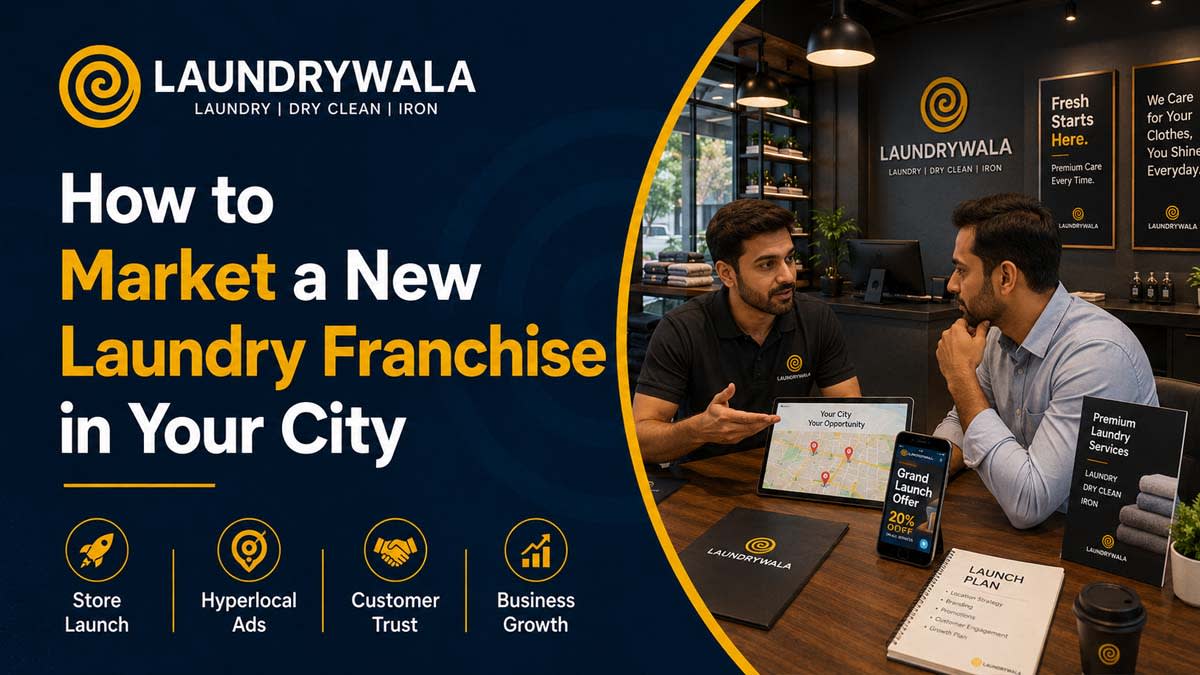
Opening a laundry franchise is only the beginning. The next challenge is making nearby customers aware of the outlet, encouraging them to place their first order and providing an experience that motivates them to return.
A well-equipped store can still struggle when local residents cannot find it on Google, do not understand its services or are unaware that doorstep pickup and delivery are available. Marketing should therefore begin before the store opens and continue consistently after launch.
Learning how to market a new laundry franchise requires a combination of local market research, Google Business Profile optimisation, neighbourhood-focused content, social media, digital advertising, apartment-society campaigns, business partnerships, referral marketing and dependable service.
Quick answer: Start marketing two to three weeks before launch. Define a practical service radius, create and verify the store’s Google Business Profile, publish genuine local content, advertise only in serviceable areas and conduct apartment-society outreach. Track enquiries, completed orders, customer acquisition cost, average bill value and repeat orders instead of measuring success through likes or reach alone.
Understand Your Local Laundry Market First
A laundry outlet usually serves a limited pickup-and-delivery radius. Marketing the entire city can waste advertising money if the store cannot collect and deliver orders efficiently across that area.
Begin by mapping a practical service zone around the outlet. Identify:
- Apartment societies
- Gated communities
- Independent residential colonies
- Hostels and PG accommodation
- Offices and coworking spaces
- Hotels and guest houses
- Gyms and fitness centres
- Salons and spas
- Clinics and healthcare facilities
- Schools and coaching centres
- Boutiques and tailoring shops
Different customer groups require different services. Working professionals may value scheduled doorstep pickup, while families may require regular wash-and-iron service. Hotels, salons and gyms may need recurring commercial laundry.
Research nearby laundry providers and compare:
- Pricing
- Google ratings
- Reviews
- Pickup conditions
- Turnaround times
- Services
- Offers
- Customer complaints
- Opening hours
- Delivery radius
Do not compete only on price. Look for service gaps such as unreliable delivery, poor communication, limited dry cleaning, no pickup service or weak garment tracking.
Entrepreneurs still planning their outlet can use this laundry business plan for India to connect market research with investment and operating decisions.
Define Your Ideal Customer Groups
Trying to market every service to every resident can make the campaign unclear. Divide potential customers into groups and create messages around their needs.
Working Professionals
Emphasise doorstep collection, scheduled pickup, wash-and-iron service and convenient delivery.
Families
Promote everyday laundry, dry cleaning, school-uniform care, curtains, carpets and seasonal garment cleaning.
Students and PG Residents
Focus on affordable laundry plans, convenient collection schedules and simple booking.
Premium-Garment Customers
Highlight professional care for suits, sarees, lehengas, jackets, wedding wear and delicate fabrics.
Local Businesses
Create separate proposals for hotels, salons, gyms, clinics, boutiques and offices requiring recurring service.
This segmentation helps the outlet choose suitable advertisements, offers and partnerships.
Build a Clear Local Value Proposition
Customers should understand the outlet’s benefit within a few seconds.
Avoid generic claims such as “best quality at the lowest price.” These statements are difficult to prove and do not explain what makes the outlet useful.
A clearer message could be:
Professional laundry and dry cleaning with doorstep pickup, transparent pricing and reliable delivery in your neighbourhood.
The message should communicate:
- What services are available
- Which area the outlet serves
- Whether pickup and delivery are offered
- How customers can book
- Why they should trust the service
Keep the business name, address, phone number, website, opening hours and offer conditions consistent across the storefront, website, Google profile, social media and advertisements.
Start Marketing Before the Grand Opening
Marketing should begin approximately two to three weeks before opening. The objective is to create awareness and collect interested local enquiries before the first day of operation.
Three Weeks Before Opening
- Install visible store signage after obtaining local permission.
- Create the store’s social-media pages.
- Begin the Google Business Profile verification process.
- Publish store-setup and staff-training updates.
- Approach nearby apartment societies and local businesses.
- Create a WhatsApp enquiry list using customer consent.
Two Weeks Before Opening
- Announce the opening date.
- Introduce the primary services.
- Publish photographs of the actual outlet.
- Start a small local awareness campaign.
- Share the pickup-and-delivery zone.
- Distribute approved society flyers.
One Week Before Opening
- Reveal the introductory offer.
- Share the complete address and map location.
- Publish the booking number and website.
- Confirm the opening-day schedule.
- Run reminder advertisements within the serviceable radius.
Avoid repeatedly messaging unrelated WhatsApp groups. Collect enquiries through opt-in forms, QR codes, direct messages or a dedicated business number.
Optimise the Google Business Profile
Google Search and Maps can become important discovery channels for a new laundry outlet.
Create and verify a separate Google Business Profile for the genuine store location. Add:
- Correct real-world business name
- Suitable primary business category
- Complete address
- Accurate map pin
- Local phone number
- Website or location-page URL
- Opening hours
- Service areas
- Laundry and dry-cleaning services
- Genuine store photographs
Google’s official local-ranking guidance explains that local results are mainly influenced by relevance, distance and prominence. Complete information, verification, genuine reviews and updated photographs can support visibility, but businesses cannot pay Google to obtain a higher organic local ranking.
Do not add unnecessary keywords, service names or locality names to the Business Profile name unless they are genuinely part of the real-world business name.
Upload clear photographs of:
- Storefront and signage
- Customer counter
- Staff
- Machinery
- Garment-tagging process
- Packaging
- Pickup vehicle
- Opening-day activities
Keep the profile updated when working hours, phone numbers or service availability change.
Create a Local Landing Page
A dedicated store or city page can help customers find accurate information about the outlet.
The page should include:
- Laundry services available
- Dry-cleaning services
- Pickup and delivery information
- Serviceable localities
- Store address
- Phone number
- Opening hours
- Map
- Booking CTA
- Original store photographs
- Relevant customer FAQs
Link naturally to Laundrywala’s professional laundry services, dry-cleaning services and store locator.
Avoid publishing multiple nearly identical locality pages with only the area name changed. Each page should contain useful, location-specific information.
Use Social Media to Build Local Trust
Social media should show customers how the service works instead of relying only on generic festival posts.
Useful content ideas include:
- Store-opening progress
- Staff introductions
- Garment-tagging process
- Stain inspection
- Fabric sorting
- Ironing and finishing
- Packaging
- Pickup and delivery
- Garment-care tips
- Customer testimonials
- Service explanations
- Society campaign updates
Create short videos using the real store, staff and delivery team. Use the city and neighbourhood names naturally in captions.
Each post should have one clear call to action:
- Call the outlet
- Send a WhatsApp message
- Visit the store
- Book a pickup
- Check the service area
Before-and-after content should be genuine, and customers’ garments or testimonials should only be shown with permission.
Run Hyperlocal Digital Advertising
Paid advertisements can generate local awareness quickly, but broad targeting may attract enquiries from areas the outlet cannot serve.
Start with the actual pickup-and-delivery zone. Expand only after the store can serve a wider area without increasing delays and delivery costs.
Select the Correct Campaign Goal
Choose an objective based on the desired action:
- Awareness for a new opening
- WhatsApp enquiries
- Phone calls
- Website visits
- Lead-form submissions
- Online bookings
Meta’s official advertising-objective guide explains how campaign objectives should match the business outcome.
Use Simple Local Creatives
An effective advertisement should show:
- Laundrywala branding
- Real store or pickup visuals
- Main service
- Locality name
- Offer terms
- Booking number
- Clear CTA
Avoid overcrowding the design with every available service and several different actions.
Test Different Versions
Test one variable at a time, such as:
- Image versus video
- Service-based versus convenience-based headline
- First-order offer versus free-pickup message
- WhatsApp CTA versus website booking CTA
Measure completed orders rather than selecting the advertisement with the highest likes.
Reach Apartment Societies and Local Communities
Apartment societies can generate multiple customers within a small delivery area, making collection and delivery more efficient.
Approach resident welfare associations or facility managers before conducting any activity.
Possible campaigns include:
- Weekend laundry collection desk
- Society-specific pickup schedule
- New-store introduction booth
- Garment-care demonstration
- QR-code booking flyer
- Resident-only introductory offer
Flyers should clearly display:
- Outlet name
- Address
- Phone number
- Service list
- Pickup availability
- QR code
- Offer conditions
- Expiry date
Assign a unique code to each society. This makes it possible to identify which activity generated each order.
Avoid random flyer distribution across areas the outlet does not serve.
Build Local Business Partnerships
Local partnerships can provide recurring orders without depending entirely on advertising.
Potential partners include:
- Boutiques
- Tailors
- Salons
- Spas
- Gyms
- Hostels
- Guest houses
- Hotels
- Clinics
- Event planners
- Uniformed offices
A partnership proposal should explain:
- Services included
- Pricing
- Collection frequency
- Turnaround time
- Minimum order
- Payment terms
- Garment-counting procedure
- Complaint-handling process
Begin with a limited trial. Do not accept a large commercial order until the outlet can maintain processing quality and delivery schedules.
Create an Introductory Offer Carefully
An opening offer can reduce a customer’s hesitation about trying a new laundry service. However, it should be simple, time-bound and financially manageable.
Possible offers include:
- Percentage discount on the first order
- Free pickup above a minimum order
- Limited wash-and-iron bundle
- Society-specific launch offer
- Referral benefit after successful delivery
Every offer should mention:
- Eligible services
- Minimum order
- Maximum discount
- Service area
- Expiry date
- Applicable terms
Avoid permanent deep discounts. Customers attracted only by price may switch when another provider offers a lower rate.
After the trial order, service quality, convenience and communication should become the main reasons to return.
Turn First Orders Into Repeat Customers
Marketing does not finish when the first order is placed. The customer’s service experience determines whether the marketing expense creates only one order or a long-term relationship.
A reliable first-order experience should include:
- Accurate garment counting
- Transparent pricing
- Clear stain communication
- Order confirmation
- Realistic delivery date
- Status updates
- Quality inspection
- Neat packaging
- On-time delivery
- Professional complaint handling
After successful delivery, request honest feedback. Satisfied customers can be invited to leave a genuine Google review.
Do not purchase reviews or offer discounts, free services or gifts specifically in exchange for positive ratings. Google’s policy against incentivised and fake reviews requires reviews to reflect genuine customer experiences.
Introduce referral programmes or monthly plans only after the basic service process works consistently.
Use a 90-Day Laundry Franchise Marketing Plan
A phased plan helps the outlet spend carefully and improve campaigns using real results.
| Period | Main objective | Recommended activities |
|---|---|---|
| Days 1–15 | Build local awareness | Google profile, store signage, social pages, society contacts and launch announcements |
| Days 16–30 | Generate first orders | Opening offer, hyperlocal ads, WhatsApp enquiries and society activation |
| Days 31–60 | Build trust | Reviews, testimonials, service videos, partnerships and repeat-order follow-up |
| Days 61–90 | Improve profitability | Retargeting, referral plan, channel analysis, customer retention and B2B trials |
Review the results weekly rather than waiting until the end of three months.
Plan the Marketing Budget by Channel
The exact budget depends on the city, store and delivery radius. A new outlet can divide its marketing budget into practical categories.
| Marketing category | Suggested purpose |
|---|---|
| Local digital advertising | Awareness, WhatsApp enquiries and bookings |
| Apartment-society outreach | Flyers, collection desks and society campaigns |
| Store visibility | Signage, standees and opening material |
| Content production | Store photography and short service videos |
| Referral and retention | Referral benefits and repeat-order communication |
| Testing reserve | New creatives, audiences and local partnerships |
Do not spend the complete budget on an opening event. Reserve funds for the first three months, when campaigns can be improved using actual customer data.
Track the Numbers That Matter
Marketing performance should be reviewed weekly during the launch period.
Track:
- Enquiries by source
- Serviceable enquiries
- Completed first orders
- Cost per completed order
- Average bill value
- Repeat-order percentage
- Revenue by channel
- Delivery cost
- Discount cost
- Complaints and refunds
- Google calls and website clicks
- Society-campaign orders
- B2B enquiries
Customer Acquisition Cost
Calculate customer acquisition cost using:
Marketing spend ÷ Number of new paying customers
Do not calculate it using all messages or leads. Use customers who completed a paid order.
Repeat-Order Rate
Calculate repeat-order rate using:
Customers placing another order ÷ Total first-time customers × 100
A rising repeat-order rate indicates that operations and customer service are supporting marketing.
Channel Revenue
Use different coupon codes, booking links or enquiry labels for Google, Meta advertisements, societies, referrals and partnerships.
Google Business Profile’s official performance reporting can provide information about profile views, calls, website clicks and direction requests.
Continue channels generating profitable, serviceable customers. Improve promising campaigns and stop activities that repeatedly produce irrelevant enquiries.
Common Marketing Mistakes to Avoid
New franchise outlets should avoid:
- Advertising across the entire city immediately
- Using a false locality in the Google profile name
- Buying reviews
- Offering permanent deep discounts
- Publishing only generic promotional posts
- Using stock images instead of real store visuals
- Running campaigns without tracking completed orders
- Promising unrealistic delivery times
- Accepting excessive B2B volume too early
- Ignoring previous customers after delivery
- Changing contact information across platforms
- Measuring success only through impressions and likes
Marketing cannot compensate for poor cleaning quality, lost garments or delayed deliveries. Operations and promotion must improve together.
Why Laundrywala Can Support Local Marketing
Laundrywala operates a multi-service laundry and dry-cleaning franchise model combining walk-in business with doorstep pickup and delivery.
The brand’s franchise programme includes support in areas such as:
- Location evaluation
- Store setup
- Branding
- Owner and staff training
- Billing and CRM
- Launch marketing
- Local campaign guidance
- Post-launch operations
Its services include laundry, dry cleaning, steam ironing, shoe cleaning, curtain cleaning and carpet cleaning. This gives the outlet multiple customer-acquisition opportunities within the same neighbourhood.
Prospective investors can review the official Laundrywala franchise model, learn more about Laundrywala or contact the franchise team for current information.
Central marketing support works best when the local franchise partner understands the neighbourhood, follows up with enquiries and maintains reliable service quality.
FAQs – India's Best Laundry Franchise Chain
Straight answers for entrepreneurs evaluating Laundrywala as a profitable laundry business and low investment franchise in India.
Still have questions?
Can't find what you're looking for? Our fabric care specialists and franchise advisors are here to help.