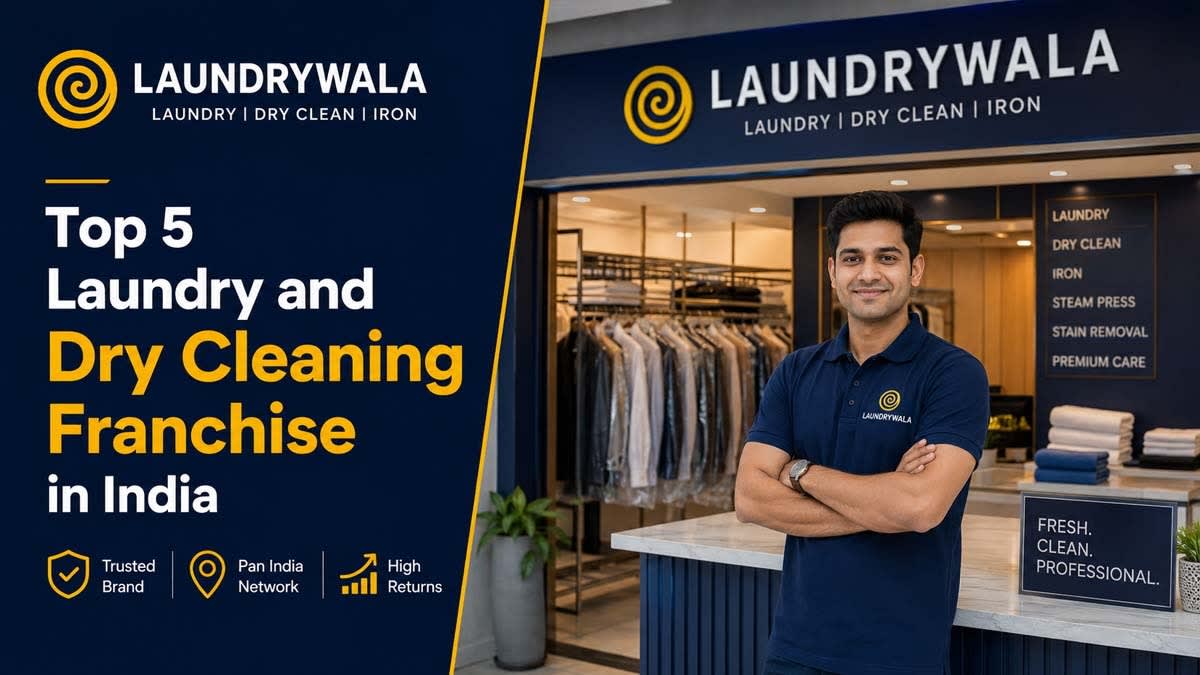
Top 5 Laundry and Dry Cleaning Franchise in India
India’s professional laundry and dry-cleaning industry is gradually shifting from unorganised neighbourhood services to branded, technology-enabled businesses. Working professionals, students, families, hotels, salons, clinics and corporate offices increasingly expect convenient pickup, transparent pricing, digital order tracking and consistent garment care.
This change has created opportunities for entrepreneurs interested in a repeat-demand service business. However, selecting a laundry franchise requires more than comparing advertised profits or choosing the brand with the largest store network.
An investor must evaluate the total project cost, available franchise format, processing model, store size, territory, royalty, operational support, working capital and local customer demand.
This guide compares the top 5 laundry and dry cleaning franchise in India using current publicly available information. All investments and business-performance figures should be verified directly with the respective company before making a financial commitment.
Quick answer: Laundrywala, Tumbledry, DhobiLite, UClean and Pick My Laundry are among the recognised organised laundry brands worth evaluating in 2026. Laundrywala offers three published formats with indicative investments ranging from ₹13.49 lakh to ₹20.99 lakh, while the other brands provide different collection-centre, laundromat, retail-processing and hub-and-spoke models.
Which Is the Best Laundry Franchise in India in 2026?
There is no single laundry franchise that is automatically best for every entrepreneur.
The right franchise depends on:
- Your available investment
- City and proposed locality
- Store rent and security deposit
- Required processing capacity
- Available water, drainage and electricity
- Retail or B2B business preference
- Territory availability
- Franchise fee and recurring charges
- Working-capital capacity
- Level of involvement in daily operations
Laundrywala is a strong option for investors seeking a compact multi-service processing outlet with clearly published equipment and space requirements. Tumbledry may suit investors prioritising a large franchise network. DhobiLite offers formats ranging from a retail collection outlet to a city-level processing hub.
UClean may appeal to investors interested in a laundromat and pickup model, while Pick My Laundry promotes multiple investment formats supported by technology and doorstep service.
The final decision should be based on written commercial proposals and location-specific financial calculations rather than promotional rankings alone.
Why Is the Laundry Franchise Business Growing in India?
Laundry is a recurring household requirement. Clothes, uniforms, bedsheets, towels, curtains, carpets and seasonal garments require cleaning throughout the year.
Professional laundry demand is influenced by several lifestyle changes.
Working Households
Professionals and dual-income families may have limited time for washing, drying and ironing. Doorstep pickup and delivery can make professional laundry more convenient than managing every garment at home.
Apartment Living
Many urban households have limited drying space, especially for blankets, curtains, carpets and large weekly laundry loads.
Premium Garments
Suits, sarees, jackets, designer outfits and embroidered wedding clothes often require professional inspection and fabric-specific treatment.
Digital Convenience
Customers increasingly expect app or website booking, digital billing, order tracking, pickup updates and online payments.
Commercial Demand
Hotels, hostels, salons, gyms, clinics, restaurants and offices may require recurring linen, towel or uniform cleaning.
These factors can support an organised laundry outlet, but demand varies significantly by locality. Investors should conduct a catchment survey before selecting a property or franchise format.
How Were These Franchise Brands Compared?
The brands in this guide have been evaluated using practical factors that matter to a prospective franchise owner:
- Availability of a structured franchise programme
- Published investment information
- Store or processing format
- Technology and order management
- Training and setup support
- Service portfolio
- Brand presence
- Suitability for first-time entrepreneurs
- Territory and expansion model
- Need for independent verification
This is an editorial comparison, not an audited financial ranking. Revenue, profit, margin and break-even claims published by a franchisor represent its own business projections unless independently verified.
Top 5 Laundry and Dry-Cleaning Franchise Comparison
| Brand | Published Investment Range | Business Model | Published Space Guidance | What Investors Should Verify |
|---|---|---|---|---|
| Laundrywala | ₹13.49–₹20.99 lakh | Retail processing and retail-plus-B2B | 200–350 sq. ft. | Package inclusions, territory and working capital |
| Tumbledry | Approximately ₹20 lakh* | Full-service laundry and dry-cleaning outlet | Around 250 sq. ft.* | Royalty, total project cost and projection assumptions |
| DhobiLite | ₹7 lakh–₹2.5 crore | Retail partner, live cleaning and master franchise | Depends on format | Available format, processing responsibility and territory |
| UClean | Request current proposal | Laundromat, retail and pickup-and-delivery | Depends on format | Current investment, royalty and processing model |
| Pick My Laundry | Approximately ₹15–₹60 lakh | Technology-enabled retail and processing formats | Depends on format | Exact setup, equipment, recurring fees and working capital |
*Brand-published information may change and may exclude GST, property deposit, working capital or other expenses.
1. Laundrywala
Laundrywala operates a professional laundry and dry-cleaning franchise system with an advertised network of 150+ stores across 75+ cities.
Its service portfolio includes:
- Wash and fold
- Wash and iron
- Dry cleaning
- Steam ironing
- Shoe cleaning
- Bag cleaning
- Curtain cleaning
- Carpet cleaning
- Wedding-wear care
- Doorstep pickup and delivery
The brand’s franchise programme provides guidance for location evaluation, store layout, machinery selection, staff training, technology, operating procedures and launch marketing.
According to the current Laundrywala franchise opportunity, investors can compare three formats.
Alpha – Basic
The Alpha – Basic format is designed as a compact retail laundry and dry-cleaning outlet.
- Indicative investment: ₹13.49 lakh
- Area requirement: 200–250 sq. ft.
- Suggested team: 2–3 people
- Electricity requirement: Approximately 8 kW
- Water storage: Approximately 1,000 litres
- Equipment: 15 kg washer and dryer
- Finishing: Ironing setup with a 4 kW boiler
This format may suit residential neighbourhoods where the investor wants in-store processing within a compact area.
Classic
The Classic format provides additional washing capacity.
- Indicative investment: ₹15.99 lakh
- Area requirement: 250–300 sq. ft.
- Suggested team: 2–3 people
- Electricity requirement: Approximately 15 kW
- Water storage: Approximately 1,000 litres
- Equipment: 15 kg and 10 kg washer-dryer stackers
- Finishing: Ironing setup with a 4 kW boiler
This model may be considered for localities with stronger household laundry demand and a broader service mix.
Combo – Premium
The Combo – Premium format combines retail processing with capacity for selected B2B orders.
- Indicative investment: ₹20.99 lakh
- Area requirement: 300–350 sq. ft.
- Suggested team: 3–4 people
- Electricity requirement: Approximately 16 kW
- Water storage: Approximately 2,000 litres
- Equipment: Commercial 18 kg setup with a separate 10 kg retail setup
- Finishing: Ironing setup with a 6 kW boiler
This format may suit entrepreneurs planning to serve residential customers along with hotels, salons, hostels or other commercial clients.
Laundrywala publishes an illustrative 22–30% net-margin planning range and a 14–20-month break-even window. These are planning estimates, not assured returns. Actual results depend on rent, daily orders, average bill value, service mix and operational management.
2. Tumbledry
Tumbledry operates a large laundry and dry-cleaning franchise network in India.
Its official franchise information describes support for:
- Location selection
- Store setup
- Staff recruitment
- Training
- Digital marketing
- Customer applications
- CRM and order management
- Cleaning-process development
The brand currently advertises a total investment of approximately ₹20 lakh and a store size of around 250 sq. ft. It also publishes profit, ROI and break-even projections on its franchise page.
Prospective investors should request the calculation behind these projections and compare it with realistic costs for their city. Rent, salaries, royalty, utilities, consumables, delivery and local marketing can significantly affect actual performance.
Before investing, verify the complete project cost, territory, franchise fee, royalty, advertising contribution and the amount of working capital required after launch.
3. DhobiLite
DhobiLite is an organised laundry and dry-cleaning brand that offers several investment formats.
Its franchise programme currently presents three broad models.
Retail Partner
The retail partner is primarily a pickup, delivery and customer-service outlet.
Published investment begins at approximately ₹7 lakh. The model may require around 100–200 sq. ft., depending on the approved location and operating arrangement.
It can suit investors seeking a lower-entry format without installing a full processing facility.
Live Cleaning Outlet
This format combines a customer-facing store with local cleaning capability.
The company publishes different investment ranges for live-processing models depending on scale, machinery and store requirements. Prospective investors should request one current figure for their selected city instead of combining numbers from different brand pages.
Master Franchise
The master-franchise format involves a larger territory and central processing capability. It requires substantially greater capital and operational responsibility than a retail outlet.
DhobiLite’s public information describes investments reaching ₹1 crore or more for large city-level or factory-led formats.
The appropriate model depends on whether the investor wants to operate a collection centre, process garments locally or manage a wider hub-and-spoke network.
4. UClean
UClean is a large organised laundry and dry-cleaning chain with laundromat, garment-care and doorstep service models.
The brand’s public website describes a network of hundreds of mini laundromats across numerous Indian cities. Its services include regular laundry, dry cleaning, steam pressing, shoe cleaning and selected home-fabric care.
UClean is associated with the laundromat concept, which can be suitable in areas containing students, bachelors, working professionals, hostels and PG accommodation.
However, a current nationwide franchise investment sheet is not clearly presented on the main official website. Investors should therefore request an updated proposal directly from UClean.
Important questions include:
- Which franchise format is available in the selected city?
- Is cleaning performed in-store or at a central facility?
- What equipment must the franchisee purchase?
- What are the franchise fee and royalty?
- Is there a mandatory marketing contribution?
- How is the service territory defined?
- Who manages pickup and delivery?
- How much working capital is recommended?
Older investment figures published on franchise directories should not replace a current written quotation.
5. Pick My Laundry
Pick My Laundry promotes a technology-supported laundry and dry-cleaning franchise model.
The brand states that its services include:
- Laundry
- Dry cleaning
- Steam ironing
- Stain treatment
- Premium garment care
- Doorstep pickup and delivery
Its current franchise information presents investments beginning at approximately ₹15 lakh. Other published pages show that larger models can reach approximately ₹60 lakh, depending on location, equipment, store size and processing capacity.
This wide range makes it important to identify the exact format being offered. A collection centre, retail-processing outlet and large production facility should not be compared as if they were the same business.
Investors should request details about the franchise fee, equipment, store setup, CRM, mobile application, staff training, marketing support, working capital and recurring charges.
Understanding the Total Franchise Investment
The headline franchise price may not represent the final amount required to open and operate the business.
Your complete budget may include:
- Franchise or brand fee
- Commercial washing and drying equipment
- Dry-cleaning or finishing equipment
- Store interiors
- Signage and branding
- Security deposit
- Advance rent
- GST and other applicable taxes
- Machinery transportation
- Installation
- Electrical modifications
- Plumbing and drainage
- Initial chemicals and packaging
- Software charges
- Staff recruitment
- Delivery vehicle or rider costs
- Launch marketing
- Licences and registrations
- Working capital
Request an inclusion-and-exclusion sheet from every brand. This makes it easier to compare similar formats and prevents unexpected costs during installation.
Laundrywala investors can review the detailed laundry franchise cost in India before finalising a budget.
Retail Processing vs Collection-Centre Model
Laundry franchises can operate through different systems.
Retail Processing Outlet
A processing outlet cleans and finishes at least some garments at the store.
Potential advantages include:
- Greater control over turnaround
- Local quality supervision
- Faster processing for selected services
- Ability to demonstrate machinery and operations
Potential challenges include higher equipment cost, electricity, water, drainage, maintenance and staff training.
Collection Centre
A collection centre receives orders and sends garments to a central facility.
Potential advantages include:
- Lower machinery requirement
- Compact outlet
- Simpler technical operations
- Lower initial setup in some models
Potential challenges include dependency on central processing, transport schedules, quality consistency and delivery turnaround.
Hub-and-Spoke Model
A central facility processes orders collected through several smaller outlets.
This model can create scale, but it requires efficient logistics, garment tracking, sorting and quality control.
Investors should understand exactly which operations will occur at their store before comparing franchise investments.
How to Evaluate Revenue and Profitability
No franchisor can guarantee the performance of every outlet.
A realistic revenue estimate should begin with the proposed locality rather than a national market-size claim.
Calculate:
Monthly revenue = Number of monthly orders × Average bill value
Revenue may come from:
- Wash-and-fold orders
- Wash-and-iron orders
- Dry cleaning
- Steam ironing
- Shoe and bag cleaning
- Curtains and carpets
- Blankets and comforters
- Wedding garments
- Express services
- Commercial contracts
Monthly expenses may include:
- Rent
- Salaries
- Electricity
- Water
- Chemicals
- Packaging
- Delivery
- Machine maintenance
- Royalty
- Marketing
- Software fees
- Taxes
- Complaint or reprocessing costs
Prepare conservative, expected and optimistic scenarios. Do not build the business plan only around the highest revenue projection given during a sales presentation.
How to Calculate Break-Even Correctly
Operating break-even and investment recovery are not the same.
An outlet reaches operating break-even when its monthly revenue covers monthly operating expenses. Investment recovery occurs only when cumulative profits recover the original project investment.
For example, an outlet can become monthly profitable after several months but still require much longer to recover machinery, interiors, deposits and franchise fees.
Ask the franchisor to provide:
- Expected monthly orders
- Average bill value
- Service-wise revenue mix
- Gross margin assumptions
- Monthly fixed expenses
- Royalty calculation
- Local marketing cost
- Working-capital requirement
- Investment-recovery calculation
Check these assumptions with existing franchise partners and your accountant.
Choosing the Right Location
Location quality influences customer acquisition, delivery efficiency and operating costs.
A suitable catchment may contain:
- Apartment societies
- Gated communities
- Working professionals
- Hostels and PG accommodation
- Students
- Hotels and guest houses
- Salons and spas
- Gyms
- Offices
- Clinics
- High-income households
Study the Delivery Radius
Analyse a realistic three-to-five-kilometre delivery zone instead of evaluating the entire city. A compact, dense route can reduce fuel costs and improve pickup speed.
Review Competition
Compare nearby laundries and dry cleaners on:
- Pricing
- Google ratings
- Service range
- Turnaround time
- Pickup availability
- Customer complaints
- Brand positioning
Competition may indicate existing demand, but the outlet needs a clear advantage in convenience, quality, service range or customer experience.
Control Rent
A highly visible location can help walk-in business, but expensive rent may delay break-even. A compact outlet close to dense housing can be more practical when doorstep orders form a significant part of the business.
Verify Technical Requirements
Before signing a lease, confirm:
- Sanctioned electricity load
- Water supply
- Water storage
- Drainage
- Ventilation
- Machine-installation space
- Garment-sorting area
- Customer counter
- Storage
- Delivery access
- Commercial-use permissions
Obtain written location approval from the franchisor before entering a long lease.
What Support Should a Laundry Franchise Provide?
A franchise should provide more than a logo and store design.
Important support areas include:
Location and Setup
The franchisor should explain site-selection criteria, layout, technical requirements, approved vendors and installation responsibilities.
Training
Training should cover garment inspection, sorting, tagging, stain handling, washing programmes, finishing, packaging, customer service and complaint management.
Technology
The system should support billing, order tracking, customer records, pickup scheduling, payments and operational reports.
Marketing
Clarify what national and local marketing support is included. Ask whether franchisees must fund Meta Ads, Google Ads, offline promotion or launch campaigns separately.
Post-Launch Operations
Confirm who will help with machine problems, cleaning-quality issues, chemical selection, staff retraining and customer complaints after the outlet opens.
Speak with existing franchise partners to understand whether the promised support continues after launch.
What Should Be Verified Before Signing?
A franchise agreement creates legal and financial obligations for both parties.
Review:
- Total investment and exclusions
- Franchise fee
- Royalty and recurring charges
- Marketing contribution
- Territory boundaries
- Agreement duration
- Renewal charges
- Equipment ownership
- Mandatory vendors
- Performance conditions
- Exit and transfer rights
- Termination provisions
- Dispute-resolution procedure
- Post-termination restrictions
Do not depend only on verbal promises. Important commercial commitments should appear in the signed agreement or an attached schedule.
Ask a qualified lawyer and financial adviser to review the documents before you pay a non-refundable fee.
Entrepreneurs can also consult official Startup India business resources when researching business registration and entrepreneurship requirements.
Why Consider Laundrywala?
Laundrywala combines a compact store requirement with in-store processing and a broad service portfolio.
Its three published formats allow entrepreneurs to compare:
- Alpha – Basic for a compact neighbourhood outlet
- Classic for increased retail capacity
- Combo – Premium for retail and selected B2B demand
The brand provides guidance for location evaluation, layout, machines, staff training, technology, marketing and operating procedures.
Its advertised network of 150+ stores across 75+ cities demonstrates experience across metro, Tier 1, Tier 2 and emerging markets. However, the franchise should still be evaluated using the same due-diligence standards applied to every other brand.
Investors should request the latest commercial sheet, verify territory availability and prepare a location-specific financial model.
You can also compare the model with an independent outlet through the guide on laundry franchise versus independent laundry business.
Steps to Start a Laundry Franchise
Step 1: Determine Your Total Budget
Include franchise cost, taxes, property deposit, installation and working capital.
Step 2: Select the Business Model
Decide whether you want a collection centre, retail-processing outlet, laundromat or hub-and-spoke operation.
Step 3: Shortlist Brands
Compare similar franchise formats rather than comparing only brand names.
Step 4: Study the Local Market
Analyse households, working professionals, competition, pricing and B2B demand.
Step 5: Request Written Proposals
Ask each brand for current investment, inclusions, fees, territory and support details.
Step 6: Speak With Franchise Partners
Discuss order growth, expenses, support, machine downtime and daily operating challenges.
Step 7: Review the Agreement
Take professional legal and financial advice before signing or paying a non-refundable amount.
Step 8: Finalise the Location
Obtain franchisor approval and verify water, drainage, electricity and commercial-use requirements.
Step 9: Complete Training and Setup
Coordinate equipment installation, software, recruitment, training and local marketing.
Step 10: Monitor the First 90 Days
Track daily orders, average bill value, repeat customers, complaints, expenses, delivery efficiency and local marketing performance.
FAQs – India's Best Laundry Franchise Chain
Straight answers for entrepreneurs evaluating Laundrywala as a profitable laundry business and low investment franchise in India.
Still have questions?
Can't find what you're looking for? Our fabric care specialists and franchise advisors are here to help.