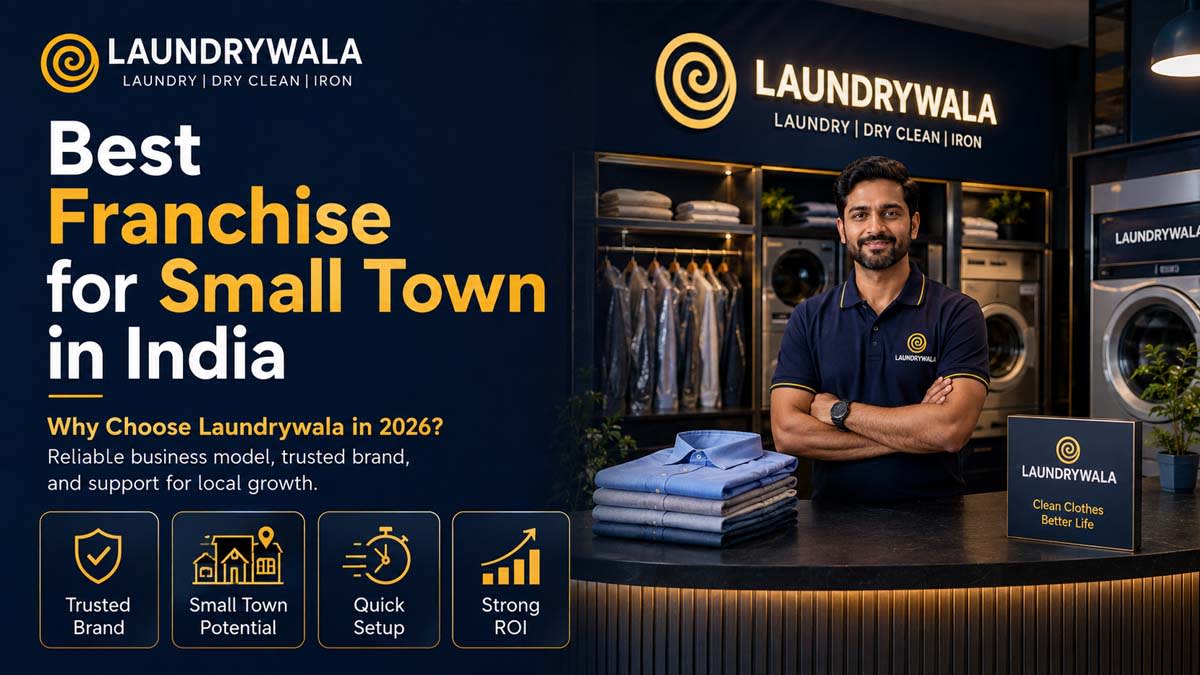
Small towns in India are increasingly becoming attractive markets for organised service businesses. Customers in district centres, education hubs, industrial towns and growing residential areas now expect transparent pricing, professional quality, digital payments and doorstep convenience.
For an entrepreneur, selecting the best franchise for small town in India 2026 requires more than comparing brand popularity or advertised returns. The business should solve a recurring local need, operate within the town’s spending capacity and provide enough support to maintain consistent service quality.
Professional laundry and dry cleaning can fit these requirements because clothes, uniforms, office wear, bedsheets and household fabrics require regular care. A properly planned outlet can serve families, students, working professionals, hotels, salons, gyms, clinics, hostels and other local businesses.
Laundrywala currently offers three franchise formats with indicative investment starting from ₹13.49 lakh. The brand operates through 150+ stores across 75+ cities and provides guidance related to location evaluation, machinery, store setup, staff training, technology, marketing and operations.
This guide explains how to evaluate local demand, compare Laundrywala’s franchise formats, select a suitable property and prepare a realistic business plan before investing.
Quick answer: Laundrywala can be considered by entrepreneurs searching for an organised service franchise in a growing small town. Its compact store formats, multiple garment-care services and recurring-demand model may suit local markets. However, results depend on location, pricing, service quality, expenses, customer retention and active management.
Why Small Towns Can Offer Good Franchise Opportunities
Business growth in India is no longer limited to metropolitan cities. Better roads, digital payments, online discovery, social media usage and rising customer expectations have increased demand for organised services in smaller markets.
A small-town business may benefit from:
- Lower commercial rent than many metropolitan locations
- Fewer organised service providers
- Strong local word-of-mouth
- Affordable pickup-and-delivery coverage
- Availability of compact commercial properties
- Lower staffing costs in some markets
- Easier relationships with local institutions
- Growing customer preference for branded services
These advantages do not mean that every town is suitable for every franchise.
A town may have a large population but limited demand for premium garment care. Another may have fewer residents but stronger commercial demand because it contains colleges, hotels, industries, hospitals or government offices.
Investors comparing sectors can explore these small business franchise opportunities in India before selecting a business model.
Why a Laundry Business Can Work in a Small Town
Laundry is a repeat-use service rather than a one-time purchase. Everyday clothes require regular washing and ironing, while sarees, suits, blazers, wedding outfits and winter garments may require professional dry cleaning.
Different customer groups create different types of demand:
- Families may require weekly washing and ironing.
- Students may prefer affordable wash-and-fold packages.
- Working professionals may value doorstep pickup and delivery.
- Schools and businesses may need uniform cleaning.
- Hotels and guest houses may require linen processing.
- Salons and spas can generate towel and sheet orders.
- Wedding customers may need saree, suit and lehenga care.
- Households may periodically clean curtains, carpets and blankets.
A laundry franchise can therefore earn through regular household orders and higher-value specialised services.
The business also carries less unsold-stock risk than many product-based businesses. However, operators must still manage machinery, staff, electricity, water, chemicals, packaging, delivery and garment safety.
What Should a Good Small-Town Franchise Provide?
The best franchise is not simply the brand advertising the highest ROI. A practical franchise system should provide clearly defined support before and after launch.
Investors should evaluate whether the franchisor provides:
- A transparent investment breakdown
- Multiple formats for different budgets
- Location and catchment evaluation
- Store-layout guidance
- Machinery recommendations
- Owner and staff training
- Written standard operating procedures
- Billing and order-management technology
- Multiple revenue-generating services
- Brand and launch-marketing support
- Garment-tagging processes
- Quality-control standards
- Post-launch operational reviews
- Clear renewal and exit conditions
Commercial commitments should be recorded in the final proposal or agreement. Verbal claims about income, territory, royalty or investment recovery should not be treated as binding.
Which Types of Small Towns May Be Suitable?
The term “small town” includes several different market types. Each one requires a different business strategy.
Education Towns
Towns containing universities, colleges, coaching centres, hostels and PG accommodation may generate regular demand for affordable wash-and-fold services.
Students can be price-sensitive. Convenient pickup, predictable delivery and practical monthly packages may matter more than premium interiors.
Industrial Towns
Industrial areas can contain factory workers, managers, guest houses and uniform-based businesses. These markets may generate household and B2B laundry demand.
Before accepting industrial or uniform contracts, review fabric type, order volume, processing cost, delivery schedule and payment cycle.
District Headquarters
District headquarters often contain hospitals, banks, schools, government offices, hotels and established residential areas. These markets may support a balanced combination of laundry, dry cleaning and doorstep service.
Tourism and Pilgrimage Towns
Hotels, homestays, guest houses and restaurants may create linen-cleaning demand. Operators should prepare for seasonal fluctuations, urgent orders and strict turnaround requirements.
Growing Residential Towns
Towns experiencing apartment development, improved highways or population growth may support organised laundry services. These markets can be promising when customer purchasing power is improving and competition remains fragmented.
Laundrywala Franchise Model
Laundrywala combines retail laundry, dry cleaning, ironing and specialised cleaning with pickup-and-delivery operations.
According to the current Laundrywala franchise opportunity, the brand operates through 150+ stores across 75+ cities.
The franchise model includes support for:
- Location evaluation
- Store setup and branding
- Machinery planning
- Owner and staff training
- Standard operating procedures
- Billing and CRM technology
- Pickup scheduling
- Launch marketing
- Quality control
- Post-launch operations
Investors can also learn about the brand’s development and service standards through the Laundrywala company profile.
Laundrywala Franchise Investment Plans
Laundrywala currently offers three franchise formats. The figures below are indicative and must be confirmed through the latest written commercial proposal.
| Franchise format | Indicative investment | Store area | Staff | Power | Water storage |
|---|---|---|---|---|---|
| Alpha – Basic | ₹13.49 lakh | 200–250 sq. ft. | 2–3 | 8 kW | 1,000 litres |
| Classic | ₹15.99 lakh | 250–300 sq. ft. | 2–3 | 15 kW | 1,000 litres |
| Combo – Premium | ₹20.99 lakh | 300–350 sq. ft. | 3–4 | 16 kW | 2,000 litres |
Alpha – Basic
The Alpha Basic format is designed as a compact retail laundry and dry-cleaning outlet.
Its listed equipment includes a 15 kg LG washer and dryer, an ironing setup and a 4 kW boiler. This format may suit a town where the primary demand comes from local families, students and working professionals.
The indicative investment is ₹13.49 lakh, while the recommended area is approximately 200–250 sq. ft.
Classic
The Classic format provides additional washing capacity.
Its listed equipment includes a 15 kg LG washer-dryer stacker, a 10 kg LG washer-dryer stacker and an ironing setup with a 4 kW boiler.
It may suit district centres, larger residential markets and towns with consistent household demand. The indicative investment is ₹15.99 lakh, with approximately 250–300 sq. ft. of store area.
Combo – Premium
The Combo Premium format supports retail orders and higher-volume B2B opportunities.
Its listed equipment includes an 18 kg Fabcare washer and dryer for B2B processing, a 10 kg LG washer and dryer for retail orders and an ironing setup with a 6 kW boiler.
The indicative investment is ₹20.99 lakh, with approximately 300–350 sq. ft. of space.
This format may be suitable where hotels, salons, hostels, institutions or other businesses create sufficient commercial laundry demand.
Calculate the Complete Opening Budget
The franchise-package amount should not be treated as the complete cash requirement.
Use this calculation:
Total opening budget = Franchise package + excluded setup costs + property deposit + pre-opening expenses + working capital + contingency reserve
Depending on the proposal and property, additional costs may include:
- GST
- Machinery transportation
- Property security deposit
- Advance rent
- Electrical-load enhancement
- Plumbing and drainage modifications
- Municipal registrations
- Staff recruitment
- Delivery vehicle or rider arrangement
- Fuel expenses
- Initial local marketing
- Working capital
- Unexpected property-related work
Request a line-by-line written cost sheet clearly stating what is included and excluded.
Avoid using the entire budget for machines and interiors. Keep sufficient working capital for rent, salaries, utilities, chemicals, packaging, delivery and marketing during the initial months.
Small-Town Location Evaluation Scorecard
Instead of choosing a property emotionally, rate each shortlisted location using a practical scorecard.
| Location factor | Maximum score |
|---|---|
| Residential and customer density | 10 |
| Customer purchasing capacity | 8 |
| Competition and pricing opportunity | 7 |
| Rent affordability | 7 |
| Visibility and access | 5 |
| Water, drainage and electricity | 5 |
| Pickup and delivery convenience | 4 |
| Nearby hotels, hostels or institutions | 4 |
| Total | 50 |
This score does not guarantee success, but it provides a consistent method for comparing properties.
Do not choose a shop only because it is located in the busiest market. A compact outlet close to a strong residential catchment may perform better than an expensive showroom with poor delivery access.
Use the Laundrywala store locator to study existing store formats and the types of localities served by the brand.
How to Validate Local Demand
Before finalising the format or property, conduct a basic market survey.
Study Existing Laundry Providers
Visit local laundries and dry cleaners. Record:
- Services offered
- Laundry price per kilogram
- Garment-wise dry-cleaning prices
- Delivery time
- Pickup availability
- Store presentation
- Packaging quality
- Google ratings
- Customer complaints
- Discounting practices
The objective is not simply to offer lower prices. It is to identify gaps such as inconsistent finishing, missing doorstep service, delayed delivery, poor packaging or limited specialist care.
Speak With Potential Customers
Talk to at least 25–50 people from the proposed catchment.
Ask:
- Which laundry services do they currently use?
- How frequently do they use them?
- What do they currently pay?
- What problems do they experience?
- Would they use doorstep pickup?
- Which garments do they send for dry cleaning?
- How quickly do they expect delivery?
These conversations may provide more practical information than general town-population figures.
Approach Potential Commercial Clients
Speak with hotels, hostels, salons, gyms, restaurants, clinics and uniform-based businesses.
Ask about their current laundry provider, average volume, quality requirements, delivery schedule and payment terms.
Do not include a potential B2B order in your financial projection until the requirement and pricing have been confirmed.
Store and Infrastructure Requirements
A laundry outlet needs more than visible road frontage.
Space Planning
Depending on the selected format, Laundrywala recommends approximately 200–350 sq. ft.
The store should provide space for:
- Customer counter
- Garment inspection
- Sorting and tagging
- Washing and drying machines
- Ironing and finishing
- Clean garment storage
- Packaging materials
- Staff movement
- Utility connections
Electricity
The current formats list power requirements ranging from approximately 8 kW to 16 kW.
Confirm sanctioned-load availability before signing the lease. Electricity upgrades can affect setup cost and launch time.
Water and Drainage
The listed water-storage requirement ranges from approximately 1,000 to 2,000 litres.
Check the regularity and quality of the water supply. Hard water may affect cleaning results, chemical usage and machine maintenance. Proper drainage is also essential for safe operation.
Pickup Access
The outlet should allow delivery staff to collect and dispatch orders without creating congestion. A ground-floor property with easy road access can be more practical than an upper-floor shop with lower rent.
Services and Revenue Sources
A small-town outlet should develop a balanced service portfolio.
Wash and Fold
Wash-and-fold services can create repeat demand from students, families and working professionals.
Local pricing should reflect electricity, water, detergent, labour, packaging and delivery expenses.
Customers can explore Laundrywala’s professional laundry services to understand eligible garment-care options.
Wash and Iron
Customers who want ready-to-wear garments may prefer washing combined with professional finishing. Office wear, school uniforms and daily clothing may generate repeat orders.
Dry Cleaning
Sarees, suits, blazers, lehengas, coats and structured garments may require specialised cleaning.
Laundrywala’s professional dry-cleaning service covers selected delicate, formal and premium garments.
Dry cleaning can increase the average order value, but garments must be inspected and processed carefully.
Specialist Cleaning
Shoe, bag, curtain, carpet, blanket and wedding-wear cleaning can create additional revenue.
The complete Laundrywala service portfolio explains how multiple clothing and home-fabric categories can be served under one brand.
Doorstep Pickup and Delivery
Doorstep collection can improve customer convenience and expand the service area. However, an excessively large delivery radius may increase fuel costs and cause delays.
A dense two-to-four-kilometre service area can be more efficient than covering an entire town immediately.
Commercial Laundry
Hotels, guest houses, salons, gyms and institutions can provide higher volume.
Before offering B2B rates, calculate processing, labour, collection, delivery, finishing and payment-cycle costs. High order volume is not useful when the agreed price does not cover the complete cost.
Profit Margin and Break-Even Planning
Laundrywala’s current planning model presents an indicative 22%–30% net-margin range and a possible 14–20-month break-even window.
These figures are not guaranteed.
Actual financial performance depends on:
- Orders completed each day
- Average order value
- Service mix
- Local pricing
- Monthly rent
- Staff salaries
- Electricity and water
- Chemical consumption
- Packaging
- Delivery expenses
- Marketing costs
- Machine utilisation
- Rewash and complaint rates
- Customer retention
- Commercial payment cycles
Do not use the old ₹1.5–3 lakh monthly-profit claim. Profit must be calculated using real local demand and operating expenses.
Use these formulas:
Monthly revenue = Completed orders × Average order value
Operating profit = Revenue − rent − salaries − utilities − consumables − delivery − marketing − maintenance − taxes and other expenses
Break-even period = Total opening investment ÷ Average monthly net cash profit
Prepare three projections:
- Conservative scenario
- Expected scenario
- Optimistic scenario
Laundrywala’s detailed laundry business plan in India can help investors organise revenue and expense assumptions.
Marketing a Laundry Franchise in a Small Town
Small-town marketing should combine online visibility with local relationships.
Google Business Profile
Create a complete listing with the correct address, phone number, opening hours, services, photographs and pickup information.
Encourage genuine customers to leave reviews and respond professionally to complaints.
Residential Outreach
Contact apartment societies, residential colonies and neighbourhood associations. Trial pickup campaigns can introduce the service without depending permanently on discounts.
WhatsApp Communication
WhatsApp can be used to confirm pickups, share order updates and remind customers about seasonal cleaning.
Avoid sending excessive promotional messages that may irritate customers.
Referral Programmes
Word-of-mouth can be valuable in smaller communities. A straightforward referral benefit may encourage satisfied customers to recommend the outlet.
Local Partnerships
Hotels, salons, gyms, boutiques, schools, wedding businesses and uniform suppliers may become commercial or referral partners.
Seasonal Campaigns
Plan campaigns around:
- Wedding season
- School reopening
- Monsoon laundry problems
- Festival garment care
- Winter-wear cleaning
- Blanket and comforter cleaning
- Curtain and carpet cleaning
Track which promotions generate repeat business rather than measuring success only through first-time orders.
Training and Operational Support
Professional laundry requires more than operating washing machines. Staff should understand fabric labels, colour separation, stain identification, machine programmes, drying, ironing, garment storage and packaging.
Before Launch
Laundrywala’s setup assistance may cover location evaluation, store layout, machinery selection, branding, interiors and vendor coordination.
During Launch
Owner and staff training may cover:
- Garment inspection
- Sorting and tagging
- Stain documentation
- Fabric-specific processing
- Washing programmes
- Drying
- Steam finishing
- Customer handling
- Packaging
- Billing and reporting
After Launch
Post-launch support may include operational reviews, quality-control guidance and customer-retention assistance.
The franchise owner should monitor:
- Daily order count
- Average order value
- Repeat-customer percentage
- On-time delivery rate
- Rewash rate
- Complaint rate
- Utility cost per order
- Pending B2B payments
- Monthly operating profit
Technology can improve control, but it cannot replace active supervision.
Registrations and Compliance
Requirements vary according to the state, municipality, business structure and turnover.
Potential requirements include:
- Proprietorship, partnership, LLP or company setup
- Business PAN and banking arrangements
- GST registration, where applicable
- Shop and Establishment registration
- Municipal trade licence
- Commercial electricity connection
- Employee-related registrations
- Business and equipment insurance
- Local waste-water permission, where required
Eligible businesses can review the official Udyam Registration portal for MSME registration.
The official GST taxpayer-registration guidance explains the application process and required details.
Entrepreneurs can also explore Startup India’s official business resources. Consult a qualified accountant or legal adviser for requirements applicable to the selected town.
Common Mistakes to Avoid
Small-town investors should avoid:
- Selecting a property only because the rent is low
- Assuming every household will use professional laundry
- Treating planning margins as guaranteed profit
- Underestimating working capital
- Buying unnecessary machine capacity
- Depending on permanent discounts
- Covering an excessively wide delivery radius
- Hiring more staff than early demand requires
- Accepting B2B work below processing cost
- Ignoring garment tagging
- Neglecting customer complaints
- Depending heavily on one commercial client
- Signing an agreement without professional review
A well-researched launch is safer than opening quickly with untested financial assumptions.
Steps to Start a Laundrywala Franchise
- Decide your total investment capacity and working-capital reserve.
- Select the town and shortlist suitable customer catchments.
- Study competitors, prices and customer expectations.
- Speak with households and potential commercial clients.
- Select the franchise format matching expected demand.
- Request the latest cost sheet and commercial proposal.
- Shortlist properties with sufficient water, drainage and electricity.
- Get the franchise agreement reviewed independently.
- Complete registrations, setup and machinery installation.
- Recruit and train the operating team.
- Prepare local launch and retention campaigns.
- Track orders, expenses, complaints and repeat customers.
To check territory availability and receive the latest commercial proposal, contact the Laundrywala franchise team or call 1800 889 3225.
FAQs – India's Best Laundry Franchise Chain
Straight answers for entrepreneurs evaluating Laundrywala as a profitable laundry business and low investment franchise in India.
Still have questions?
Can't find what you're looking for? Our fabric care specialists and franchise advisors are here to help.