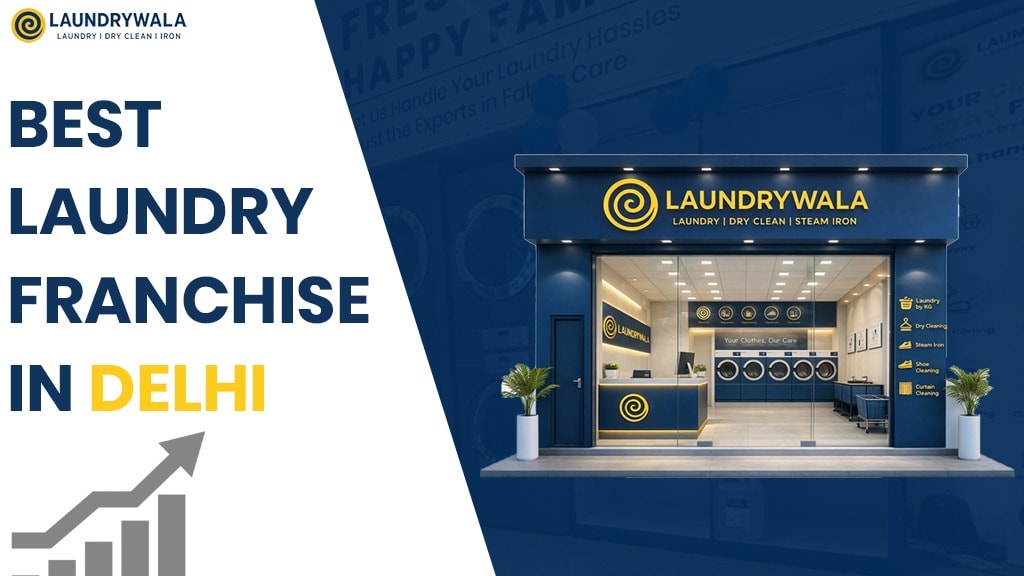
Delhi has dense residential neighbourhoods, office districts, universities, hostels, hotels and clinics. These catchments can create regular demand for washing, ironing, dry cleaning, shoe care and home-fabric cleaning.
Starting a laundry franchise in Delhi can therefore be worth evaluating. It is not guaranteed income: performance depends on the catchment, rent, competition, service quality, pricing and owner involvement.
Laundrywala offers three store formats with indicative investments starting at ₹13.49 lakh, along with setup, training, technology and operational support. Confirm the final project cost and terms through the latest written proposal.
Quick answer: A Laundrywala franchise in Delhi currently requires an indicative investment of approximately ₹13.49 lakh to ₹20.99 lakh, depending on the selected format. Published store requirements range from 200 to 350 sq. ft., with an estimated team of two to four people. Investors should also budget separately for rent deposit, taxes, site modifications, local permissions and working capital.
Why Delhi Can Support an Organised Laundry Business
Laundry is a recurring household need. Clothes, uniforms, bedsheets, towels and home fabrics continue to require cleaning throughout the year. What changes from one locality to another is the customer’s willingness to outsource that work and the price they are prepared to pay for convenience and professional care.
Apartment communities, student areas and office clusters can create repeat demand for wash-and-fold, wash-and-iron and steam-pressing services. Premium residential neighbourhoods may add demand for dry cleaning, wedding-wear care, shoe cleaning and home-fabric care.
A branded outlet can differentiate itself through garment tagging, digital billing, clear pricing, quality checks and scheduled delivery. Brand recognition alone is not enough; customers stay when garments are returned correctly finished and on time.
Delhi’s market should not be treated as one uniform territory. Rent, customer income, competition, road access and order density can differ significantly between two nearby neighbourhoods. The practical opportunity must be assessed at the catchment level, usually within the delivery radius of the proposed outlet.
Who Are the Target Customers in Delhi?
A laundry outlet should identify its priority customers before selecting a property or planning local marketing.
Working Professionals and Families
Working couples and busy households may outsource regular washing, ironing and dry cleaning to save time. Convenience, dependable pickup and transparent communication are important for this segment.
Students, Hostels and PG Residents
Areas near universities, coaching centres, hostels and paying-guest accommodation can generate regular laundry-by-kilogram orders. Price sensitivity is usually higher, so order volume, batching and delivery efficiency matter.
Premium Garment Customers
Customers with suits, sarees, lehengas, coats, embroidered outfits and designer garments need fabric-specific care. These orders can carry a higher ticket value but also require stricter inspection, stain communication and quality control.
Hotels, Salons, Clinics and Offices
Selected commercial clients may need recurring linen, towel or uniform cleaning. B2B orders can increase processing volume, but the franchise owner must calculate capacity, transport cost, payment terms and service timelines before accepting a contract.
Apartment Societies
Gated communities can be valuable for pickup campaigns, resident offers and referral programmes. A society may provide several customers within one delivery stop, reducing the cost per pickup when routes are planned well.
Laundrywala Franchise Investment Plans
Laundrywala currently publishes three franchise formats. These figures are indicative and may change according to the city, site condition and approved commercial proposal.
| Franchise format | Indicative investment | Store area | Suggested team | Power | Water storage |
|---|---|---|---|---|---|
| Alpha – Basic | ₹13.49 lakh | 200–250 sq. ft. | 2–3 people | 8 kW | 1,000 litres |
| Classic | ₹15.99 lakh | 250–300 sq. ft. | 2–3 people | 15 kW | 1,000 litres |
| Combo – Premium | ₹20.99 lakh | 300–350 sq. ft. | 3–4 people | 16 kW | 2,000 litres |
Alpha – Basic
The Alpha – Basic format is a compact retail store with a published 15 kg washer and dryer, ironing setup and 4 kW boiler. It may suit a neighbourhood focused on household and retail garment-care orders, provided the capacity matches projected demand.
Classic
The Classic format adds retail capacity through published 15 kg and 10 kg washer-dryer stackers plus a 4 kW boiler. Verify its higher electrical-load requirement before signing the lease.
Combo – Premium
The Combo – Premium format combines an 18 kg commercial setup, a separate 10 kg retail setup and a 6 kW boiler. It requires more space, utilities and staff, so assess likely retail and B2B volume before buying the additional capacity.
Review the official Laundrywala franchise opportunity and request the latest city-specific proposal before choosing a format.
What Is Included and What Costs Extra?
The advertised amount is not automatically the total cash required. Request a written line-item quotation explaining every inclusion and exclusion.
Ask whether the proposal includes:
- Franchise or brand fee
- Washing and drying equipment
- Ironing table and boiler
- Machinery transportation
- Installation and testing
- Store design and branding
- Billing, application or CRM setup
- Initial training
- Launch marketing material
- Initial consumables and packaging
- Equipment warranty and maintenance terms
- GST and other applicable taxes
The investor may also need to arrange additional funds for:
- Security deposit and advance rent
- Brokerage and legal documentation
- Civil, plumbing and electrical work
- Drainage and water storage
- Signage permissions
- Local licences or registrations
- Delivery vehicle or rider setup
- Staff recruitment and salaries
- Electricity and water deposits
- Chemicals, packaging and tags
- Local advertising
- Insurance
- Working capital for the first few months
Use the detailed laundry franchise cost guide to create a more complete budget. Keep an operating reserve instead of spending the entire available capital on machines and interiors.
How to Choose the Right Delhi Location
The best property is not necessarily the most expensive showroom. A smaller outlet near dense residential demand may offer stronger economics.
Study a Practical Delivery Radius
Map the apartments, independent homes, offices, hostels, PGs, salons, hotels and clinics that can be served efficiently. Consider travel time during Delhi traffic, not only the distance shown on a map.
Compare Local Competition
Compare nearby providers by price, reviews, service range, delivery time and complaints. Competition may confirm demand, but the outlet still needs a reason for customers to switch.
Check Rent Against Expected Sales
Prepare conservative, expected and optimistic order projections, then test whether the rent remains viable under the conservative scenario.
Verify Property Infrastructure
Before signing a long lease, confirm:
- Sanctioned electricity load
- Water supply and storage space
- Drainage capacity
- Ventilation and heat management
- Machine entry and installation access
- Space for sorting, finishing and packaging
- Ground-floor access where practical
- Delivery vehicle parking
- Commercial-use permissions
- Landlord approval for required modifications
Match the Catchment to the Service Mix
Student-heavy areas may generate more laundry-by-kilogram orders, while premium residential and office catchments may create greater demand for dry cleaning and specialised garment care. The selected model, pricing and marketing plan should reflect the local customer mix.
Revenue Sources for a Laundry Outlet
A Delhi laundry franchise can earn through several complementary services.
| Service category | Typical customer need | Business role |
|---|---|---|
| Wash and fold | Everyday washable clothes | Repeat order volume |
| Wash and iron | Office and household garments | Convenience plus finishing |
| Dry cleaning | Suits, sarees, coats and structured garments | Higher-value specialised care |
| Steam ironing | Clothes washed at home | Frequent, lower-ticket orders |
| Shoe and bag cleaning | Material-specific accessory care | Additional revenue per customer |
| Curtain and carpet cleaning | Large home fabrics | Seasonal or higher-value orders |
| Wedding-wear care | Lehengas, sherwanis and embellished outfits | Premium specialised service |
| Commercial laundry | Linen, towels and uniforms | Recurring B2B volume |
A balanced mix can reduce dependence on a single service. Doorstep delivery expands the radius, but fuel, rider time and small orders affect profitability. Set minimum orders and routes using actual local costs.
Laundrywala’s broader laundry and garment-care services show the range that may be offered, subject to outlet capability and company guidelines.
Operating Costs, Margin and Break-Even
Monthly profitability is determined by revenue minus all operating expenses. Important costs include rent, salaries, electricity, water, fuel, chemicals, packaging, repairs, software, marketing and taxes.
Laundrywala’s current planning model publishes an illustrative 22–30% net-margin range and a 14–20-month break-even window. These figures are planning assumptions, not guaranteed returns. Actual performance depends on the location, rent, order count, average bill, service mix, customer retention and operating discipline.
Investors should build their own financial model using three scenarios:
Conservative Scenario
Assume slower customer acquisition, lower order volume and higher initial marketing cost. This scenario helps determine how long the business can operate using available working capital.
Expected Scenario
Use realistic order growth based on the selected catchment, local prices and delivery capacity. Do not copy revenue figures from another city without adjusting them for Delhi rent and competition.
Optimistic Scenario
Model stronger retail demand or early B2B contracts, but do not use this scenario as the only basis for borrowing or investment.
Track daily orders, average bill value, repeat-customer rate, rewash rate, delivery cost, complaints and monthly profit-and-loss. Revenue alone does not show whether the outlet is healthy.
Registrations and Infrastructure
The exact registrations depend on the legal entity, premises, turnover, staffing and services offered. Investors should confirm requirements with a qualified chartered accountant, lawyer and the relevant Delhi authorities.
Requirements may include:
- Business constitution documents
- PAN and business bank account
- GST registration when applicable
- Shop and establishment compliance
- Municipal trade permission where applicable
- Employee-related registrations when thresholds apply
- Commercial electricity and water arrangements
- Fire-safety requirements based on the property and equipment
- Signage or local property permissions
- Appropriate insurance cover
Eligible small businesses may also consider free, paperless Udyam registration through the official Government of India portal. Registration eligibility and benefits should be checked for the specific enterprise.
Do not assume that a landlord’s approval replaces statutory permissions. Complete the required checks before investing in major civil work or machinery installation.
Support Provided by Laundrywala
Laundrywala states that its operating system is used across more than 150 stores in over 75 cities. Its franchise support covers several stages of the outlet journey.
Before Launch
- Location and catchment evaluation
- Store layout and setup guidance
- Machinery planning
- Branding and interiors
- Vendor coordination
- Staff recruitment guidance
- Owner and employee training
- Billing, app and CRM setup
At Launch
- Go-live preparation
- Brand creatives
- Local marketing guidance
- Digital listing support
- Order and customer-management setup
After Launch
- Operational reviews
- Process and quality-control guidance
- Customer-engagement support
- Performance monitoring
- Assistance with recurring operational issues
The franchise agreement and written proposal should define the exact scope of support. Ask how frequently reviews occur, who provides technical assistance, which expenses are borne by the franchisee and whether vendors are mandatory.
Read more about Laundrywala before discussing the opportunity with the franchise team.
How to Start the Franchise
Step 1: Define the Total Budget
Separate the money available for the franchise package, property, setup and working capital. Do not choose a model solely because the package amount fits the budget.
Step 2: Select Delhi Catchments
Shortlist neighbourhoods based on residential density, customer profile, competition, rent and delivery feasibility.
Step 3: Request the Current Proposal
Ask for all three franchise formats, detailed inclusions, recurring charges, agreement terms and territory availability.
Step 4: Arrange Location Evaluation
Share shortlisted properties with the franchisor. Verify utilities and commercial permissions before signing a long-term lease.
Step 5: Build a Financial Plan
Estimate monthly orders, average bill, service mix, rent, salaries, utilities, delivery cost and marketing expenditure. Include a contingency reserve.
Step 6: Review the Agreement
Examine the franchise term, territory, fees, brand standards, mandatory purchases, renewal, transfer, exit and dispute-resolution clauses. Obtain independent professional advice where necessary.
Step 7: Complete Setup and Training
Coordinate civil work, machine installation, branding, software, recruitment and training. Test the complete order flow before the public launch.
Step 8: Launch Local Marketing
Build visibility through Google Business Profile, apartment-society campaigns, referral offers, local partnerships, social media and pickup-awareness activities.
Step 9: Monitor the First 90 Days
Review order count, repeat customers, average bill, delivery performance, rewash cases, complaints and operating expenses every week. Early corrective action is more useful than waiting for monthly losses to accumulate.
Risks to Evaluate Before Investing
A laundry franchise is an operating business, not a passive-income product. Common risks include:
- Paying excessive rent
- Selecting a weak catchment
- Underestimating working capital
- Hiring more staff than demand supports
- Poor garment tagging or quality control
- Machinery downtime
- Delivery delays
- Customer claims for damage or missing items
- Aggressive discounting
- Accepting low-margin B2B contracts
- Weak local marketing
- Depending on unrealistic ROI promises
Ask for written commercial information and avoid relying only on verbal claims. Speak with existing franchise partners about setup time, support, order growth, service challenges and actual operating involvement.
Why Consider Laundrywala for Delhi?
Laundrywala combines retail laundry, dry cleaning, steam ironing and specialised care with technology-enabled order management and doorstep pickup. The brand’s three formats allow investors to compare store capacity against their budget and target catchment.
The strongest reason to evaluate any franchise is not the promise of easy profit. It is the availability of a workable operating system, training, technology, quality procedures and support that can reduce the trial-and-error of starting independently.
Delhi entrepreneurs should still conduct their own location study, financial assessment and agreement review. A well-chosen site and disciplined operator may build a strong repeat-customer business, while a poor location or uncontrolled cost structure can underperform even under a recognised brand.
FAQs – India's Best Laundry Franchise Chain
Straight answers for entrepreneurs evaluating Laundrywala as a profitable laundry business and low investment franchise in India.
Still have questions?
Can't find what you're looking for? Our fabric care specialists and franchise advisors are here to help.